






Van Cleef & Arpels present Egyptian fascinations. A collection of Haute Joaillerie comprising approximately 180 pieces that extends a dialogue begun by the House in 1923. The entire collection deserves to be examined less as a thematic novelty than as the continuation of a patrimonial fund that has remained active for a century.


Immediate reception of the 1922 discovery
The discovery of Tutankhamun’s tomb by Howard Carter on November 26, 1922, prompted a flurry of funerary objects in the press, reviving interest in ancient Egyptian pharaohs in Europe. This was followed by the attraction of ancient Egyptian cults in Roman Antiquity and the Napoleonic campaigns of 1798–1801. These resulted in Dominique Vivant Denon’s Voyage dans la Basse et Haute Égypte (1802) and the Description de l’Égypte (from 1809).
Van Cleef & Arpels, Founded in Paris in 1906, from 1923 to 1924, it produced ribbon bracelets, brooches, pendants and ladies’ watches combining Art Deco geometry with a repertoire of Egyptian motifs (profiles, papyrus flowers, scenes from everyday life). Ten of these pieces are now preserved in the House’s patrimonial collection.


From royal orders to the archives of the House
The patrimonial fund of Van Cleef & Arpels It preserves traces of a more direct connection with Egypt. The one established with his royal family between the 1930s and 1950s. In 1937, at the International Exhibition of Arts and Techniques in Paris, the House presented a double clip titled Pivoine en Serti Mystérieux. The technique was patented in 1933; the piece was acquired in 1946 by the Egyptian sovereigns.
In 1939, a more institutional order followed. A tiara, a necklace, and ear studs for the wedding of Princess Fawzia of Egypt. As well as a platinum and diamond necklace for Queen Nazli. A Collerette necklace from 1929, featuring cascades of emerald drops, also joined the wardrobe of Princess Faiza, sister of Fawzia, in 1937.
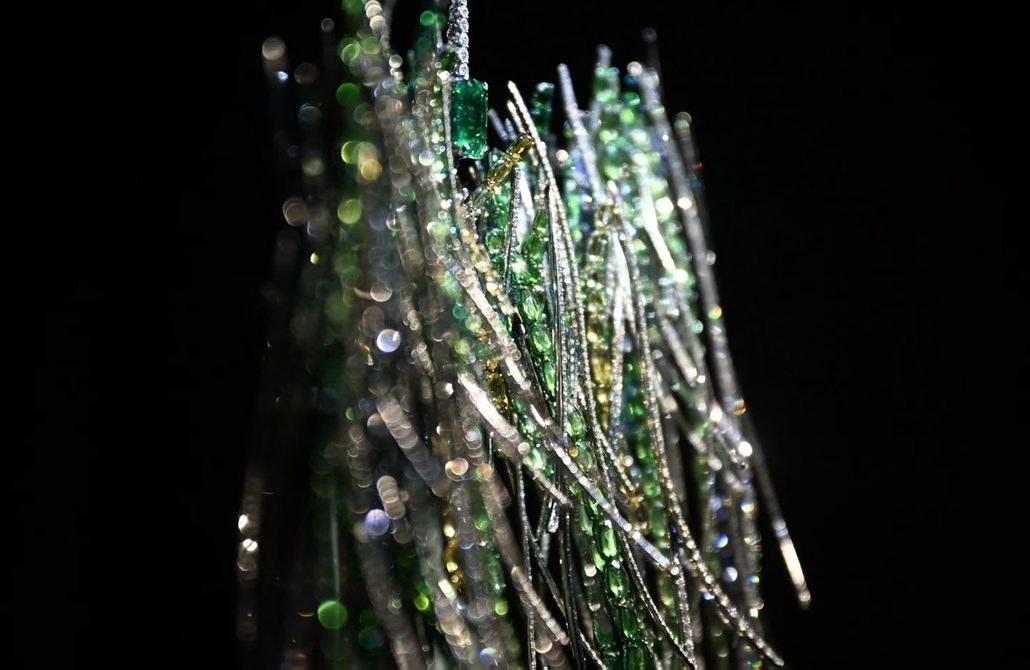
This precise piece serves as a direct reference to one of the creations in the current collection. A necklace whose structure of platinum pendents, white gold and diamonds takes up the alternation of emerald drops and fine white pearls from the historical model. Even the extended clasp at the back.


The technical vocabulary of the collection
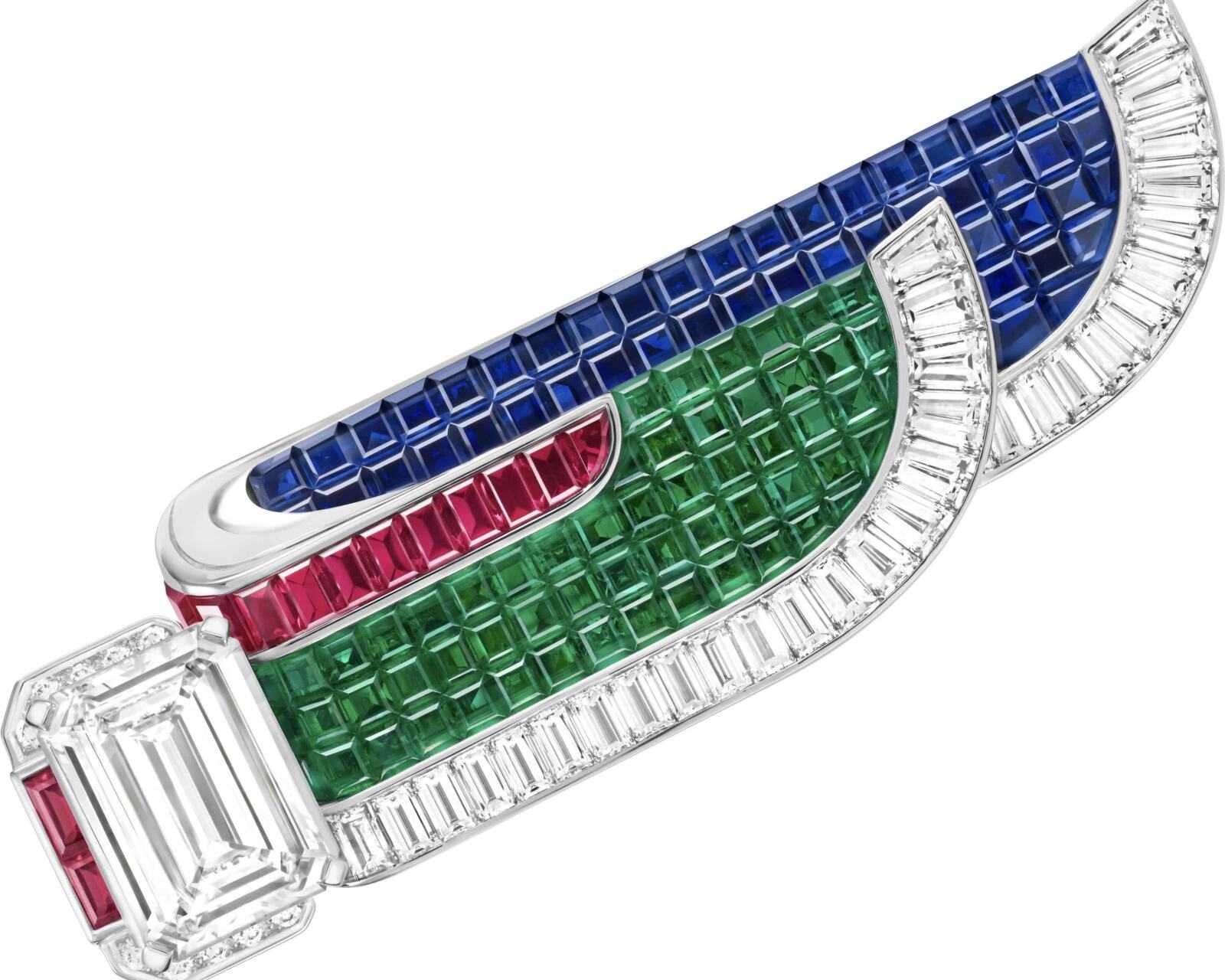
The Mystérieuse Serti, a patented non-visible beading technique patented in 1933, forms a significant part of the collection. Notably, the Mystérieuse Fleur de lotus clip and the Mystérieuse Déesse ailée necklace. On the latter, a 14.05 carat pear-cut DFL Type 2A diamond is detached to be worn as a ring, following a transformability principle that the Maison has been practicing for several decades.
The center stones follow a matching logic specific to the Pierres Service. Fancy Vivid Yellow diamond of 10.02 carats on the necklace Legendary beauty. 8.47 carat Brazilian-origin sugar-colored emerald on the Cardinal Emerald Ring, thirty-seven Zambian emeralds on the necklace Egyptian coast. The collection also uses ornamental stones. Lapis-lazuli, turquoise, coral, onyx combined with faceted gems in a logic of contrast rather than harmony of tones. A method that the House has been applying since the interwar period.

A coherent iconographic reading of the history of Egyptomania
The exhibition Tutanhamun and his time at the Petit Palais in 1967, followed by numerous re-readings in 20th-century decorative arts, it has kept a repertoire of forms alive. Scarab, lotus, cartouche, sphinx that Van Cleef & Arpels has revisited repeatedly. Scarab clip from 1957, Osiris necklace from 1986, Scarab ring from the Palais de la chance collection in 2012.
Egyptian fascinations It is part of this continuity rather than a stylistic break. While expanding the corpus to include figures that are less often featured in jewelry design, Bastet, Bénou, a sphinx with a falcon-headed head, and compositions with volumes that are close to the round-bosse style.
Each piece in the collection bears a cartridge engraved with the Maison’s initials in hieroglyphic writing. A discreet signature that places the collection within the direct lineage of the works of 1923-1924, rather than merely a contemporary evocation of the Egyptian motif.
Thus, Egyptian fascinations prolongs the history of Egyptomania Van Cleef & Arpels while making this ancient heritage a living material, reinterpreted by the Maison’s jeweler’s eye and savoir-faire.