





The jewels from the Al Thani collection at the Grand Palais.
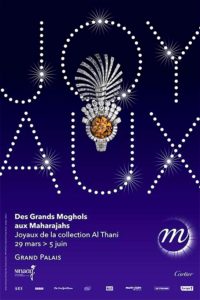
The exhibition Des Great Mughals to the Maharajas: Jewels from the Al Thani Collection
It opens its doors this Wednesday, March 29, 2017, at the Grand Palais.
It has to be said that this is an event because it is an exceptional collection that is being presented. Because it is the world of Indian jewelry and its history, The period from the Mongol era to the present is presented. Moreover, unique in its very long chronological period, the Al Thani collection represents four centuries.
Also, this collection is remarkable for its diversity. From objects from the imperial Mogul treasure to the masterpieces of contemporary jewelers who incorporate ancient stones into their jewelry, or whose inspiration draws from the traditional forms and motifs of India.
The basements of South Asia have long hidden fabulous stones. Thus, the Golconda diamonds, sapphires from Kashmir, rubies from Burma, or pearls from the Gulf inspired the Indian artisans. It is all these precious achievements, marks of fashion, stories, and social status that led His Highness Sheikh Hamad bin Abdullah Al Thani to create this unique collection.
Here is a glimpse of this magnificent universe.
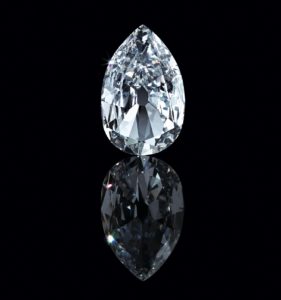
India, circa 1760 carved in 1959 and 2011
Diamond 17.21 cts
© The Al Thani Collection 2016. All rights reserved.
Photo Prudence Cuming Associates Ltd
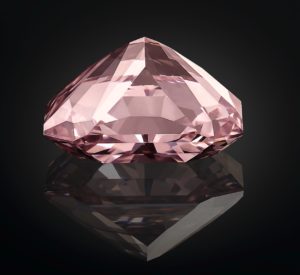
India, pre-1526 carved in the 1880s and 1990s
Diamond 28.15 cts
© The Al Thani Collection 2016. All rights reserved.
Photo Prudence Cuming Associates Ltd
In 1526 India was conquered by Ahir ud-din Babur, a descendant of Timur (Tamerlan) and Genghis Khan. He founded a dynasty closely linked to precious stones. The Mughals perpetuated the Timurian custom of engraving their names on the most precious stones, thus forming a dynastic heritage.
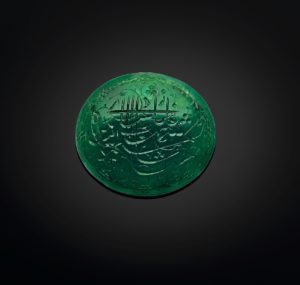
North India or Deccan, dated 1031 AH (1621-1622)
Inscription in Persian: Shihab al-din Muhammad Shah Jahan Ghazi Emperor 1031
© The Al Thani Collection 2016. All rights reserved.
Photo Prudence Cuming Associates Ltd
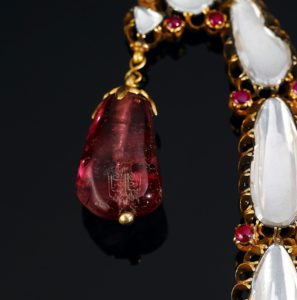
Inscription in Persian on the pendants: 12 Shah Jahan-i Jahangir Shah 1049 (12 Shah Jahan (sons) of Jahangir Shah 1049)
© The Al Thani Collection 2016. All rights reserved.
Photo Prudence Cuming Associates Ltd
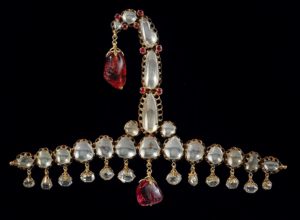
North India, 1875-1900
1639-1640 (two spinels)
Diamonds, Rubies, Spinels, Gold
© The Al Thani Collection 2016. All rights reserved.
Photo Prudence Cuming Associates Ltd
The Mughal emperors also appreciated hard stones that served as base materials in the creation of luxury objects.
Moreover, these stones had protective powers. The vases, mirrors, boxes, or even swords made of jade or quartz ensured the protection of their owner. According to beliefs, jade could reveal and protect from poisons. The art of the Mogul lapidaries reached an unparalleled level, especially in the work of agate, onyx, and rock crystal.
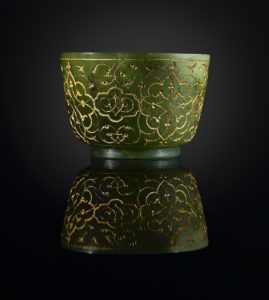
Jade, Gold
Central Asia, 1450-1500
Central Asia or Iran, 16th century (decoration)
© The Al Thani Collection 2016. All rights reserved.
Photo Prudence Cuming Associates Ltd
This is the kundan technique, which allows the gemstones to be set in gold without the use of claws, and is one of the characteristics of Indian jewelry. The stone is surrounded by gold, thus ensuring its retention. Around this closed setting, one will appreciate the «Indian sizes» (far from the symmetrical facet sizes), which respect the original dimensions of the stone to the maximum extent possible.
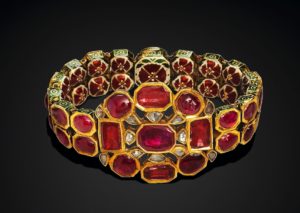
Jaipur 1750-1800
Ruby, Diamond, Embellished Reverse, Gold
© The Al Thani Collection 2013. All rights reserved.
Photo Prudence Cuming Associates Ltd
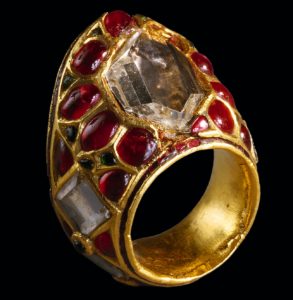
India around 1625-1650
Diamonds, Rubies, Emeralds, Gold
Saint Petersburg, Hermitage Museum
© National Hermitage Museum, Saint Petersburg, 2017 /Vladimir Terebenin
Another characteristic of Indian jewelry is represented by their enamelled decoration. It is certainly the enamelled jewelry of the Renaissance that managed to inspire Mughal culture until the early 19th century.
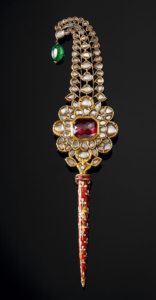
North India 1675-1750
Spinelle, Diamonds, Rubies, Emeralds, Gold
Embossed heel and back.
© The Al Thani Collection 2013. All rights reserved.
Photo Prudence Cuming Associates Ltd
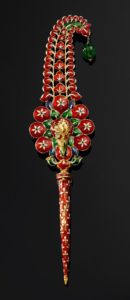
North India 1675-1750
Spinelle, Diamonds, Rubies, Emeralds, Gold
Embossed heel and back.
© The Al Thani Collection 2013. All rights reserved.
Photo Prudence Cuming Associates Ltd
Jewels have always held a certain power. Especially in India, precious stones and jewelry were synonymous with royalty.
Reserved for men, the most beautiful stones affirmed the prosperity of the kingdom. Thus, the ornaments of turbans, crowns, necklaces, earrings, bracelets on the upper arm, bracelets, rings, belts, and ankle bracelets represented power.
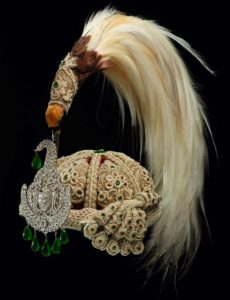
Nepal around 1900
Pearls, Colored Glass, Diamonds, Emeralds, Rubies, Silver, Bird’s-eye feathers, Canvas
© The Al Thani Collection 2013. All rights reserved.
Photo Prudence Cuming Associates Ltd
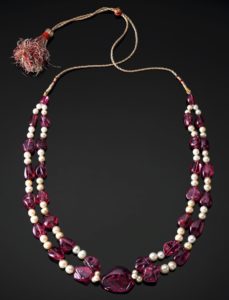
In the North, 1600-1650
Beads, beads, on a modern cord
Emperial inscriptions in Persian dating from 1609 to 1635 on four spinels. Central spinel 162 cts. Other spinels 790 cts.
© The Al Thani Collection 2013. All rights reserved.
Photo Prudence Cuming Associates Ltd
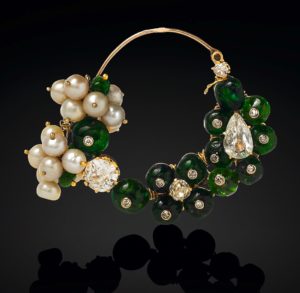
Western India 1925-1950
Diamonds, Pearls, Emeralds, Gold
© The Al Thani Collection 2013. All rights reserved.
Photo Prudence Cuming Associates Ltd
Unchanged until the early 19th century, the fashionable jewelry observed a growing European influence with the adoption of certain models, sizes in facets, and settings open to Western claws.
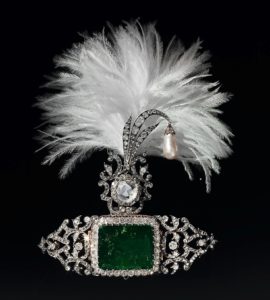
India, around 1900 (turban ornament) Paris 2012 (Cartier clip)
Emerald, Diamond, Pearl, Silver, Gold
© The Al Thani Collection 2013. All rights reserved.
Photo Prudence Cuming Associates Ltd
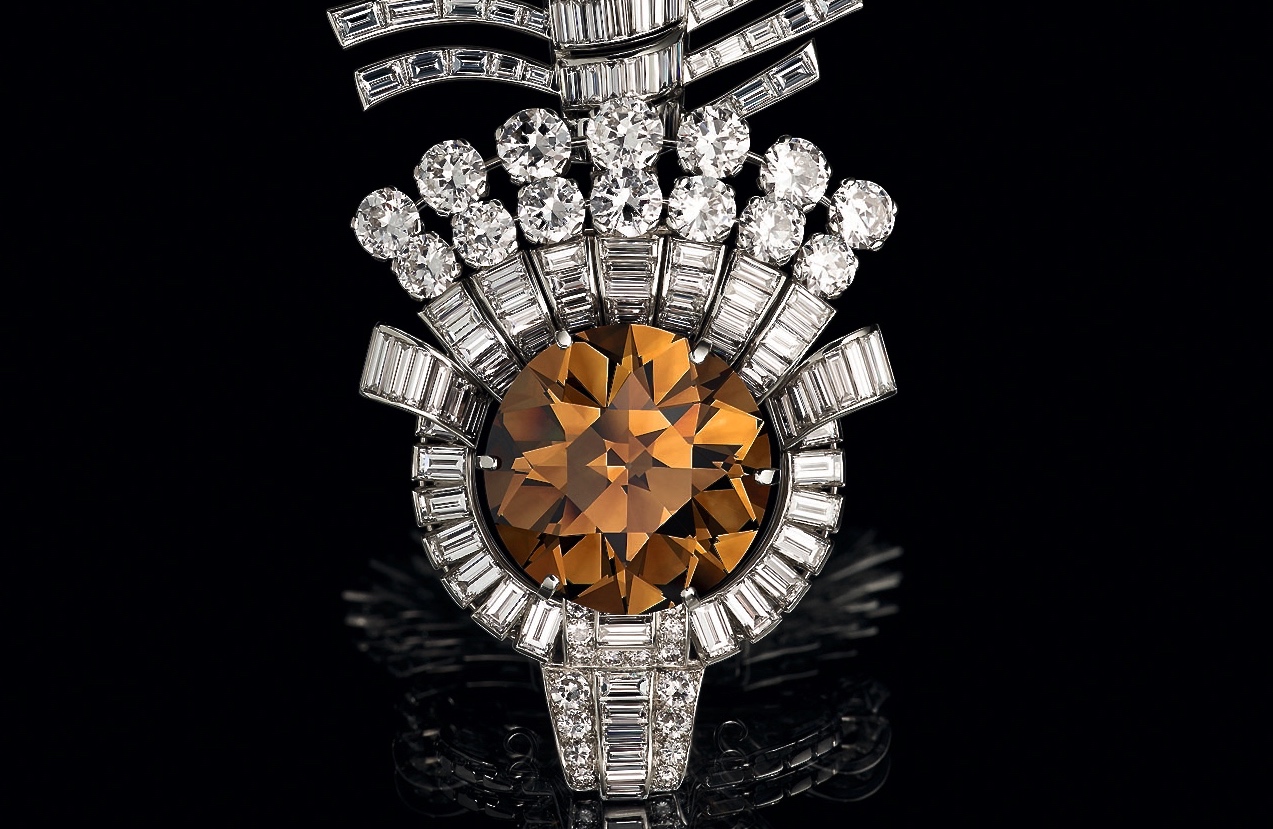
From the end of the 19th century, the princely elites preferred platinum to gold for the mounting of their most precious stones, before exporting their jewelry to Europe in accordance with the latest Western trends.
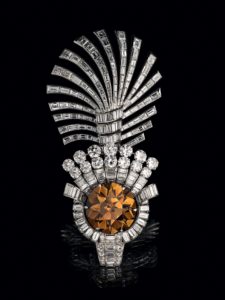
Diamonds, Platinum
Diamond Tiger's Eye 61.50 cts
Cartier London 1937
© The Al Thani Collection 2016. All rights reserved.
Photo by Laziz Hamani
In 1911, Jacques Cartier embarked on a journey to India, hoping to find both a new clientele and other sources of supply for precious stones. He thus inaugurated an era of close relations with the Indian princes and the major houses.
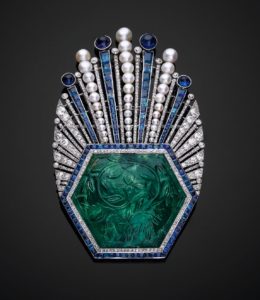
Paul Iribe, RéailsationRobert Linzeler
India 1850-1900 (Emerald) Paris 1910 (frame)
Emeralds, Sapphires, Diamonds, Pearls, Platinum
© The Al Thani Collection 2016. All rights reserved.
Photo Prudence Cuming Associates Ltd
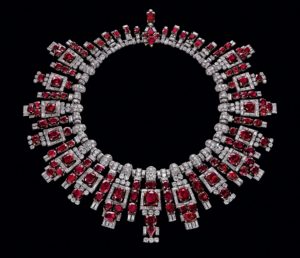
Ruby, Diamond, Platinum
Cartier 1937
© Christie’s Images Ltd
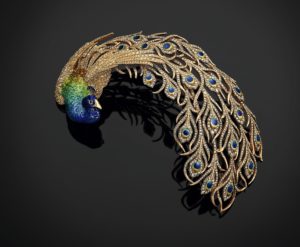
Meller, also called Mellerio
Paris, 1905
Or, Platinum, Diamonds, enamel background
© The Al Thani Collection 2015. All rights reserved.
Photo Prudence Cuming Associates Ltd
A magnificent exhibition that will transport you to a world where the stones compete with one another for admiration with their extraordinary colors and sizes worthy of great adventure novels.
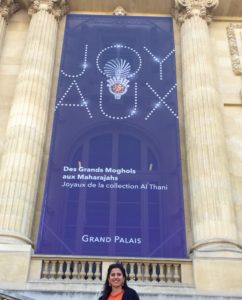
From March 29, 2017 to June 5, 2017
Grand Palais Paris