


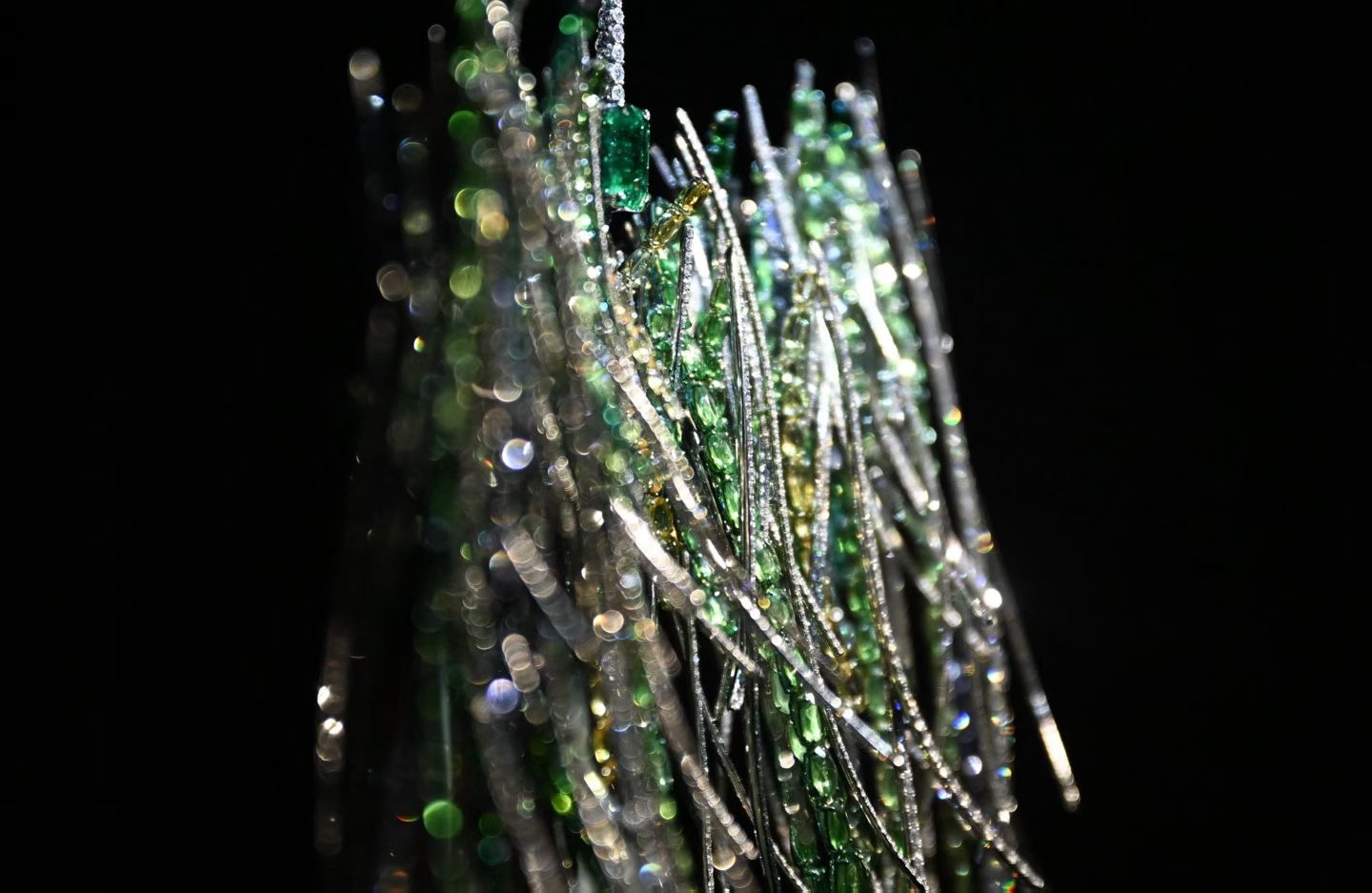
At Sotheby’s Paris, Feng J.’s creations dialogue with Claude Monet’s late works. This encounter reveals a unique vision of haute joaillerie: that of an artist who composes with precious stones like a painter with his palette.
We must look at Feng J.'s jewelry as we would a painting.
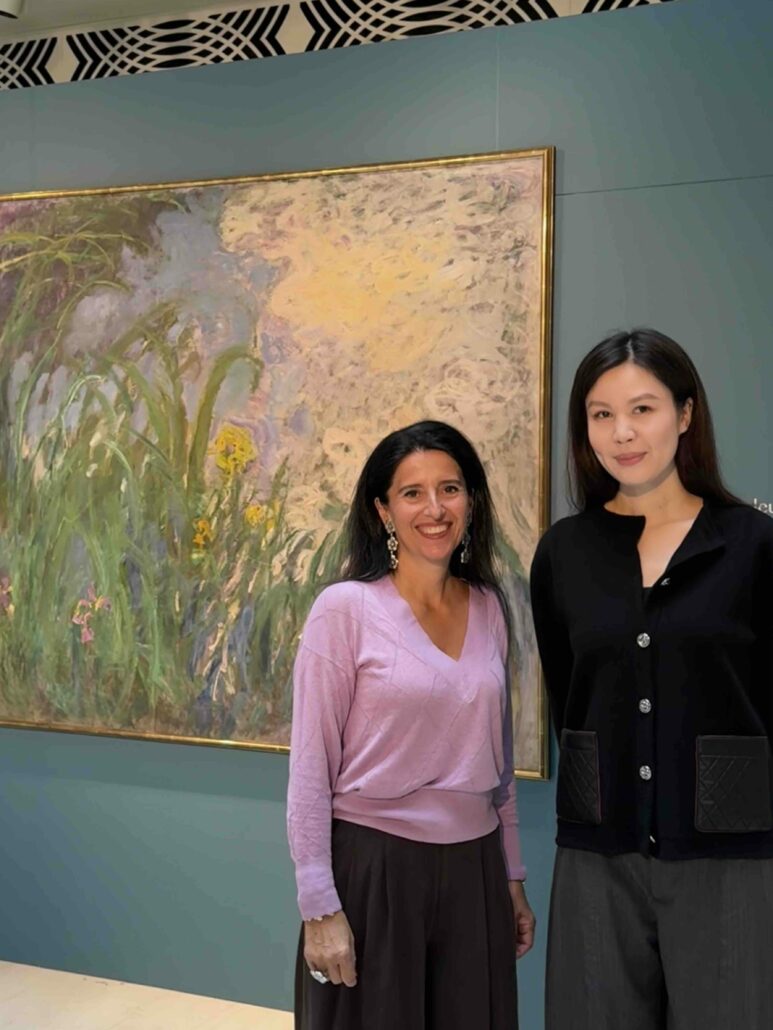
During my meeting with the designer at Sotheby’s Paris, on the occasion of the presentation of her new creations alongside several works by Claude Monet, it was this approach that particularly struck me. Feng J. is not just talking about gems or techniques; she talks about colors, contrasts, movement, and balance.
For her, gemstones are pigments.


A palette of precious stones
In 1884, Monet wrote to his friend Théodore Duret that, to translate certain landscapes, «we would need a palette of diamonds and pearls.».
More than a century later, Feng J. seems to be responding to this intuition.
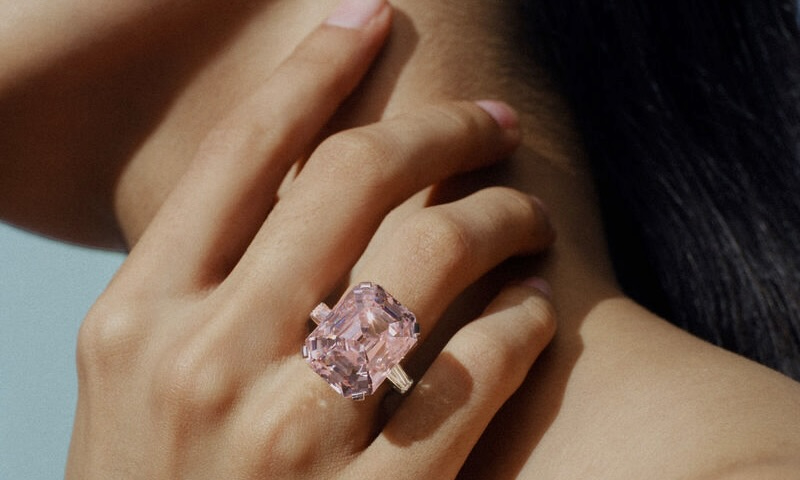
She chooses the gems as a painter chooses his colors. A sapphire becomes a blue, a spinel a shade, a tourmaline an unexpected variation. The diamond can evoke a reflection, a light, or a touch that breaks up a composition.
The stone is therefore never considered solely for its rarity. It is chosen for its ability to contribute to a work of art. This way of thinking explains the very personal identity of Feng J. Haute Joaillerie: the jewel is first born from an artistic vision, then finds in precious material the means to express it.
Monet, a founding encounter
Feng J. discovered impressionism while studying at the Academy of Fine Arts in China. Monet’s paintings revealed a different way of looking at nature: suggesting rather than describing, capturing an atmosphere, allowing the color to gradually build the image.
This discovery accompanies her thinking as she begins to create her own jewelry.
She develops, in particular, the floating set, a setting that gives the stones a sense of suspended animation, and reinterprets the double rose size to work with the colors and reflections.
His approach is also nourished by Chinese artistic tradition and his family history. His great-grandfather was a painter at the imperial court of China. This heritage and his fascination with Impressionism form a unique writing style.


From Hangzhou to Giverny
Nature is one of the main driving forces behind his work.
Feng J. draws inspiration from the landscapes of Hangzhou, her hometown, especially around the West Lake, with its weeping willows and nymphs. She finds an unexpected correspondence there with Monet’s garden in Giverny.
The oak, the water, the flowers and the variations in the vegetation thus become a common vocabulary.
But Feng J. is not trying to reproduce nature. She transforms it.
A flower becomes an abstract composition, a leaf a study of color, a dragonfly a moving line. The real garden gives way to a garden of precious stones.


Four creations, four visions
This approach is reflected in the new pieces presented at Sotheby’s.
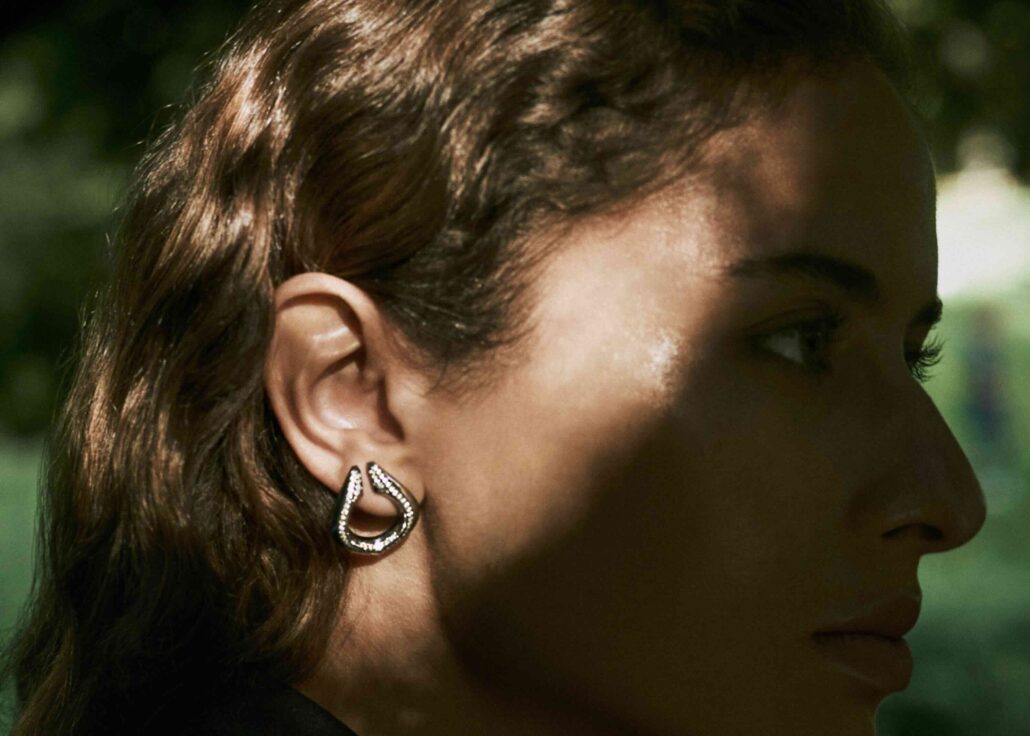
Butterfly with willow branches extends the series inspired by the landscapes of Giverny. The shapes of the insect and the plant respond to each other in an almost graphic composition.
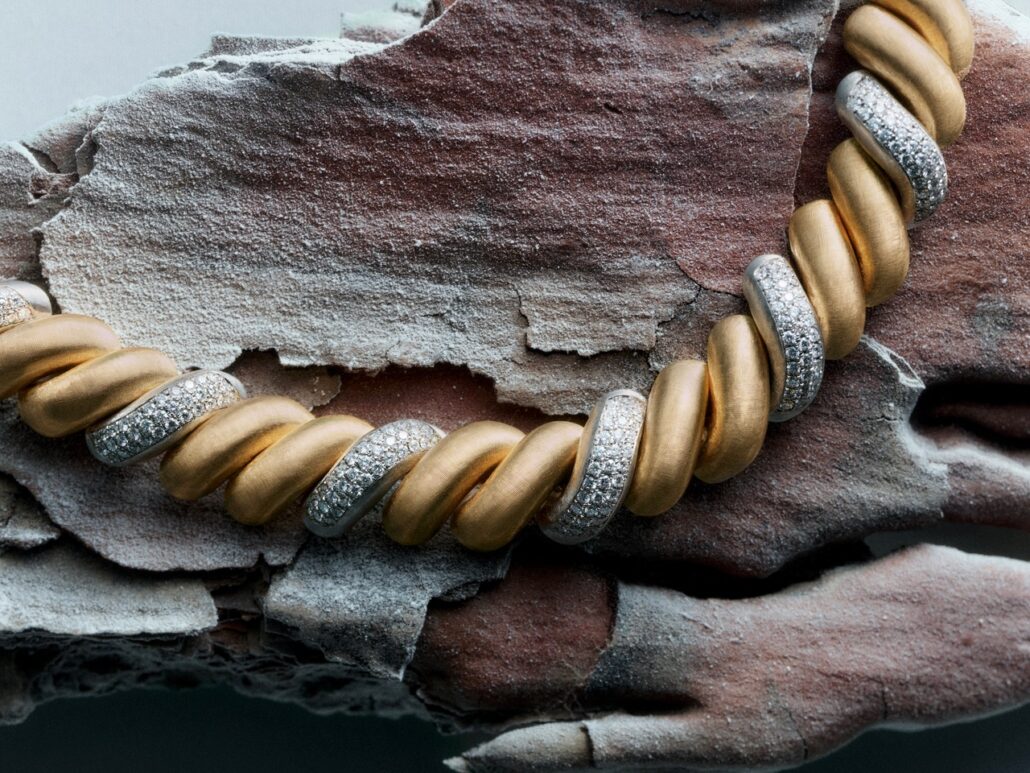
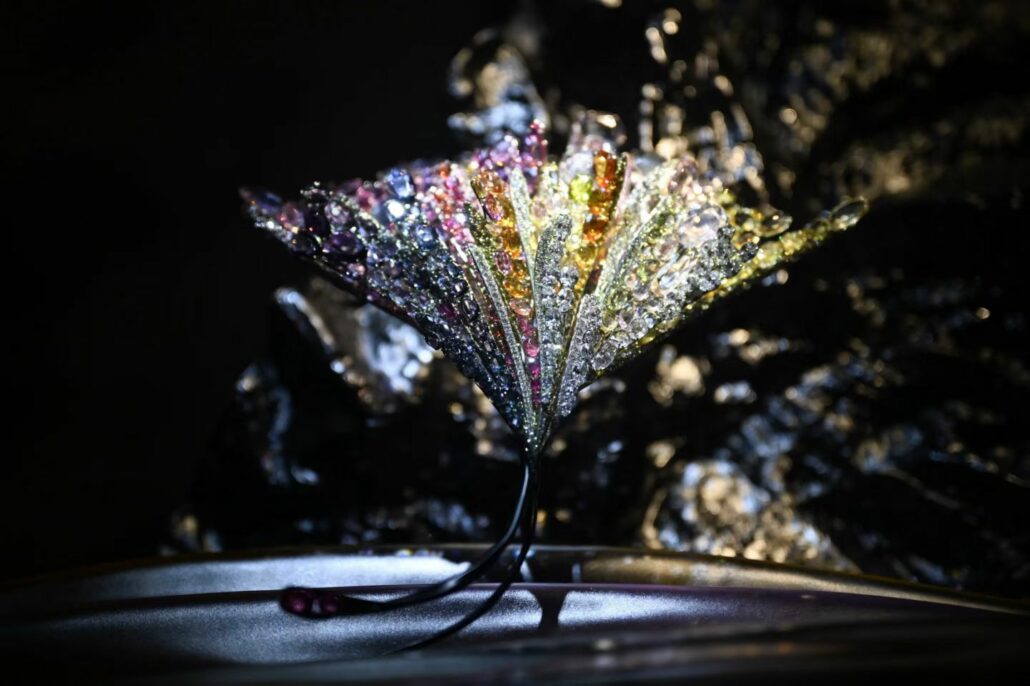
With Gingko leaf at dawn, Feng J. transforms a recurring motif from his universe into a study of nuances and contrasts.
Dream of Giverny It evokes more a sensation than a specific place: the feeling of a garden that has become a memory.
Finally, Orchidée de Reims continues this research on the plant by making the flower an almost abstract form.
Four jewels, but with the same intention: to make color the true subject.
© Esprit Joaillerie


The jewel as a work of art
Compared to Monet's paintings, Feng J.'s creations take on a special dimension.
Iris and Saule, the weeping ones, The new Schlumberger collection, which will soon be offered by Sotheby’s, echoes this same desire to translate nature through color.
Monet paints with touches. Feng J. composes with gems.
One places color on the canvas; the other brings it into the precious material. In both cases, nature is never simply represented: it becomes a sensation.
Perhaps this is where Feng J’s uniqueness lies. Her high-end jewelry is not just about showcasing rare stones; she uses them as a palette of colors, an artistic vocabulary.
When the designer opens her palette of gemstones, the jewel ceases to be solely a precious object.
It becomes a paint that can be worn.