



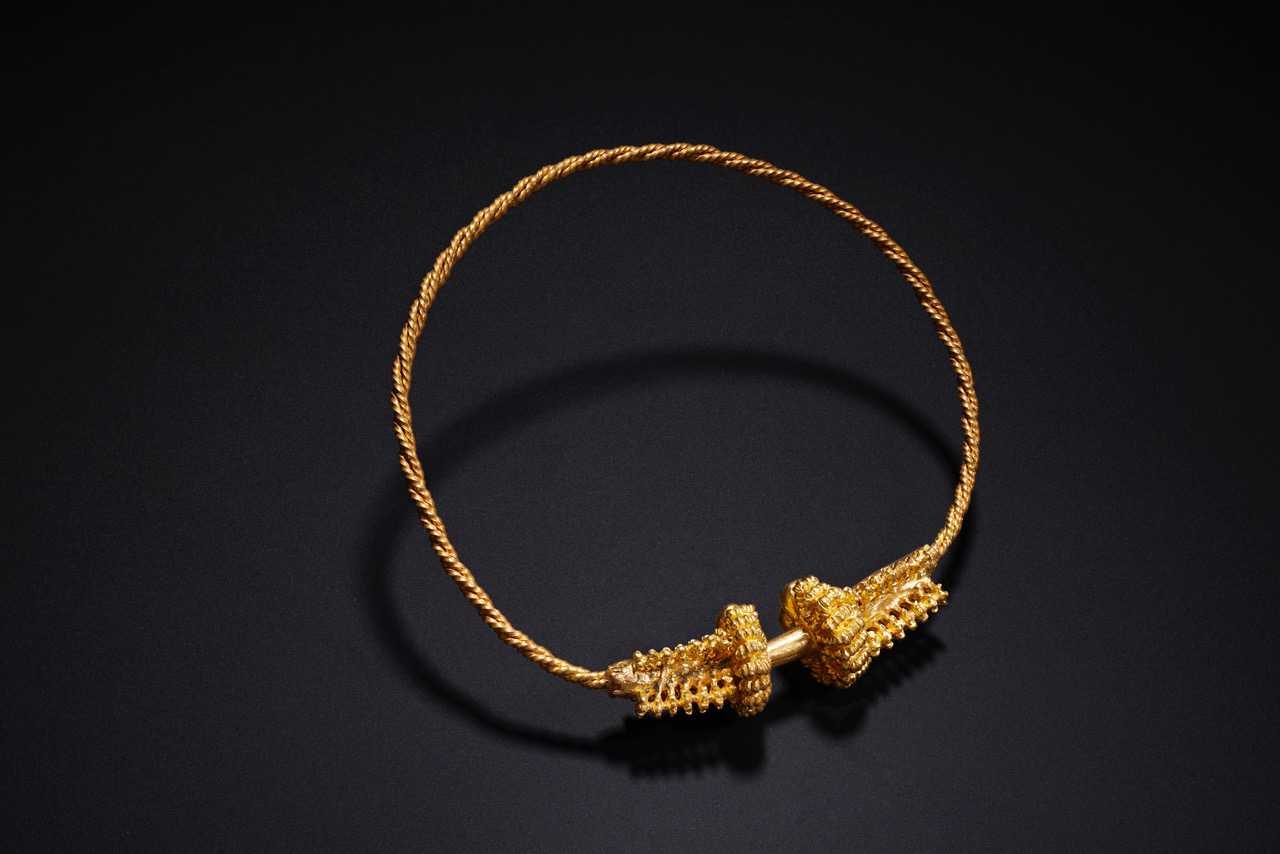
Montans' torque at The School of Jewelry Arts, an experimental archaeology project that explores the forgotten gestures of the Celts.
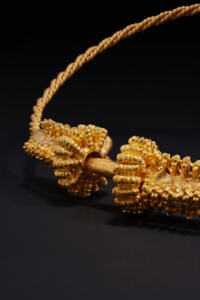
Details of replica no. 1/2, ends of torque (washer, crown, clasp)
© School of Jewelry Arts – Photo: Benjamin Chelly
Until September 21, 2025, the Hôtel de Mercy-Argenteau in Paris is hosting an exhibition dedicated to the reconstruction of the Celtic torque discovered in Montans, in the Tarn. Organized by The School of Jewelry Arts, This presentation highlights an innovative approach that combines the history of techniques and archaeology.
Dating from the Second Iron Age (450–25 BC), this rigid gold necklace was found in 1843. Its complex elaboration raises questions about ancient know-how. The project, initiated by the Montans Archaeological Center, the National Museum of Archaeology, and Barbara Armbruster, Research Director at the CNRS, aims to understand these processes by reproducing the object exactly.
The goldsmith Antoine Legouy, a Meilleur Ouvrier de France, worked closely with the specialists and Grégory Weinstock, Director of Haute Joaillerie at Van Cleef & Arpels. Together, they studied the material properties of gold and the necessary processes for its fabrication.
Emmanuelle Amiot, curator of the exhibition, emphasizes the importance of the dialogue between scientific research and artisanal practice: «The intelligence of the hand complements scholarly knowledge. This partnership enriches the history of art and deepens our understanding of techniques in their historical context.»
This exhibition, at the intersection of experimental archaeology and jewelry making, reveals how the transmission of gestures is essential to capture the intensity of an object. The School of Jewelry Arts thus reaffirms its role in the valorization of a living heritage.
Featured visual credit: © L’École des Arts Joailliers – Photo: Benjamin Chelly