





The Museum of the Legion of Honor, a unique museum.
Esprit joaillerie takes you to the Museum of the Legion of Honor.
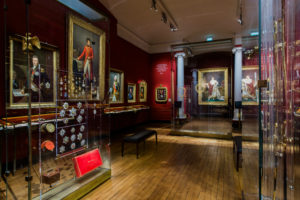
Located on the left bank opposite the famous Orsay Museum, the Museum of the Legion of Honor offers visitors many treasures.
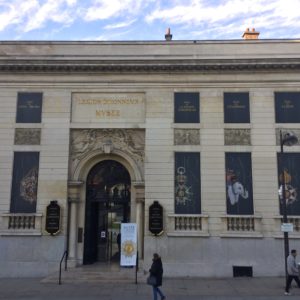
Lovers of beautiful objects, history enthusiasts, enthusiasts of the Legion of Honor and the First Empire, or simply curious, let’s discover together some of these remarkable objects with historical, artistic, and sociological dimensions.
This exceptional necklace of the Order of Saint Michael dates from the reign of Louis XIV; it was presented in 1661 to Marinus van Stavenisse, a notable Dutchman from the town of Zlerikzee, at a time when the order had lost its importance. Most of the necklaces, before being returned upon the death of the recipient, disappeared during the Revolution, when the order was abolished and the insignia melted down. Only three examples are known today, one preserved at the Het Loo Palace, In Apeldoorn, one of the Amsterdam Rijksmuseum and this one, at Museum of the Legion of Honor, filed by a Dutch family.
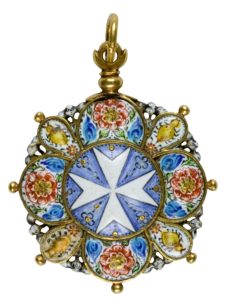
Created in 1693 by Louis XIV, the Order of Saint-Louis inaugurated the principle of military merit chivalry.
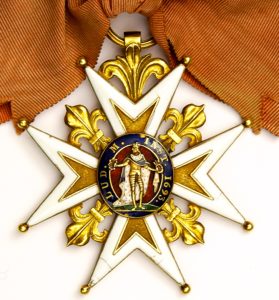
from Saint-Louis © Legion of Honor Museum
It is divided into three grades and rewards officers, nobles, or roturiers.
This insignia was awarded to the Chevalier d’Eon during the reign of Louis XV. A diplomat, spy and soldier, he is best known for his taste for disguise. It is an excellent example of the extraordinary stories hidden behind each decoration.
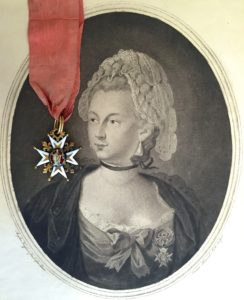
and Knight of the Order of Saint Louis. © Museum of the Legion of Honor
This was given to him during negotiations at the end of the war.
Seven years after stealing the secret contents of Secretary of State Wood’s briefcase from His Majesty the King, and sending them to Versailles, the Knight of Eon took advantage of his weakness to obtain Burgundy wine.
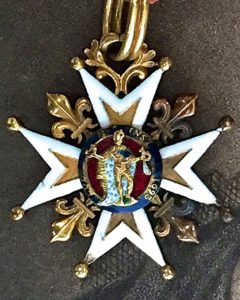
«Dragon to the army and the cabinet,» according to the words of the Duke of Brissac, the Knight of Eon received this insignia when he did not possess the ten years of service normally required «to be eligible for this grace.».
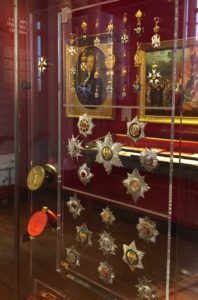
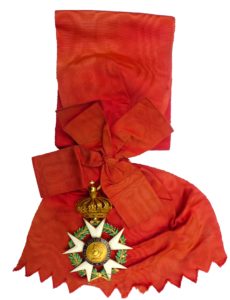
This star, without a pommel and surrounded by an uninterrupted wreath of foliage, is an insignia of a great eagle never before seen. It differs from the «regulatory» models on display in the museum, among which are the examples of Marshal Lannes and Jean-Etienne Portalis.
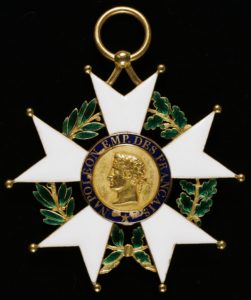
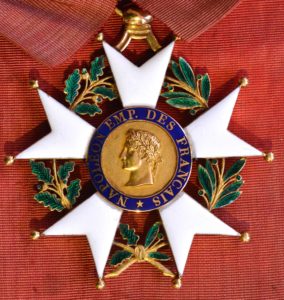
The Grand Eagle insignia of Marshal Ney is a composite jewel, having been modified several times in accordance with the course of events, and thus faithfully illustrating the Marshal’s journey through the various changes of regime.
It was transformed as early as 1806 by the addition of a crown. The centers were then changed for the first time (figure of Henri IV reversed and lilies on the reverse) during Ney’s rallying for the First Restoration in 1814. Then a second time when he once again embraced the Napoleonic cause. This is thus a rare example of Cent-days centers, featuring the legend
«NAPOLEON.EMPEROR.OF.FRANCE»
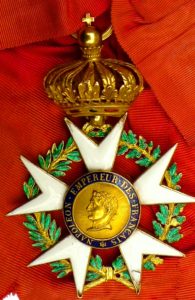
«Mirror of History and Society», this decoration entered history serving as a piece of evidence for Marshal Ney, who wanted to prove that his alliance with Bonaparte was not premeditated.
He declared before the Chamber of Peers: «Mr. de Bourmont claims that I wore a decoration of Bonaparte. I kept the one of the King in front of Bonaparte, and until my return to Paris (on March 20), where my jeweler provided me with new ones; one can hear it.».
Mr. Cailloué, a jeweler at the Palais Royal, was called to testify the next day and presented his account book with the mention of the change of the medallions of two grand cordon crosses for 50 francs on March 25; however, this did not allow the marshal to be saved.
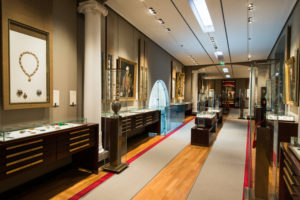
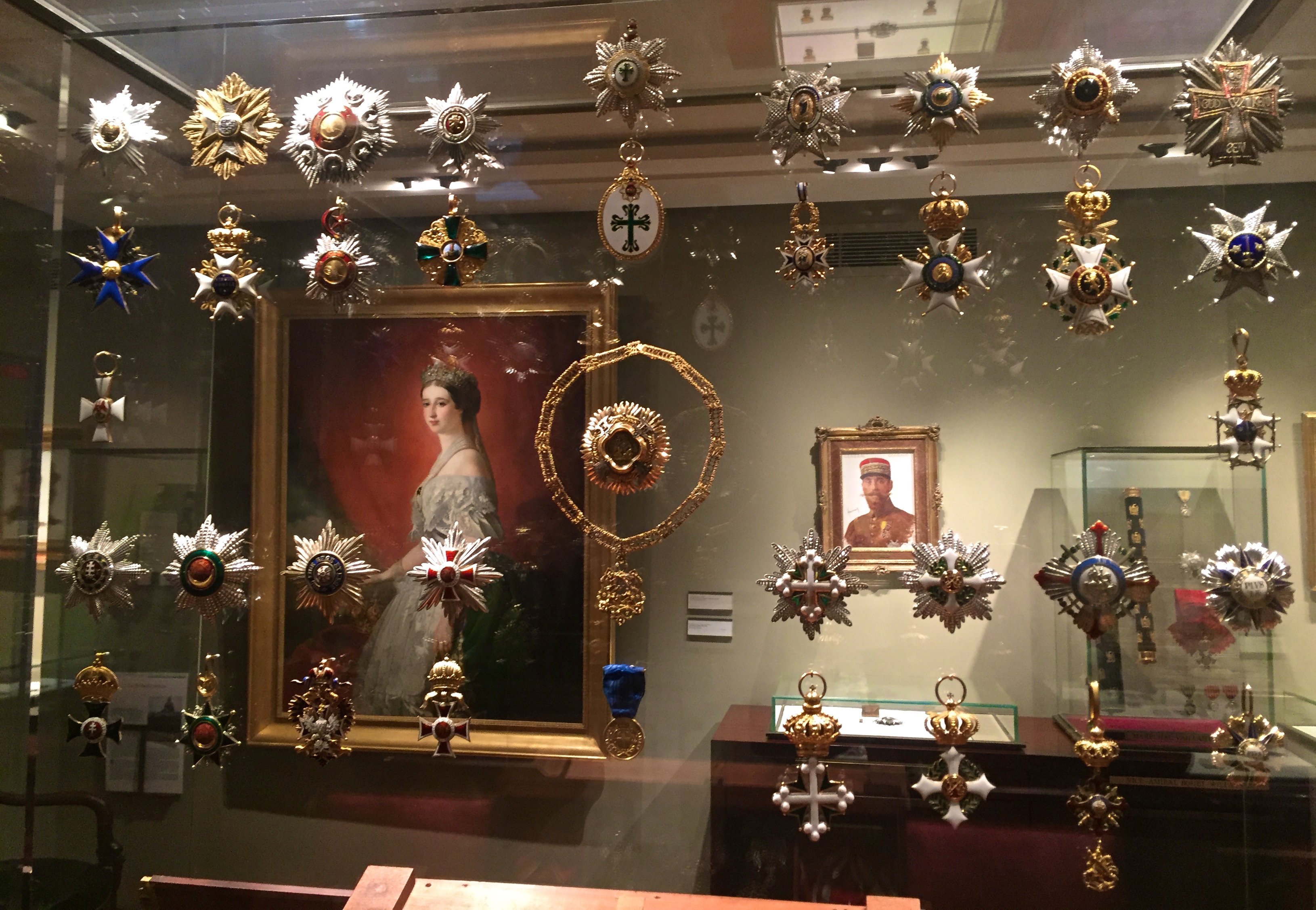
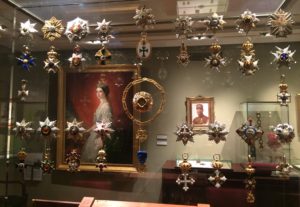
Hall of Foreign Orders © Museum of the Legion of Honor
Founded in 1348, the Order of the Garter is one of the oldest and most prestigious chivalric orders still in existence. Its history, combining legend and medieval history, is very interesting.
His famous motto «honi soit qui mal y pense» (May God be praised whoever thinks ill of it) was reportedly uttered by King Edward III during a court ball, seeing the ironic smiles of his courtiers as he rose after picking up the jousting lance of the Countess of Salisbury. This motto actually refers to the claims of this king over the crown of France (linked to the Hundred Years War), meaning «May God be cursed whoever thinks that I am not the true king of France» and the jousting lance, an element of the knight’s military equipment, refers to a symbolic union between the crowns of France and England.
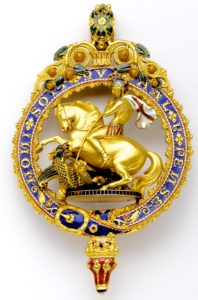
(United Kingdom) © Museum of the Legion of Honour
This insignia, with impressive dimensions (15.3 cm in height), dates from the early 19th century. While the Neo-Gothic style was emerging in England, many jousts, like medieval tournaments, were organized. It was on this occasion that this «fantastical» insignia was reportedly ordered.
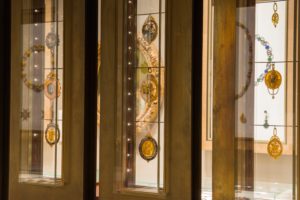
The insignia of the Order of the Golden Fleece (Austrian model) which belonged to Prince Karl Anselm of Thurn und Taxis (1733-1805) was presented to him in 1775.
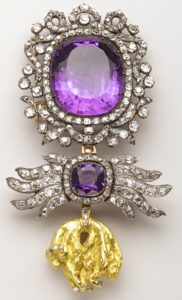
It perfectly illustrates the double meaning of the word «decoration». A true jewel of opulence, it featured several ornaments to adorn the Golden Thread, depending on the prince's attire (yellow diamond, emerald, etc.).
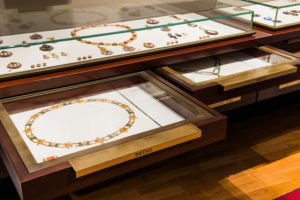
The order of the Kingdom of Thailand, the order of the nine gems, was established in the 19th century. It is inspired by the belief in the beneficial influence of the stars on the destinies of men, derived from the Hindu tradition.
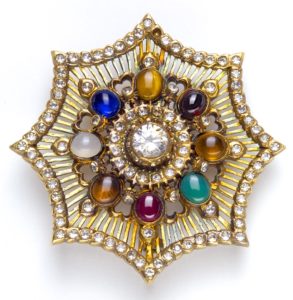
In this conception of the universe, each stone captures the positive influence of one of the nine stars that surround the Earth.
Here is the correspondence of the gems: the ruby for the sun, the diamond goes to Venus, the pearl to the moon, the coral for March, the zircon is the ascending intersection point of the lunar orbit with the sun, the sapphire is linked to Saturn, the cat’s eye at the descending intersection point of the lunar orbit with the sun, the sapphire to Jupiter and finally the emerald to Mercury.
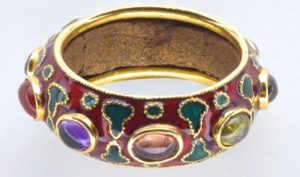
It is worth noting that among the insignia received, only the men wear this ring on the right index finger.
To conclude this first visit of Museum of the Legion of Honor, Here is a portrait of Prince Romuald Vladislav Konstantinovitch Giedroïtze, chamberlain of the court, marshal of the nobility of the Troki district and attached to the Ministry of Public Education.
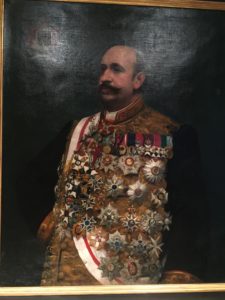
This Russian chamberlain wears an improbable combination of orders, illustrating the proliferation of decorations in the late 19th and early 20th centuries. The caricatural aspect of this excess will be one of the reasons for the creation of the National Order of Merit in France on December 3, 1963. The coat of arms is that of the Guedroïtze family.
The motto « VITAM IMPEDERE VERO », which means «devoting one's life to the truth», is taken from a poem by Juvenal. Among the many foreign orders are the Croix de Chevalier de la Légion d'honneur (Second Empire), the Palmes Académiques, and the Royal Order of Cambodia, which became a French colonial order in 1896.
Esprit Joaillerie strongly recommends a visit to this «historical jewel». It will appeal to both young and old, who will not remain indifferent to the wonders of the Museum of the Legion of Honor.
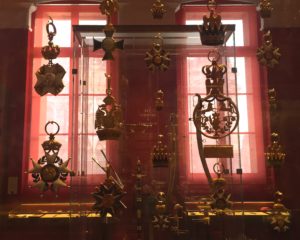
My thanks go to Tom Dutheil, the museum’s conservator, for his fascinating historical anecdotes during my visit.
Honneu Legion Museumr
2 rue de la Légion d’Honneur 75007 Paris
From Wednesday to Sunday 13h to 18h