






Mabe beads preserved for several decades, from morganites with powdered reflections to Paraíba tourmalines with electric blue flashes, TASAKI presents a new history of Haute Joaillerie, between memory, color and movement.

Paraíba Tourmaline Necklace
Platinum, Paraiba Tourmalines and Diamonds
© TASAKI
Some creations begin with a drawing. Others take shape much earlier, in a discovery, a harvest, or a material patiently preserved. TASAKI, The latest pieces of Haute Joaillerie are part of this particular context, where savoir-faire dialogues with the history of the House.
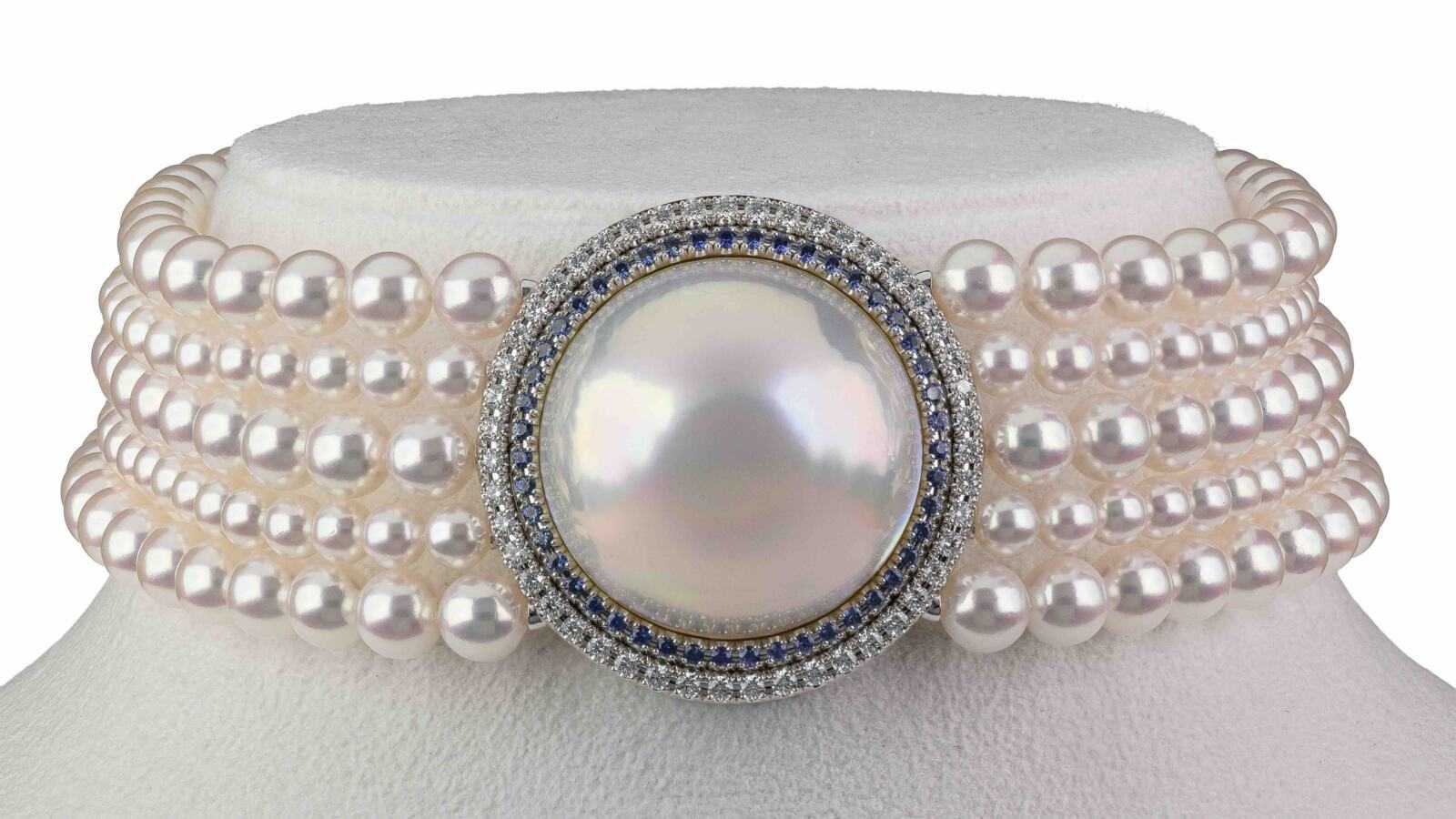
The Mabé pearl is one of the most emblematic chapters in this story. In 1970, TASAKI develops the artificial reproduction of the Mabé oyster, which was then weakened by cultivation difficulties and the decline of the species. This advance makes it possible to preserve its production while establishing the Maison as a benchmark in the world of this pearl recognizable by its bulbous silhouette and its changing iridescence. Pearls preserved like a treasure. Several decades ago, when TASAKI He exploited his own pearl farm in the Persian Gulf; a few Mabé pearls with a diameter exceeding 30 millimeters were harvested. A rare size for the Mabé. Rather than immediately turning them into jewelry, the House chose to keep them in its workshops in Kobe. They remained there for many years, awaiting a creation capable of revealing their presence.
Today, these pearls take place in a necklace of which only two copies exist. One has already been acquired before its completion. The other becomes the only piece destined to reach Europe.
Beyond its jewelry value, this creation tells a story of patience. It links the Perlier heritage with the TASAKI in a contemporary vision, where time itself becomes a material for creation.
With the Morganite set, TASAKI Explore a softer palette, a powdery light. The pink shades of the stones unfold in a subtle gradient, punctuated by the alternation of pearly and oval sizes. Each morganite is selected individually and then paired with the others to create a continuous chromatic transition. Around them, a ribbon of platinum studded with grey diamonds accompanies the color without detracting from it. This choice gives the composition a more velvety tone. The grey diamonds add depth and relief, while leaving the morganites to occupy the center of attention. Despite its sculptural architecture, the necklace retains great flexibility. The stones seem to float at the heart of the setting, while the lines follow naturally those of the neck. A complex construction, designed to disappear behind the fluidity of the gesture.
Finally, the Tourmaline Paraíba piece changes in intensity. Here, the color becomes movement. Combining tourmalines and diamonds, the plastron necklace forms a mosaic of blues with multiple variations. The stones, different in shape and size, are organized in an organic structure that follows the neckline. The structure, precisely articulated, allows the entire piece to follow the movements of the body. The volume remains present, but the creation retains a sense of flexibility and lightness.
Through these three expressions, TASAKI reveals different ways of thinking about Haute Joaillerie. The pearl carries the memory of a scientific adventure and a preserved heritage. The morganite reflects the pursuit of chromatic harmony. The Paraíba tourmaline makes color a force in motion.