




Two gemologists and a color historian bring to rubies the depth that centuries have bestowed upon them. A first title that opens a rare collection. Rubis, the first roast.
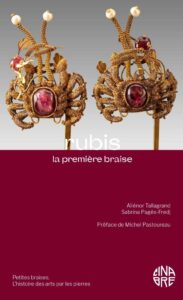
There are materials that humanity chose long before it had the words to name them. Ruby is one of them. Long before the mineralogical nomenclature identified it as a corundum bearing its red hues with a chromium content, it already adorned the regalia of sovereigns, shone in medieval reliquaries, and lit up the Persian poets. Its name is entirely derived from the Latin adjective ruber Red, simply red, and perhaps it is in this economy of meaning that its power lies.
At Cinabre Editions, which turns the gem into a prism for reading the history of civilizations, this is the first title in the collection. Small Braises It comes as a given. Art historian and gemologist Aliénor Tallagrand crosses her gaze with that of Sabrina Pagès-Fredj, gemologist and creator of the podcast Ring apart, To lead the reader from a Burmese mine to the workshops of Renaissance jewelers, from Moghal treasuries to the Mogok counters. The preface is entrusted to Michel Pastoureau, a historian of colors whose authority on red is no longer in doubt « Longtime confused with the scabbard and the spinelle, the ruby is actually a red sapphire of the same family, another bloodstone.»
The stone belongs to the four precious stones (diamond, sapphire, emerald, ruby). This canonical square stone has been elevated by the jewelry tradition to the status of an absolute reference. But it is undoubtedly the most romantic of them all, precisely because its history is one of fertile confusion. A gem in the Middle Ages, a spinel in the Renaissance, it accumulated identities like a traveler accumulates visas. It was only in the 18th century that modern mineralogy gave it its uniqueness: rubies are corindrons, red sapphires, blood brothers of the blue stone worn by the kings of England.
Its geography is that of desire. The Burmese mines of the Mogok Valley have long set the benchmark for color — this pigeon’s blood, The pigeon blood, which remains the benchmark of auctions. But in the last decade Mozambique has established itself as a major source, alongside Sri Lanka, Vietnam and Thailand. Each terroir gives the crystal a unique tone, which the skilled eye can read like a sommelier deciphering a vintage.
The work does not merely list the deposits; it traces the threads of meaning. Blood of Christ in Christian iconography, stone of love and power in the Eastern tradition, rubies have borne symbolic burdens that few gems have assumed with such consistency. Engraved and mounted for more than two millennia, they alone embody the exuberance of the maharadjas, those Indian collections where stones are measured in carats as other treasures are counted in arpents. The works summoned here are paintings, court jewels, and devotional objects—all of them milestones in a history of love that humanity bears to this stone.
Small Braises Announces a long-term collection: after the ruby, sapphire, emerald and diamond will be the subject of successive volumes. Each will follow the same rigorous framework of composition, provenance, uses, symbolism, and presence in the arts to transform gemology into a narrative discipline. This first title already shows that the bet is being made.
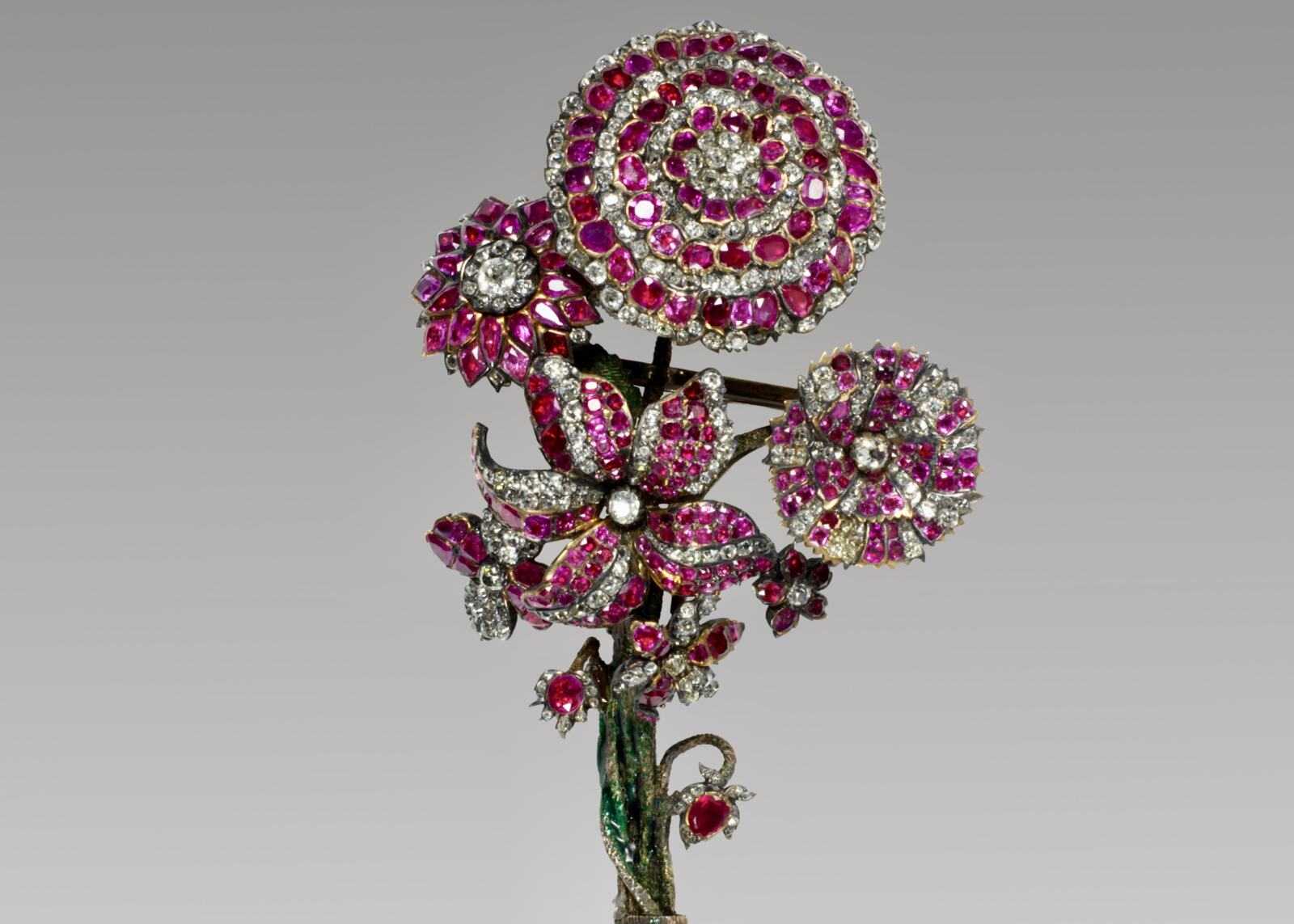
Visual Bouquet of Flowers, Russia. 1750-1770. Ruby, Diamonds, Gold, Silver and Enamel. © Victoria & Albert Museum, London.