





One might enter Line Vautrin’s universe as one enters a forest: without immediately seeking a path. Forms shift, symbols answer one another, and objects seem to retain the trace of a thought in motion. Here, the dragon is not merely an imaginary creature. It becomes an inner figure, one the artist attempts to approach through her doubts, her explorations and her transformations.
Originally published in 1986, In Search of the Dragon, or The Inner Journey emerged from a period of existential crisis and creative questioning. In it, Line Vautrin offers an intimate voice, shaped by the uncertainties that accompany the artistic gesture. The text belongs to a cycle begun some ten years earlier, when her Pellimorphoses first appeared.
These hybrid works, made from resin forms set between two transparent surfaces, seem to belong to a world that resists precise definition. Vouivre, dragon, chimera: each viewer is free to find their own interpretation. As so often in Line Vautrin’s work, the object refuses to be confined to a single meaning. It suggests, shifts and intrigues.
Line Vautrin, an artist between poetry and material
Born in 1913, Line Vautrin belongs to the generation of creators who profoundly reshaped the French decorative arts in the 20th century. Trained from an early age in metalworking in her family’s workshop, she began creating bronze jewellery, boxes and powder compacts in the 1930s.
Her vocabulary gradually took shape around signs, rebuses, animals and literary references. In her hands, an object could become a riddle; a phrase, a motif; a mirror, a doorway into the imagination.
In 1954, she developed and patented Talosel, a material based on cellulose acetate that she worked by incorporating fragments of mirror. This invention accompanied a new chapter in her practice and gave rise to her celebrated sorcière mirrors, whose radiating forms have since become emblematic of her artistic language.
Yet to reduce Line Vautrin to a handful of iconic objects would be to overlook what makes her work so distinctive. Jewellery, decorative objects, mirrors, sculptures and writing all belong to the same quest: bringing poetry forth from material.
Fanny Michaëlis enters the “inner journey”
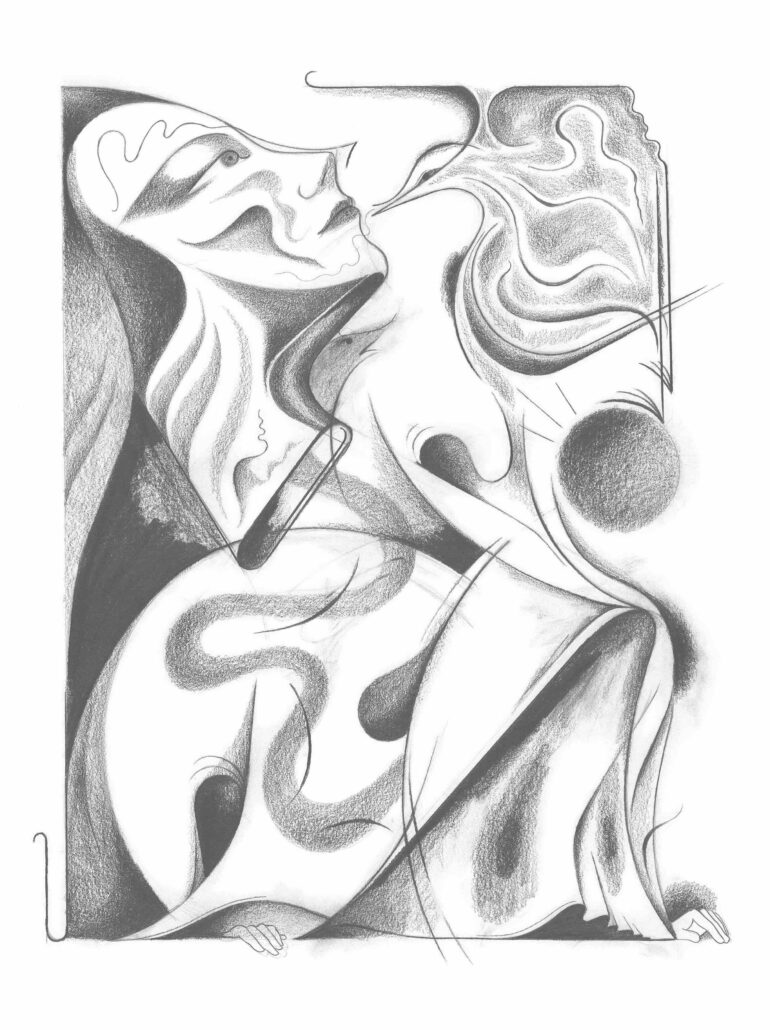
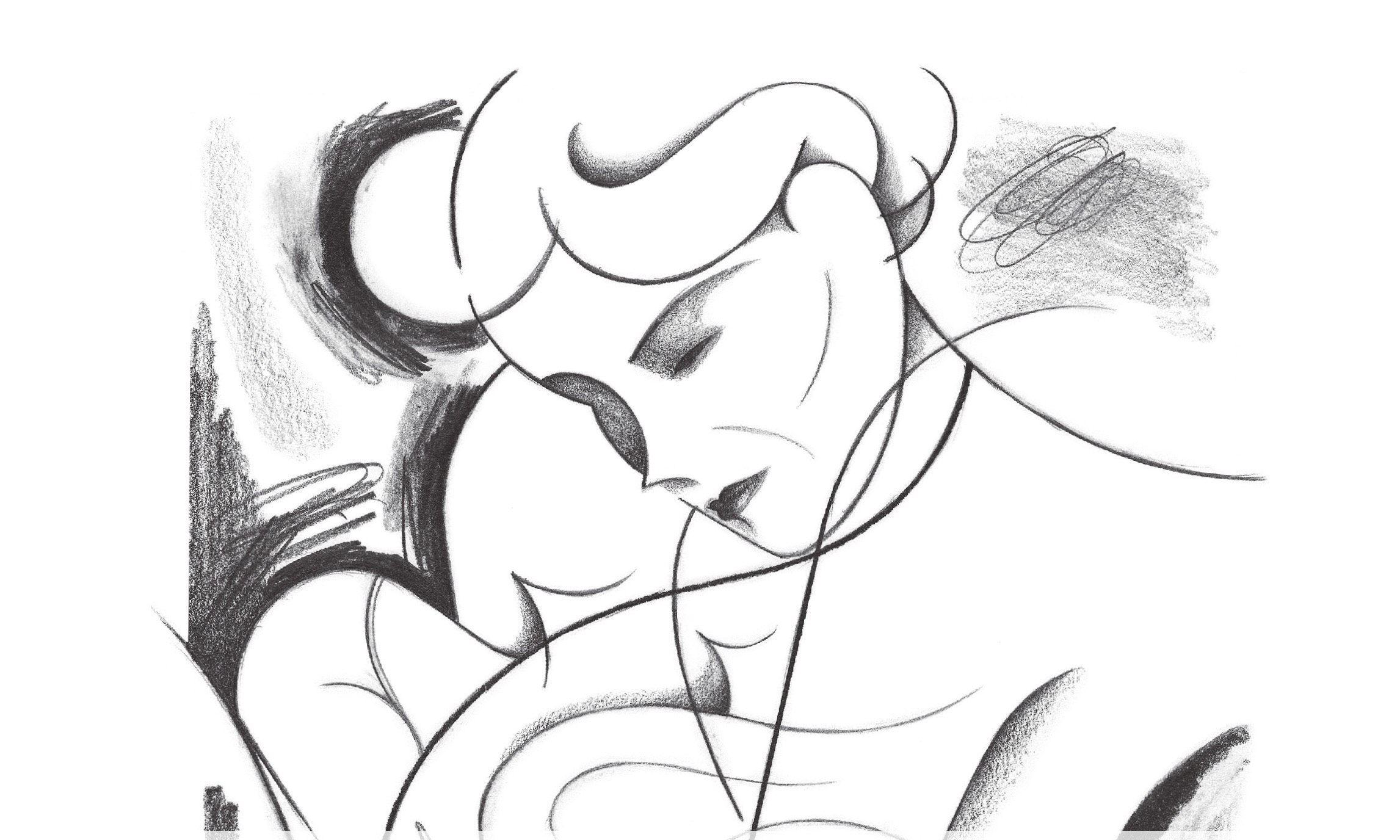
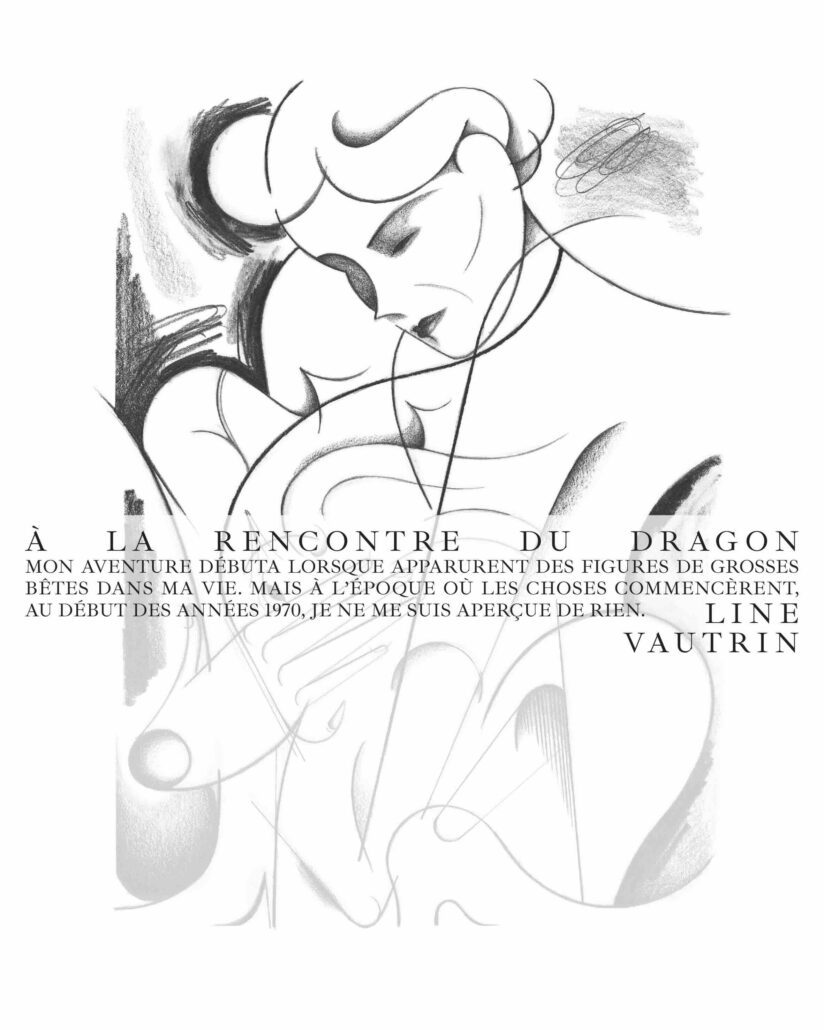
For this new edition, the Line Vautrin Endowment Fund has chosen to bring an earlier text into dialogue with the vision of a contemporary artist. Fanny Michaëlis, illustrator and graphic novelist, accompanies the narrative with drawings conceived as a conversation with the Pellimorphoses.
Her contribution does not seek to explain Line Vautrin’s work. Instead, it extends its silences and its strangeness.
“I conceived and created the drawings accompanying this edition, alongside the Pellimorphoses, as a dialogue, attempting ‘the inner journey’, guided by Line Vautrin’s language,” she explains.
Her lines, at times charcoal-like, at others pared back, seem to move at the same rhythm as the text. Presences appear and withdraw, leaving behind a figure that can be recognised without ever being entirely grasped: Line Vautrin herself.
Educated at the École des Beaux-Arts in Paris and later at the Institut Saint-Luc in Brussels, Fanny Michaëlis has developed a distinctive graphic universe spanning drawing, graphic novels and illustration. Her books have been published by Cornélius and Casterman. In 2024, she created the poster for “La BD à tous les étages”, an event devoted to comics at the Centre Pompidou, which also acquired several of her original drawings.
A meeting of two imaginations
What makes this new edition particularly compelling is the encounter between two different moments in time. On one side, Line Vautrin’s voice, transforming introspection into literary matter. On the other, Fanny Michaëlis’s line, inhabiting the spaces left open by the text.
The dragon thus becomes a way of speaking about creation. It is what one searches for without knowing precisely what will be found. An inner form that eventually takes shape.
The book reminds us how much Line Vautrin, beyond her jewellery and mirrors, was an artist of the imagination. Her work continually moves between the visible and the invisible, between object and idea. This new publication reveals a more intimate dimension of her practice: that of a woman confronting her own creative territories.
In Search of the Dragon, or The Inner Journey ultimately reads as an invitation: to look differently at Line Vautrin’s forms, and perhaps, in turn, to set out in search of what lies behind them.
In Search of the Dragon, or The Inner Journey — Line Vautrin, illustrated by Fanny Michaëlis. New edition published with the support of the Line Vautrin Endowment Fund.