





When Victorian England Adorned Itself with Insect Wings
London, the 1880s. In gaslit drawing rooms, something glimmers with a light that is neither a diamond’s nor a pearl’s: a deep, almost metallic green that shifts to blue as a woman turns her head. These are beetle wings. Victorian England, passionate about natural history, ancient Egypt and curiosities from every corner of the Empire, had fallen in love with insect jewelry. It appeared in brooches, necklaces and embroidery. In 1888, the actress Ellen Terry wore a Lady Macbeth costume embroidered with thousands of beetle wing-cases, later immortalized by Sargent in a celebrated portrait.
Why would an age so corseted, so devoted to propriety, turn to the remains of insects to adorn itself? Perhaps because the nineteenth century, haunted by death and fascinated by evolution, looked to the infinitesimal for an answer to the immense. Darwin himself collected beetles with a lover’s fervor. A century and a half later, in Athens, the question finds an unexpected echo.

Lito Karakostanoglou: A Beauty That Refuses to Be Locked Away
The Greek designer could not bear the idea of leaving such treasures asleep in their boxes. To shelter such beauty, she says, is to condemn it to invisibility. The sentiment is almost a definition of jewelry: a gem that is never worn is only an object waiting, and a scarab that is never seen is merely a relic.
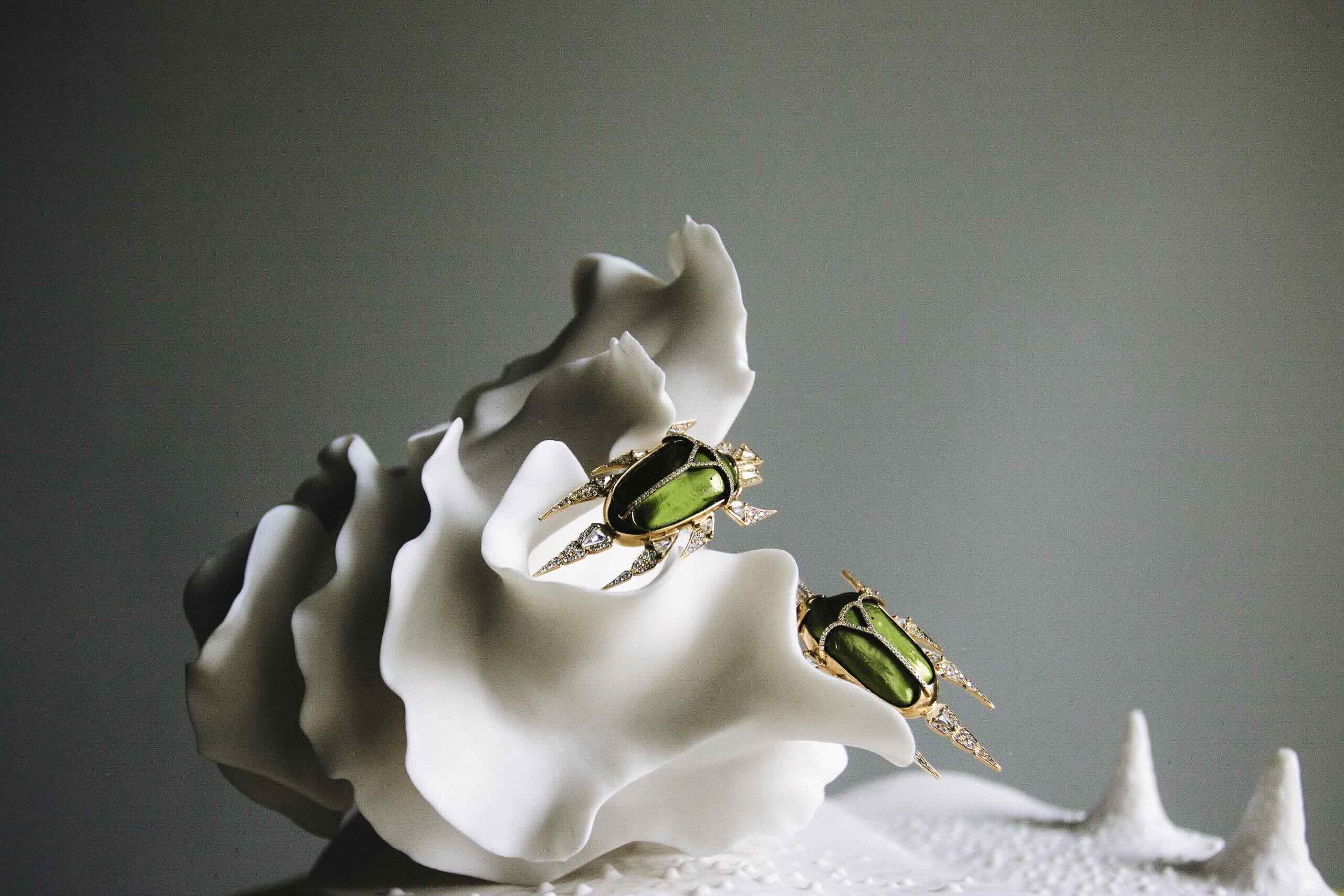
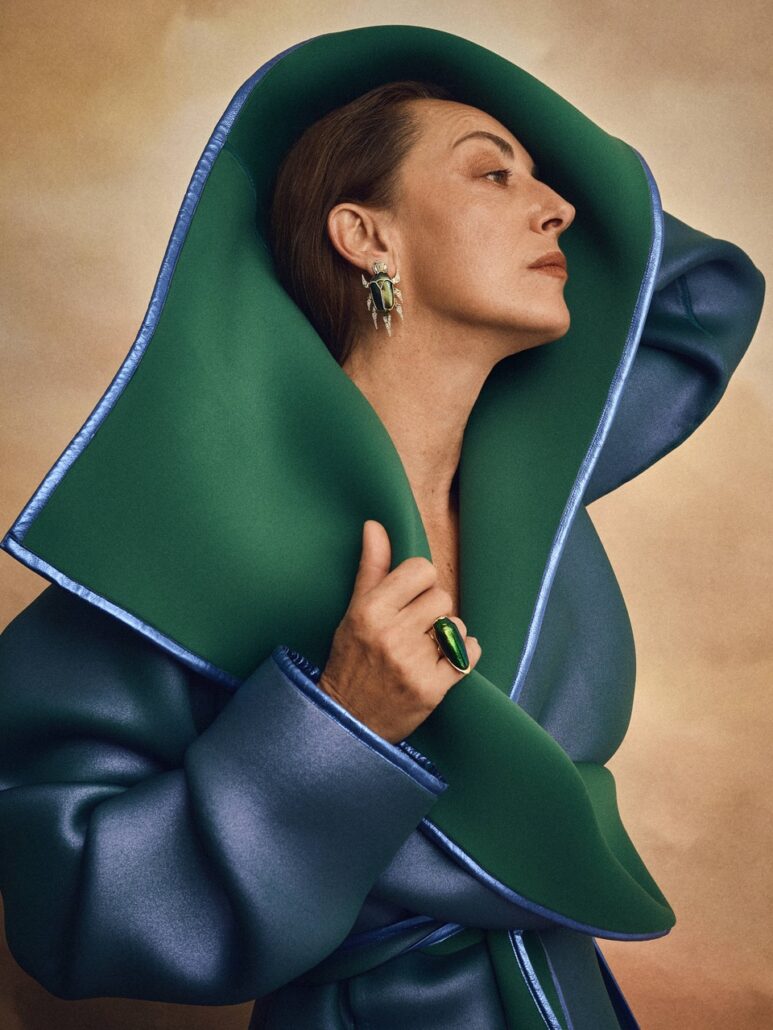
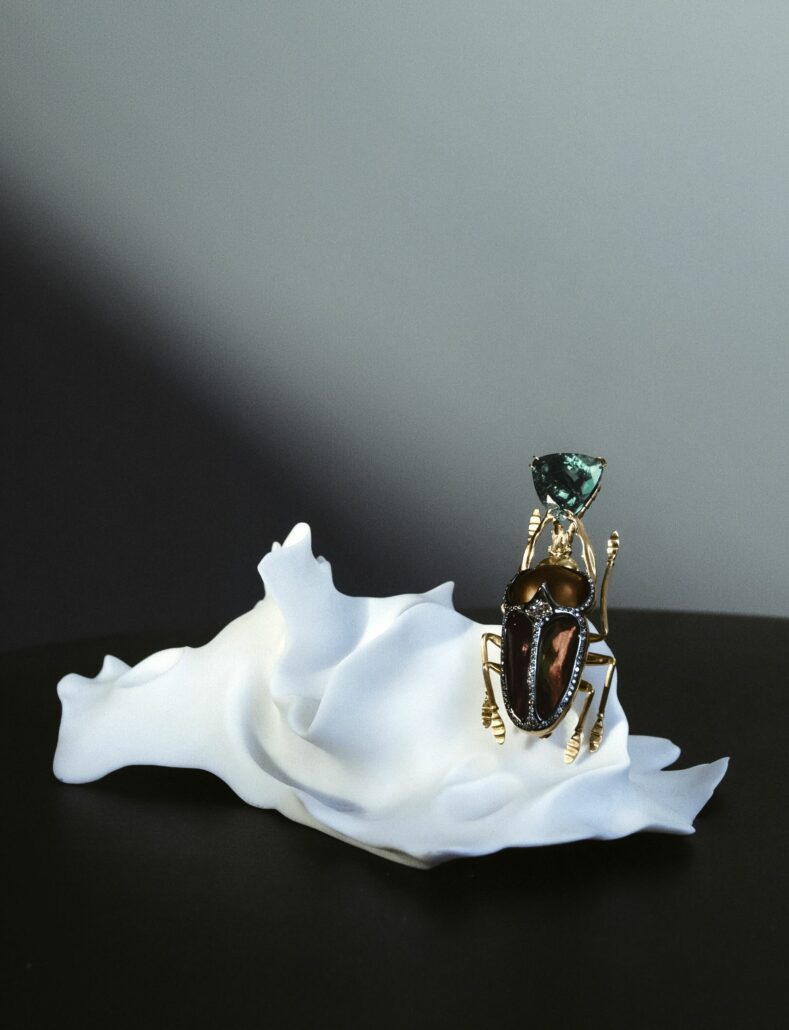
Cosmic Guardians was born of that refusal. Its starting point is a collection of rare, preserved scarabs from Deyrolle, the Parisian house one enters as if stepping into a childhood dream, among glass cases, pinned butterflies and motionless animals. Lito Karakostanoglou describes it as her most personal collection to date, and it is easy to believe her: these pieces carry a tenderness that mere exercise in style cannot explain.

What the Scarab Says: Amulet, Metamorphosis and Rebirth
Since ancient Egypt, the scarab has been both enigma and amulet, an emblem of rebirth, of metamorphosis, of what endures after disappearance. The Victorians knew the symbol well; Egypt was their great reverie. Lito picks up the thread with entirely contemporary freedom: no imitation, no stylized motif. The scarab is there, real, with its iridescent shell and its fragility intact.
Contrast is the heart of the work. 18k gold, diamonds and precious stones speak of permanence. The insect speaks of the instant. Between the two arises a tension the designer embraces: strength and fragility, what resists and what fades.
Scarab Iridescence: A Color That Is Not a Color
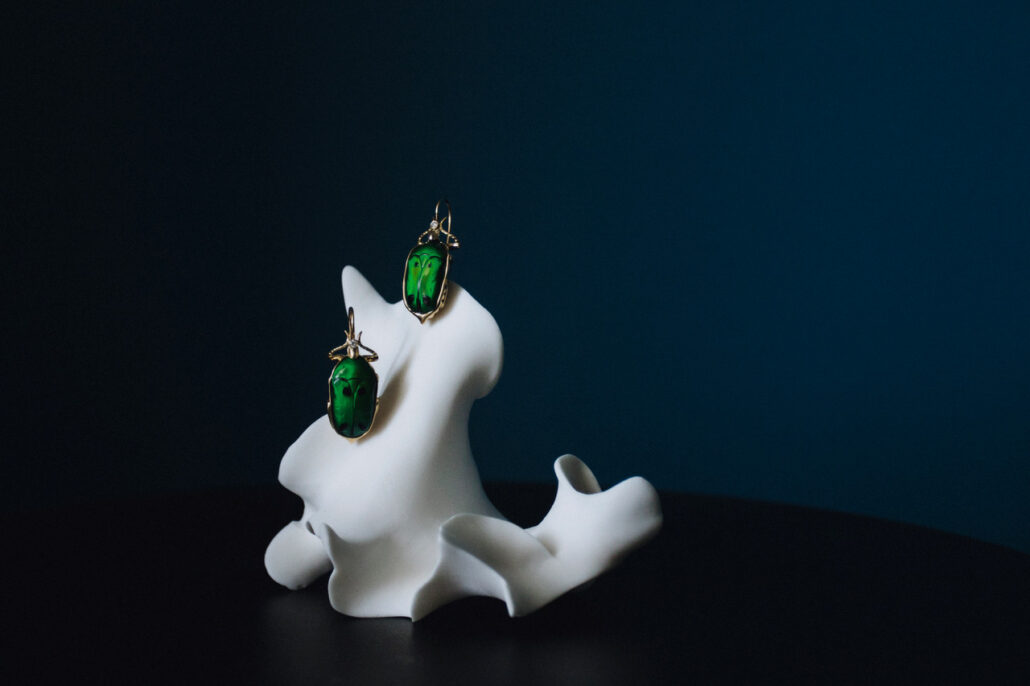
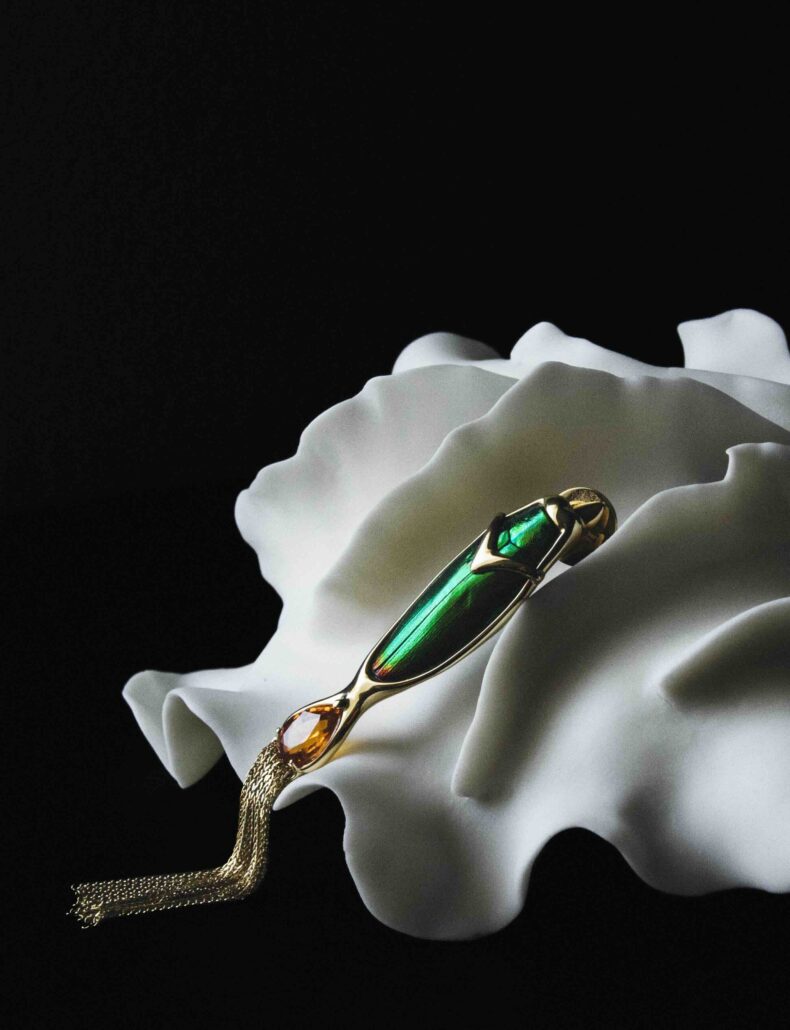
One has to look closely to understand what makes these pieces magical. These metallic greens, these blues that slip away under the light, owe nothing to pigment. No dye, no paint: it is the microscopic architecture of the elytra, built of infinitely thin layers, that makes light interfere and sends it back in shifting flashes. Color is born of structure, which is why it moves with the slightest gesture of the hand or neck.
Under a loupe, the test is simple: slowly tilt the piece. Authentic iridescence changes hue with the angle, moving from green to blue to coppery tones, with an almost liquid depth. A polymer imitation often freezes the color into a flatter, more uniform reflection.
To a trained eye, this iridescence is a signature. It allows an expert to recognize genuine brilliance, to rule out the alterations that time or careless handling leave on the surface, and to expose modern imitations. In Cosmic Guardians, each scarab keeps its original iridescence, carefully preserved.
The Athens Workshop, or the Patience of Hands
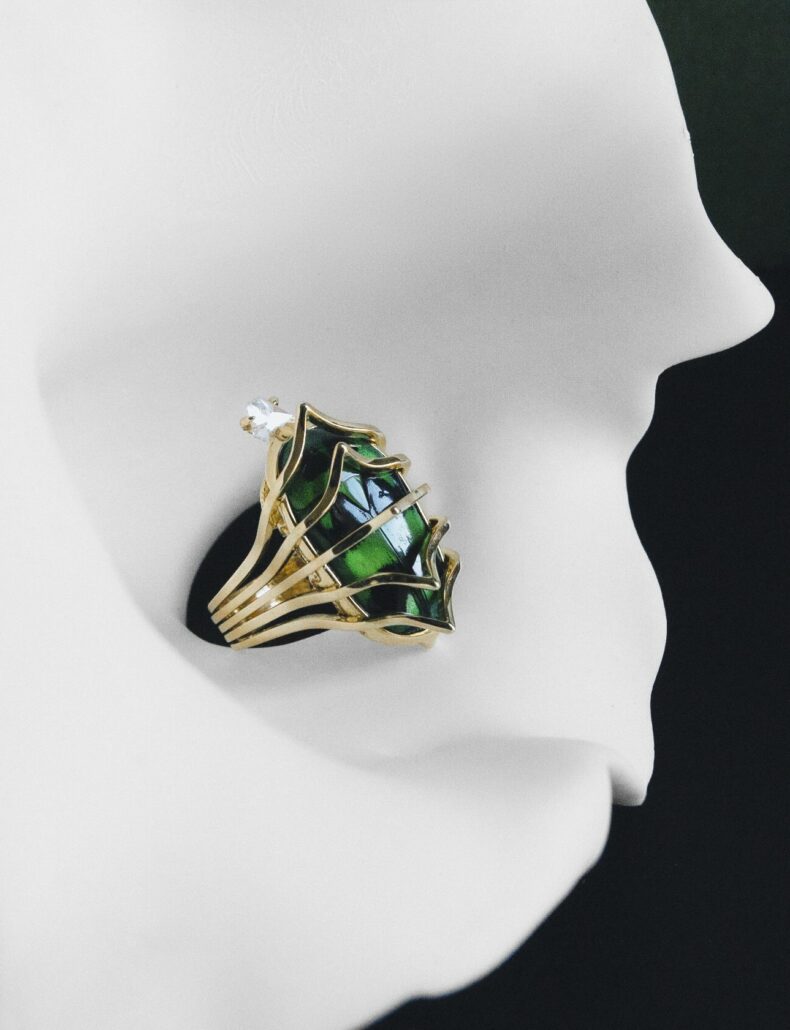
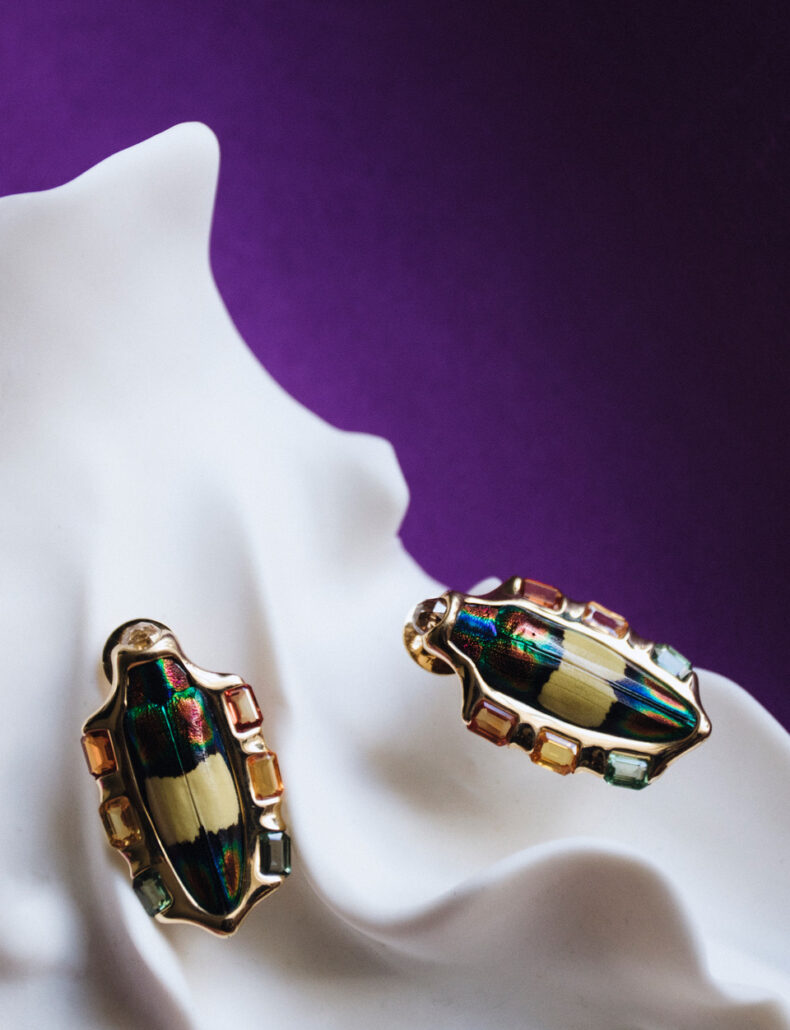
This poetry rests on formidable technique: setting an exoskeleton without damaging it, building around it an architecture of gold that protects it while letting it breathe. The master artisans of the workshop had to reinvent everything, with delicate conservation methods to preserve the original luster, articulations that must be checked under a loupe, and clasps and settings of extreme precision.
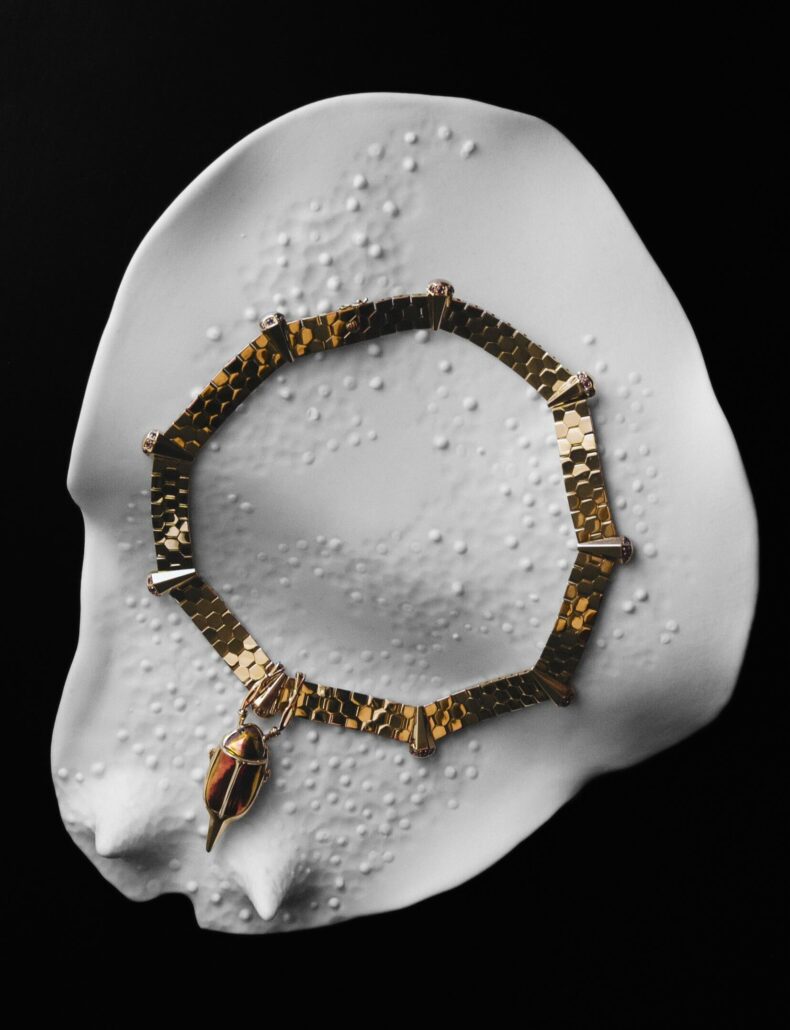
The result is visible in the choker, whose articulated rings let the wings move and shimmer against the skin, and in the ring where a scarab, with a fine gold tip, holds a diamond. Earrings, bracelets, a brooch and even a tiara complete the ensemble. Each piece is made to rest directly on bare skin, to beat with the wearer’s heart and to play with light like a living creature.
A Porcelain Habitat by Diane Alexandre
One last gesture, and not the least: each piece comes with its own individual certificate and a porcelain “habitat,” hand-modeled by ceramist Diane Alexandre. It is no longer a jewelry box but a dwelling. There, the jewel regains something of the cabinet of curiosities, that art of displaying the world in miniature in order to contemplate it better.

Lito Fine Jewelry: Greek Goldsmithing in the Present Tense
Founded in Athens in 1999, Lito Fine Jewelry has become a reference in contemporary design by uniting the heritage of Greek goldsmithing with a sculptural language, somewhere between romanticism and futurism. Every piece is made by hand in the Athens workshop. The house also has its places: the Cabinet of Curiosities in Kolonaki, now iconic, and the Premier Étage, where art and luxury meet. The creations are also available online and through a selection of retailers worldwide.
 Voir sur Instagram

Epilogue: Refusing to Let Beauty Vanish Unwitnessed
Victorian women wore insect wings to remind themselves that everything passes. Lito Karakostanoglou makes the opposite gesture: she wears the scarab to say that something endures. Cosmic Guardians is less a collection than an invocation, of reverence, of protection, of the dialogue between nature and art. A jewel, in the end, may be nothing more than this: a way of refusing to let beauty vanish without a witness.