



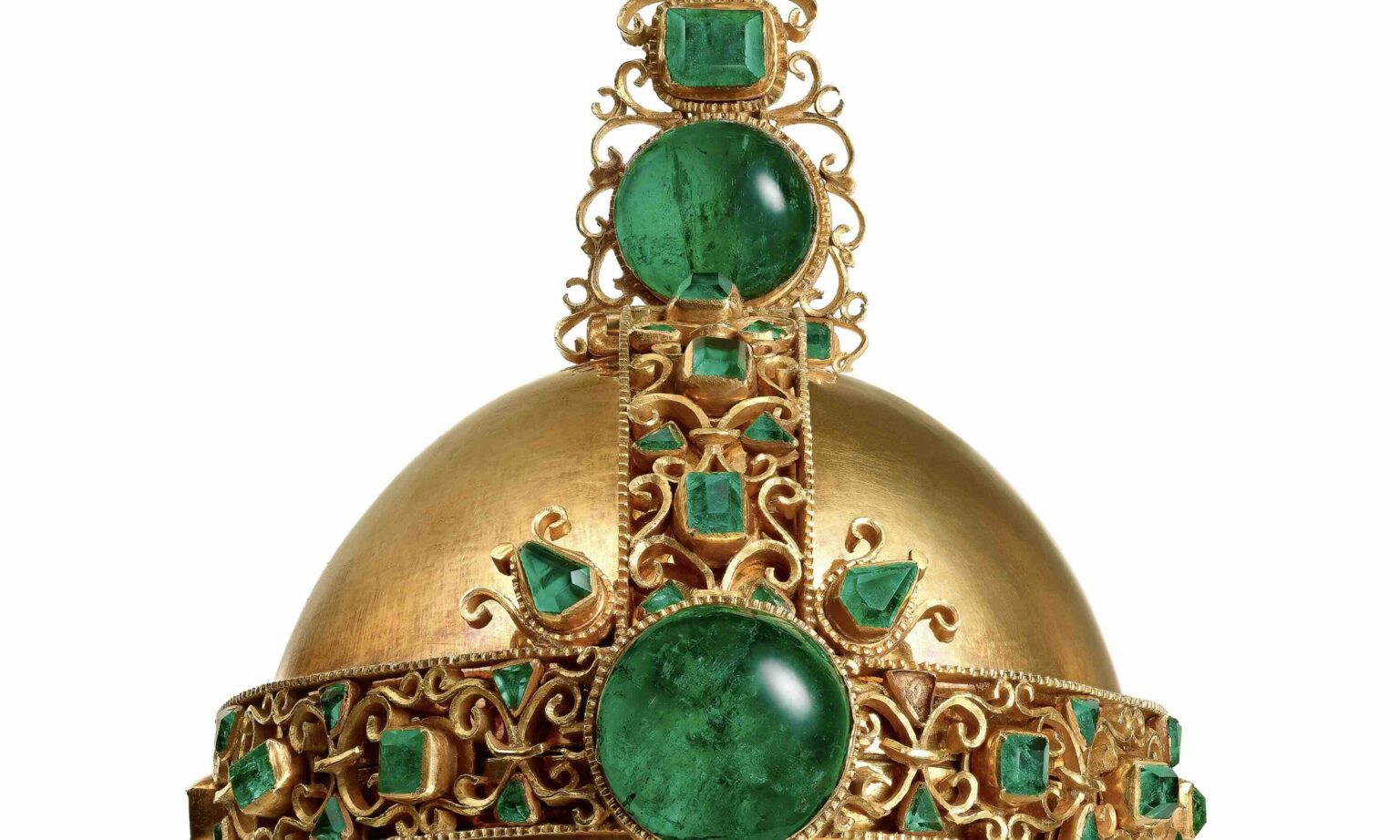
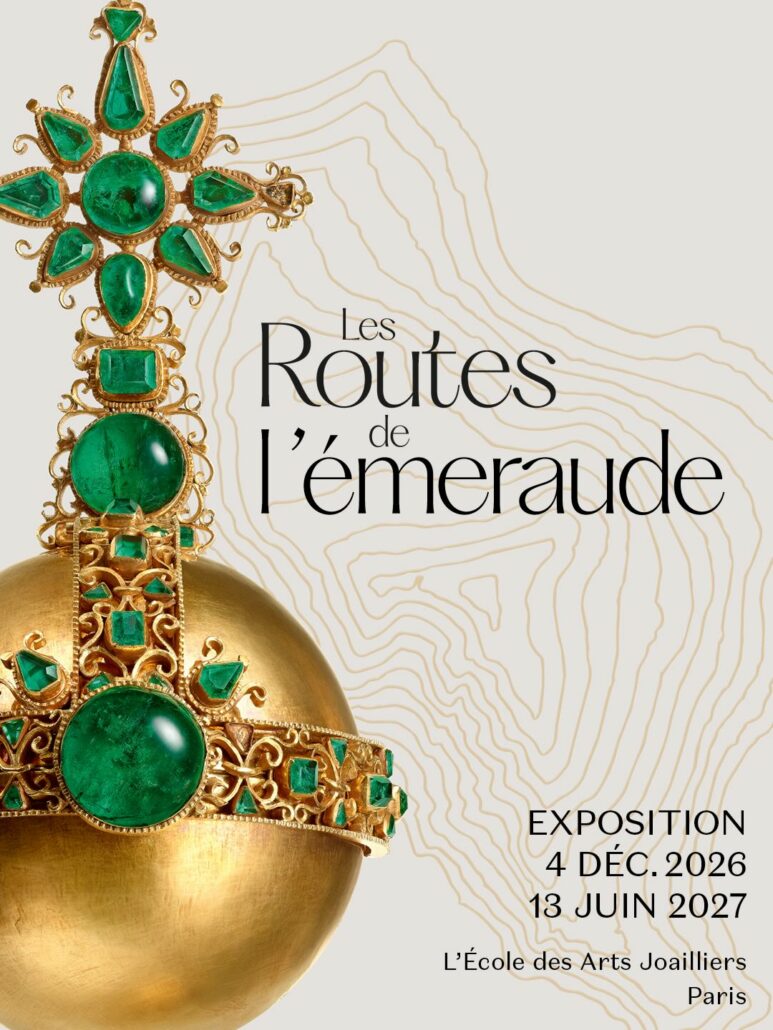
Off the coast of Florida in 1622, a storm sank the Spanish galleon Nuestra Señora de Atocha. Among its cargo were emeralds freshly arrived from the New World. More than four centuries later, a gold orb set with these green stones is on view in Paris, among the major pieces of Les Routes de L'Émeraude ( The Routes of the Emerald). Presented by L'École des Arts Joailliers with support of Van Cleef & Arpels, the exhibition follows the gem from mine to trading post, from court to workshop, and asks what these itineraries reveal about the people who traced them.
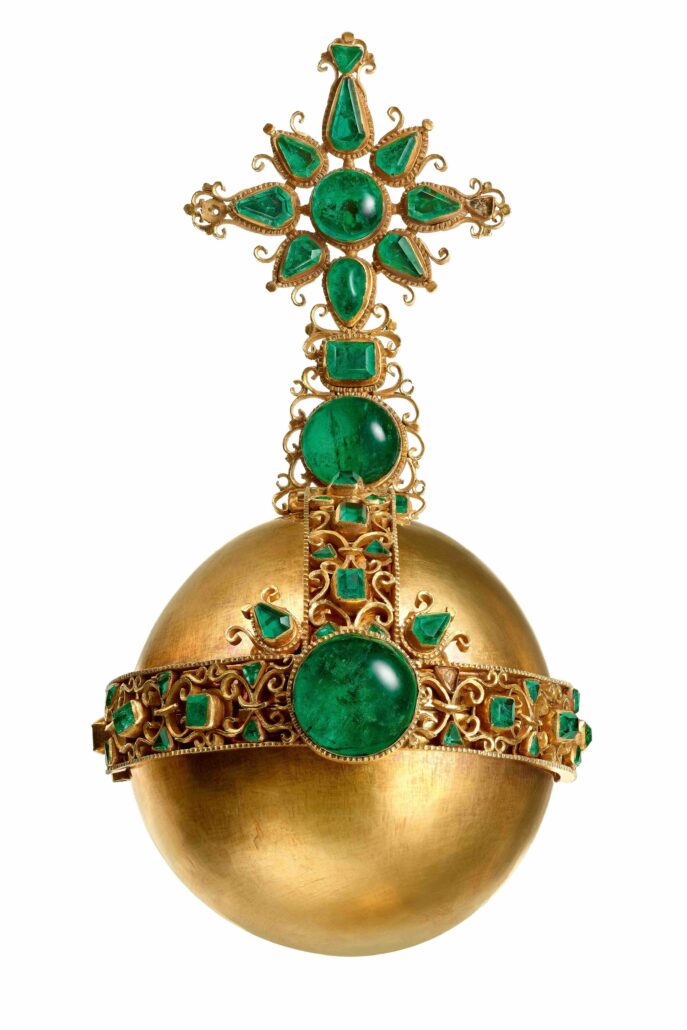
Or, émeraudes colombiennes
Collection Muzo Atocha, Muzo Emerald Colombia
© Photo : L’École des Arts Joailliers, Nils Herrmann
A Stone That Long Lacked an Exact Name
The word comes from that ancient Greek smaragdos, "green gem". Everything is said and everything remains blurred. Until the late eighteenth century, color alone determined classification : jasper, peridot, fluorite or chrysoprase could all bear the same name. To read a Greek, Latin, Arabic or Persian text is therefore to guess which stone it describes. The exhibition opens on this uncertainty, before mineralogy settles the question : the emerald is the green variety of beryl, colored by chromium and vanadium.
Then comes geography. Bactria, in Central Asia, was mined as early as the Hellenistic period. Egypt followed, the dominant source until the sixteenth century, and from there taste for the stone spread across the roman Empire, from the Maghreb to Gaul. Then, in the wake of the Spanish conquests the deposits of New Granada, present day Colombia., came to light. the Egyptian mines fell into oblivion, and would not be rediscovered until the early nineteenth cebtury.
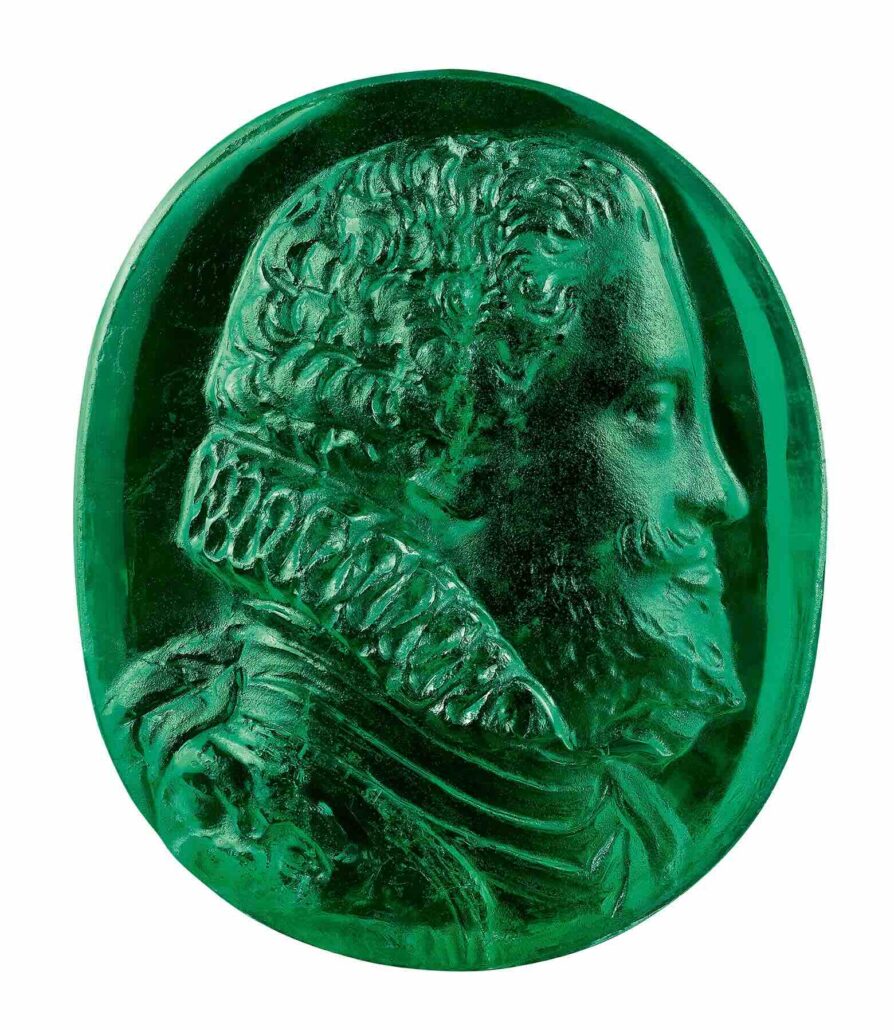
Émeraude colombienne gravée, 9,06 ct
Collection Greens of Cheltenham
© Photo : L’École des Arts Joailliers, Nils Herrmann
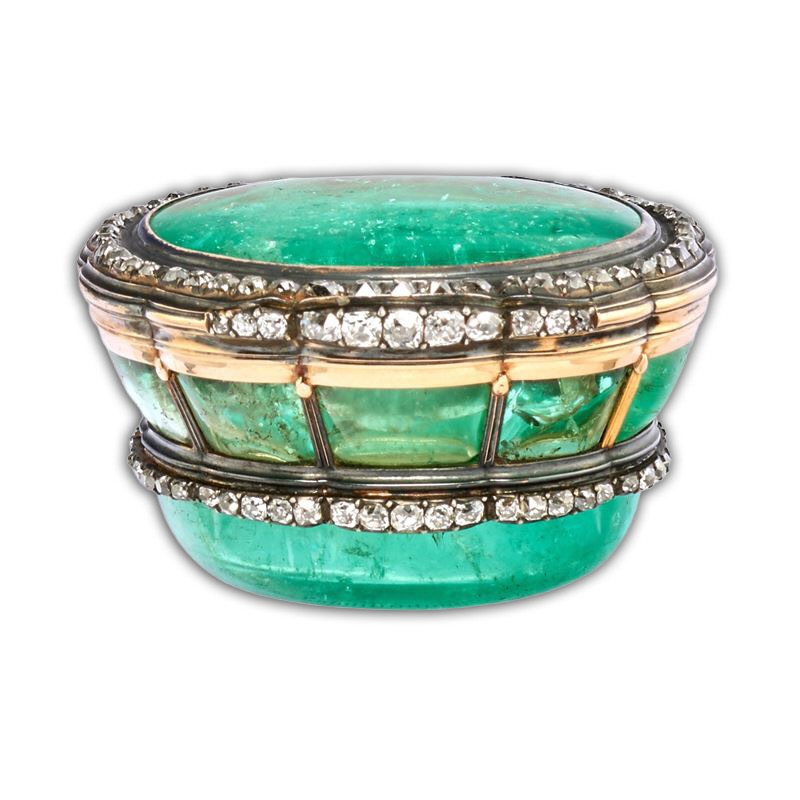
Argent, or, diamants et éméraudes
Collection Fabrice Gros
When science takes over from the Archives
Created in partnership with the Centre de recherche et de restauration des musées de France, the exhibition sets written sources against laboratory analysis. On one side, the AGLAE particle accelerator; on the other, the study of inclusions and X-ray fluorescence : two methods for answering a question once thought to belong to legend. Where does this stone come from ? The display devoted to piecess whose origin remains debated, a Gallo-Roman earring and a ring from the Saint-Denis necropolis, is a reminder that an attribution is a hypothesis held to be sound until further notice. The curator, Marie-Laure Cassius-Duranton, sees in it an opportunity to dismantle persistent myths about the origin of historic emeralds.
For the gemologist that I am, this is where the stone reveals itself. Its inner garden tells the story of its birth, and the three-phase inclusion, where solid, liquid and gas coexist, holds within a fraction of a millimeter the three states of matter.
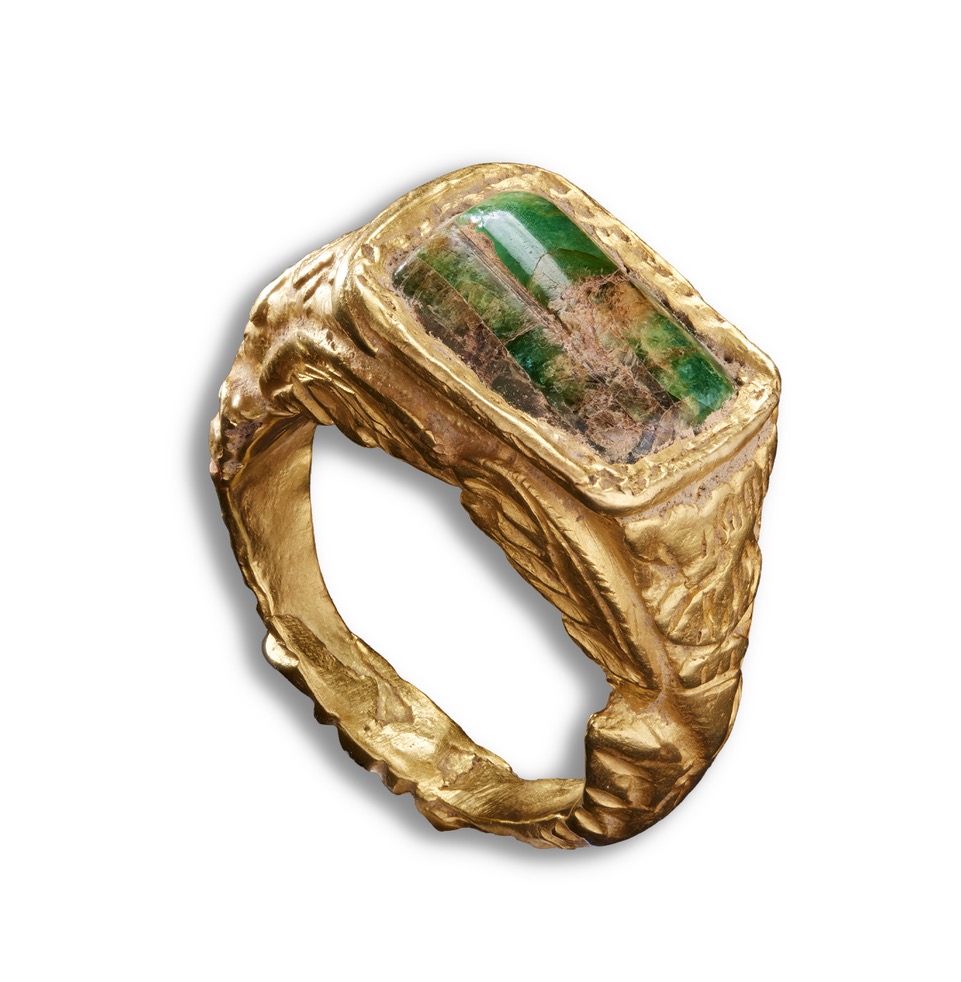
Collection Fabian de Montjoye
© Photo : L’École des Arts Joailliers, Benjamin Chelly
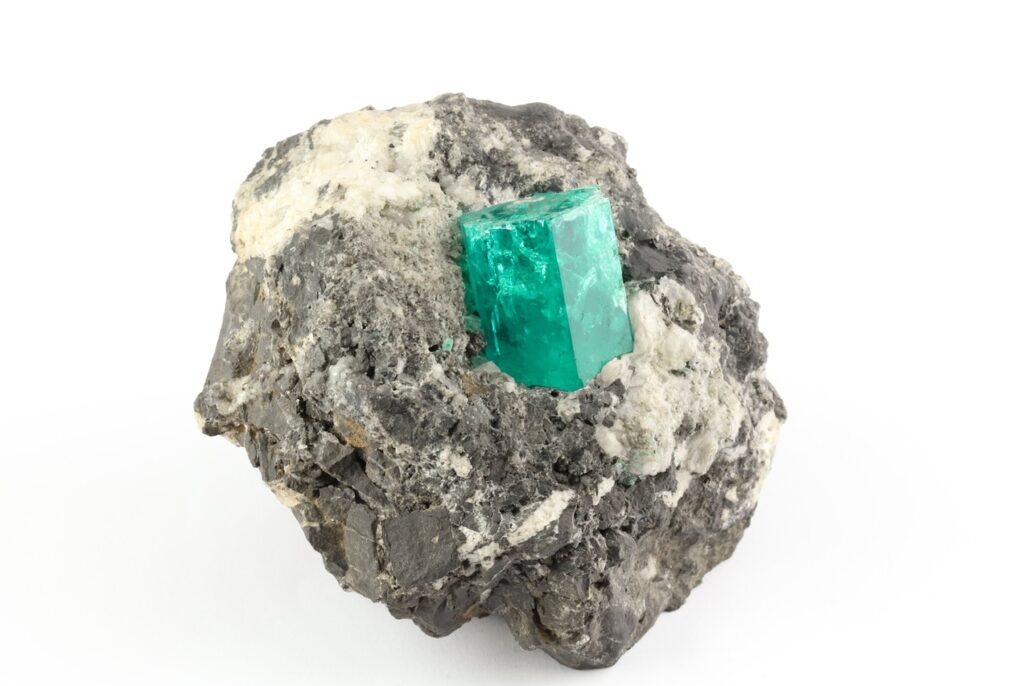
Musée de Minéralogie de L’Ecole des Mines Paris PSL, ENSMP 6334
© Photo : Musée de Minéralogie de L’École des Mines Paris, PSL E. Gaillou
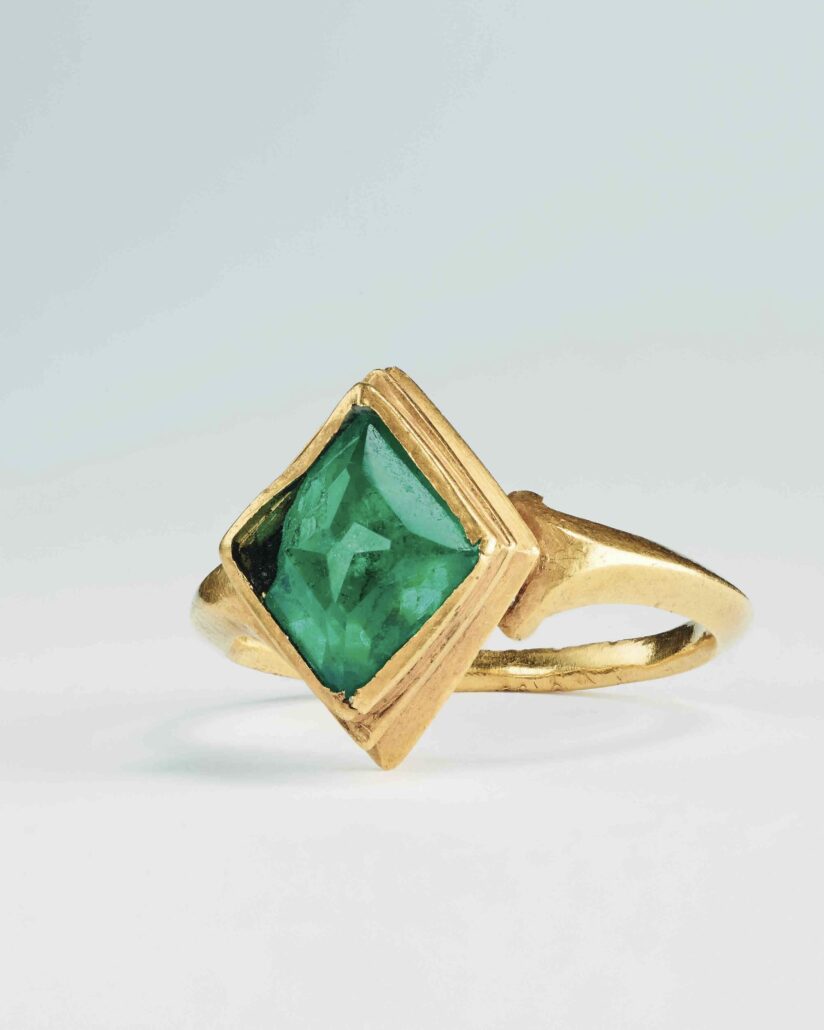
Or, émeraude colombienne
Collection Muzo Atocha, Muzo Emerald Colombia
From the Pacifique to Goa, from Bogota to Place Vendôme
The second part follows the routes. Colombian emeralds of unprecedented transparency and luminosity, unpended the European market. they reached India across the Pacific, by way of Philippines, or across the Atlantic as far as Goa. Mughal, Ottoman and Persian princes were their first buyers. At the Mughzl court, lapidaries engraved verses of the Quran and devised a floral iconography inspired by the gardens of paradise. The color of the stone made it a sacred gem of Islam.
Europe was not left behind. The gallleon's gold orb, recovered in 1985 and shown with two other pieces from the wreck, had never before been displayed in a museum setting. Facing it the engraved portrait of Archduke Ernest of Austria shows the art of emerald engraving was not the preserve of the East.
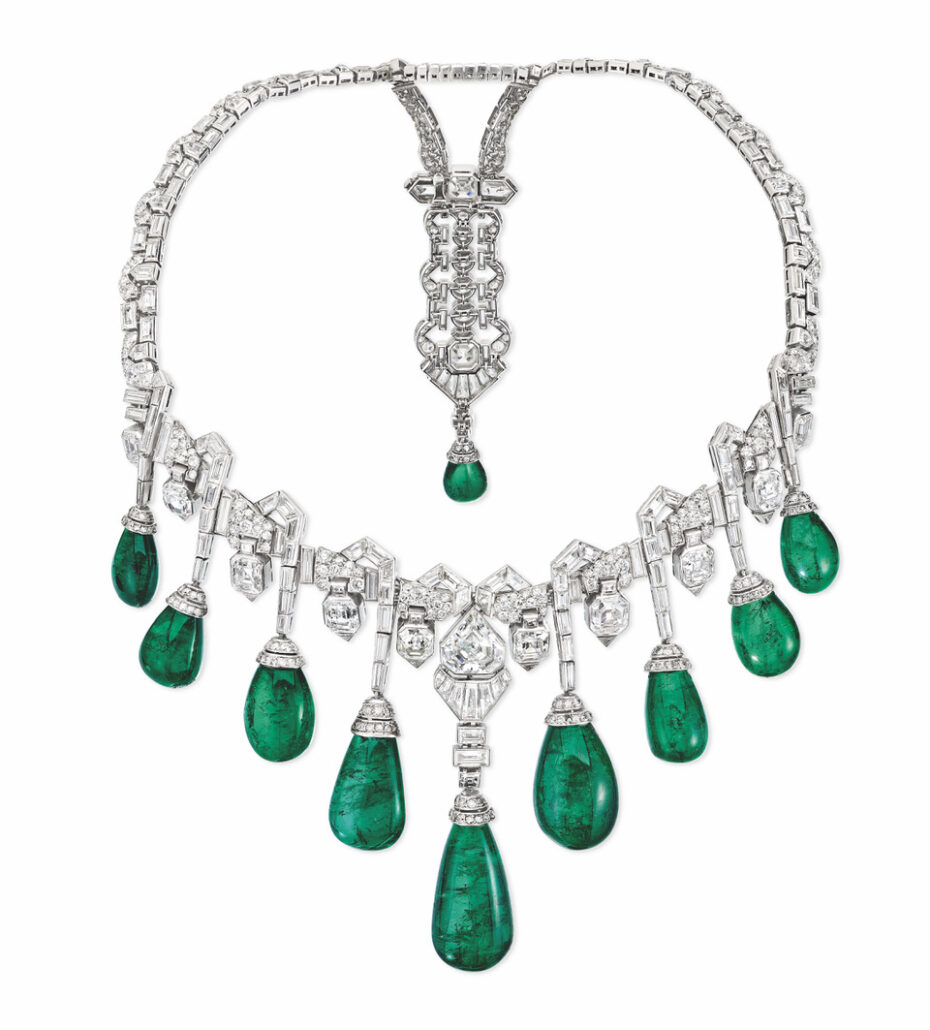
Platine, émeraudes de Colombie et diamants
Ancienne collection de la princesse Faiza d’Égypte
Van Cleef & Arpels Collection
The final chapter is the one the Parisian eye recognizes at once. With the fall of the Mughal Empire, engraved emeralds made their way back to Europe, and the jewelers of the 1920s seized upon them. Platinum, diamonds, pampilles :the 1929 Van Cleef & Arpels collerette, formerly belonging to Princess Faiza of Egypt, is answered by Boucheron's gouache order book for the Maharaja of Patiala. Here we touch on what makes the jeweler's art singular, the capacity of a single piece to carry several civilizations within it intact.
What stones tell us about time
There is a quiet lesson in this exhibition. The gems appear dismounted, recut, reset, sold, exchanged, plundered, handed down. None is truly in its original state. Each jewel is a palimpset, and each setting a stage along the way. One then thinks of what these objects teach about duration. The stone takes shape over millions of years, the jewel lasts only as long as a taste, and yet it is the jewel that makes the stone travel. The expert's eye dwells on the material, the historian's on the hands that have worn it; the exhibition's merit that it does not choose between them.
A visit designed for all ages
The roughly 200 pieces, lent by 33 institutions and private collectors, among them the Muséum national d'Histoire naturelle, the Mineralogy Museum of the École des Mines, the Musée national de la Renaissance in Écouen and the Bibliothèque nationale de France, as well as Chaumet, Boucheron and Van Cleef & Arpels, are presented in a display of about 200 m².
A six-stage route, designed at a child's eye level, invites visitors from age 7 to peer through a giant magnifying glass, follow an animated map, or listen to the legend of Alexander the Great fighting gragons with emeralds on their foreheads.
The programme extends the vistor experience with a series of conferences, an Art & Science cycle entitled The World of Gemstones, a new course dedicated to emeralds, a workshop for children, and the podcast La Voix des Bijoux.
Practical Information
Exhibition The Routes of the Emerald, 4 December 2026 to 13 June 2027 Venue: L’École des Arts Joailliers, Hôtel de Mercy-Argenteau, 16 bis boulevard Montmartre, Paris 9th Opening hours: Tuesday to Sunday, 11 a.m. to 7 p.m.; late opening until 8:30 p.m. on Thursdays Free admission, reservation required: lecolevancleefarpels.com