




The Musée du quai Branly invites us to discover the Mayan civilization.
“Maya’s revelation of an endless time”
This great civilization reveals some of its secrets; this people possesses one of the oldest cultures of Mesoamerica. It was by defying nature that the ancient Mayans were able to establish themselves in very different environments, between volcanoes and tropical jungle.
A thousand-year-old heritage, the Mayas stand out for their great creativity, their technical prowess, but also for their aesthetic pursuit.
The green gold of the Mayans: jade.

Yucatán, Chichén Itzá
600-900 BC.
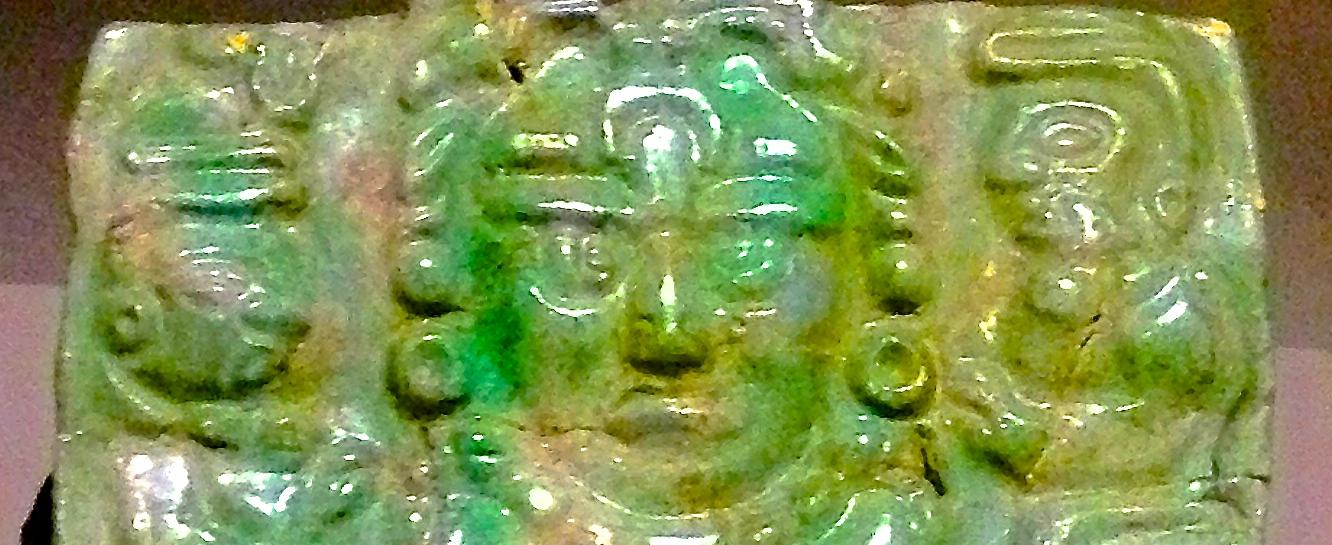
This pectoral features in its center the figure of the sun god «Aj K'in», one of the main deities of the Mayan cosmology, associated with the warmth and vitality of the star.

Credit Museum du Quai Branly
The sun god is characterized by his large quadrangular eyes, his strabismus, his pupils shaped like volutes, and his camus nose. He was one of the major deities of the Mayan pantheon, because his functioning and the continuity of the universe depended on him. Among the Yucatec Mayans, he was called K’inich Ajaw, «Lord of the Sun Eye».

In Mesoamerica jade appears only in the form of jadeite, because the other jade called nephrite does not exist there (the texture of jadeite is made of small grains, the texture of nephrite jade is composed of fibrous crystals. Jadeite is harder; the hardness index for nephrite jade is 7 and 6).
Made from intense green jade is composed of sodium and aluminum silicate; it is a very hard and brilliant stone that has fascinated the Mesoamericans. This gemstone of choice was therefore designated for the manufacture of many jewelry items.

For a long time, it was ignored that jade deposits existed in Central America. It was only in the 1970s that these deposits were rediscovered in Guatemala, and mineralogical studies showed that all the jadeite used came from the Rio Motagua region.
The raw material is found in the form of small pebbles or blocks weighing several kilos in the alluvial deposits of the Rio Motagua.

Jade is worked with very simple means.
The stone is cut using string, a flat piece of wood or slate, and an abrasive material such as obsidian or jade dust. When the part between the two grooves is thin enough, the desired piece can then be detached with a strong blow of a hammer.
The engravings are made using a piece of obsidian.
Jade is used to create countless ritual objects, ornaments, funerary masks, and jewelry.

Credit Museum du Quai Branly
The funerary masks were made using many tesserae, small polished jade cubes, in order to preserve the image of the leaders after their death. Furthermore, small pieces of seashells, snails, obsidian, and other materials were used to represent the eyes and mouth. The dignitary’s attire was complemented by ear ornaments, necklaces, bracelets, and other jade jewelry, a material that symbolized the regeneration of nature, vegetation, and life.

250-900 BC.

600-900 BC.
This type of jade ornament, decorated at each end, was generally used as the central piece of necklaces intended for the great lords of the Maya.
The design and construction of the object take into account the original form of the raw jade. The pieces are selected based on their shape.
It is thanks to their sense of observation that the Mayas adapted and acquired a great knowledge of the fauna and flora.

900-1250 BC.
Represented realistically, this jaguar is particularly worked-on. Its open mouth, a sign of strength and ferocity, has earned it the association with the power of leaders and the unrestrained forces of nature.

600-900 BC.
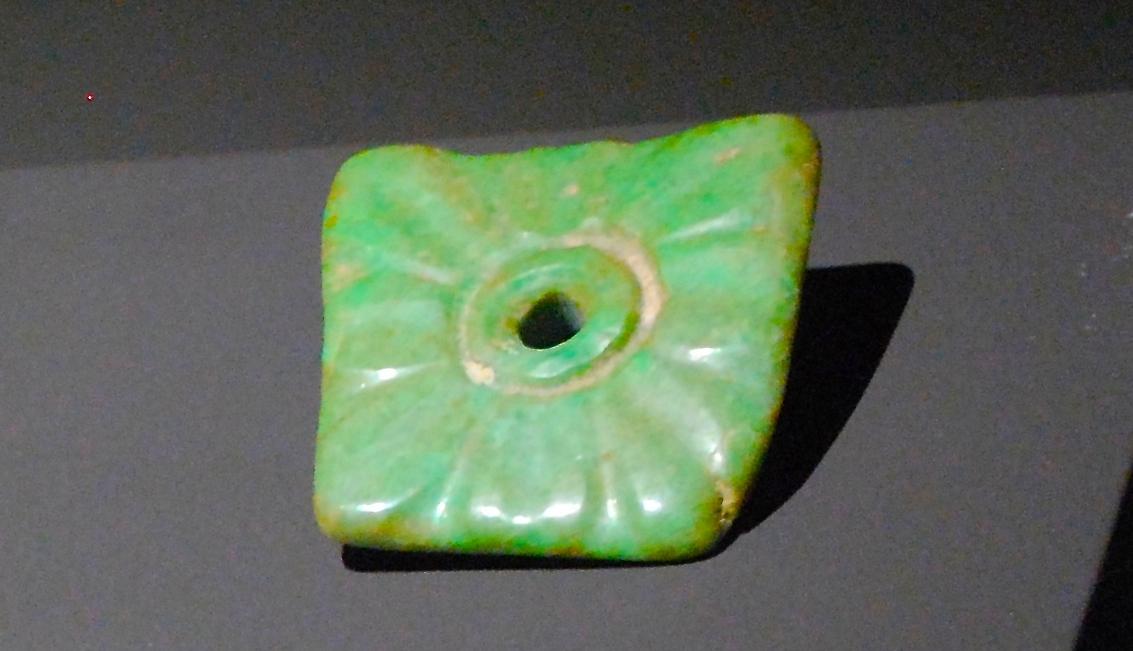
Cut in the shape of a four-petal flower, this ornament is one of the most common representations of the sun. It is also a reference to the four cardinal points: the center is the axis of communication between the different levels: the Sky, the Earth, and the Underworld.

Credit Museum du Quai Branly
Here is a small golden frog with turquoise incrustations as eyes. It comes from Chichén Itzá. Due to the close connection between these amphibians, the aquatic deities and the Underworld, it reveals a particularly symbolic symbolism. Through their coassings, frogs and toads announced the rain and thus the regeneration of the Earth.

Limestone
Plants, animals, and their relationship with humans are recurring themes in Maya art, and the representations of these subjects are as naturalistic as they are stylized.


Jade 600-900 BC.
Composed of tubular and spherical beads, this necklace has a central element made of a pectoral engraved with the symbol «ik», in the shape of a T, which represents wind and the vital breath.


900-1250 BC.
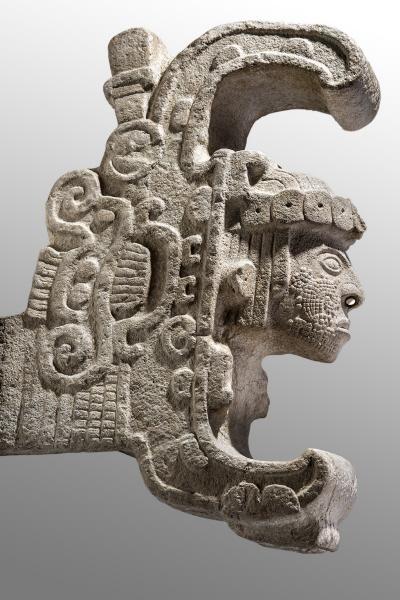
These atlantes or caridaites are richly dressed and adorned with numerous accessories: a headdress, earrings, a large pectoral, and bracelets.

The archaeological excavations carried out in Temple XII of Palenque have revealed a spectacular collection of jade pieces, including this necklace composed of heavy quadrangular jade beads.

The intense green color and the durability of the stone were intimately associated with life.
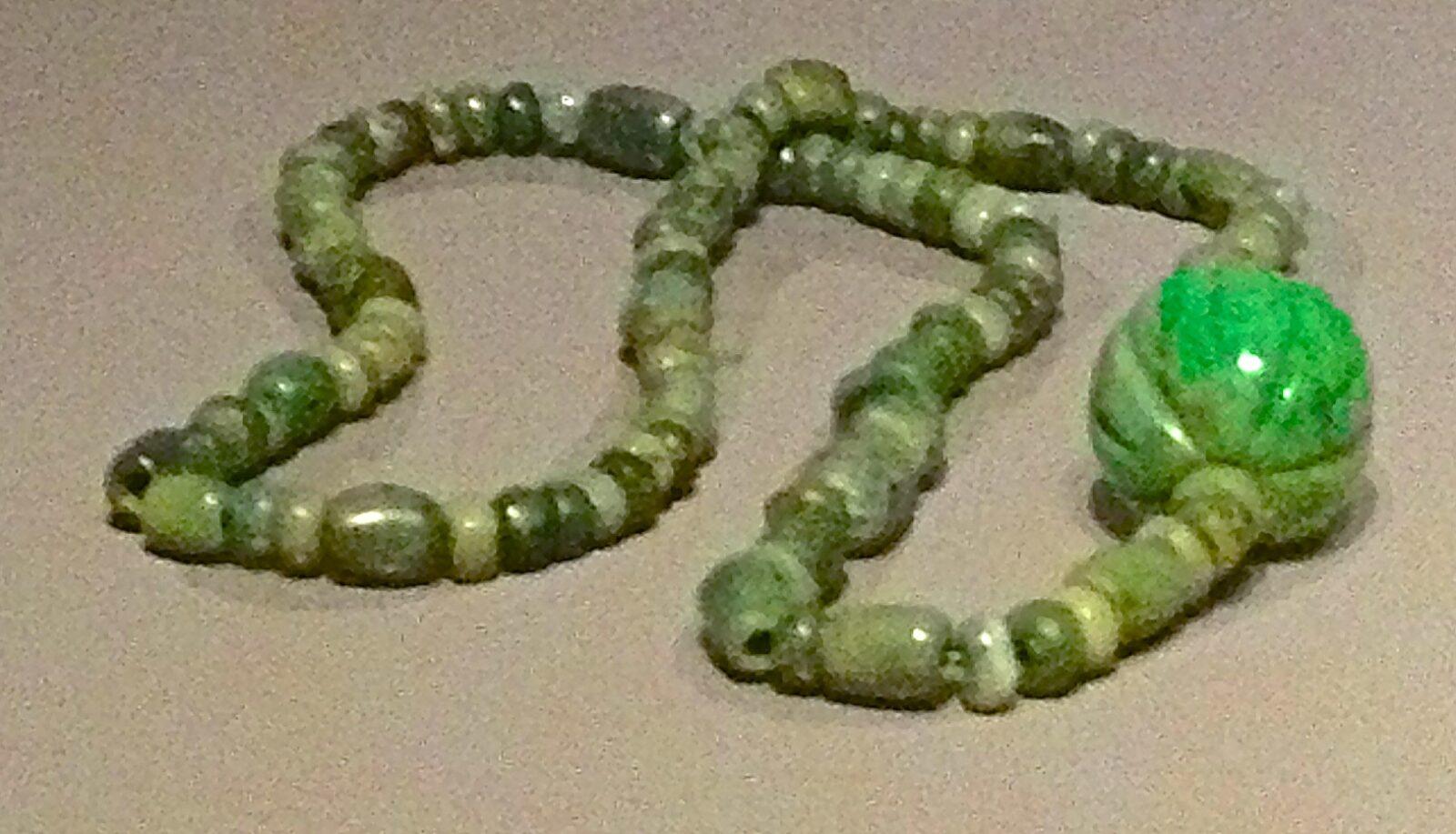

Reserved for the elite and highly valued by the Mayas, jade is a coveted commodity.

Jade necklaces were worn by both women and men.

600-900 BC.
This face is probably that of a dignitary; he wears a double tiara of jade beads, a symbol of authority.

These jade objects are passed down from generation to generation, they are revered and buried ritually because they are the property of the ancestors.


Jade and Coquillage
This bracelet, made of jadeite and seashells, is composed of more than 150 jade beads and nearly 60 spherical and tubular seashells.
Jade beads are very commonly used in pendants, necklaces and bracelets.

Often the name of the object and the name of the owner were engraved on it.

The exhibition “Mayas: Revelations of an Endless Time” allows us, through a thematic journey, to better understand this civilization as “the art of living a magical and brutal life”.

The Mayans were exceptional astrologers and mathematicians, attentive to nature; they knew how to take advantage of their environment; close to their gods, they performed sacrifices to please them.

600-900 BC.
No, the end of the world is not going to happen! The Mayans envision the world as a succession of cycles… not a final ending, but a transformation. Like jade, whose green color symbolized regeneration, subject to cycles of evolution.

Quai Branly Museum from October 7, 2014 to February 8, 2015
Credit Museum of the Quai Branly
My thanks to Laurence Vaugeois, Agence Pierre Laporte.
www.quaibranly.fr