






An exhibition never remains entirely unchanged when it moves from one city to another. Yet it can evolve enough to make a return visit worthwhile. This is the premise behind Bvlgari’s Kaleidos: Colors, Cultures and Crafts. In Shanghai, the exhibition finds a distinctive setting at the Power Station of Art, the first public contemporary art museum in mainland China. By its very nature, the venue places jewelry firmly within the realm of artistic creation, rather than viewing it solely as adornment. Bulgari with Kaleidos Colors, Cultures and Crafts. L’itinérance trouve à Shanghai un terrain singulier au Power Station of Art, premier musée public d’art contemporain de Chine continentale. Un lieu qui, par sa vocation même, place d’emblée la joaillerie du côté de la création plutôt que de la seule parure.
A Grammar of Color, Two Systems of Thought
The exhibition is built around a hypothesis that is simple to state, yet more complex to demonstrate: color does not merely exist; it conveys meaning. To explore this idea, the exhibition brings together Western theories developed by Goethe and Chevreul with the Chinese system of the Five Elements, known as Wu Xing, in which each color is associated with a direction, a season and a natural force. A connection that might have remained theoretical becomes tangible throughout the exhibition, room after room, through pieces selected for their ability to embody this dual perspective.
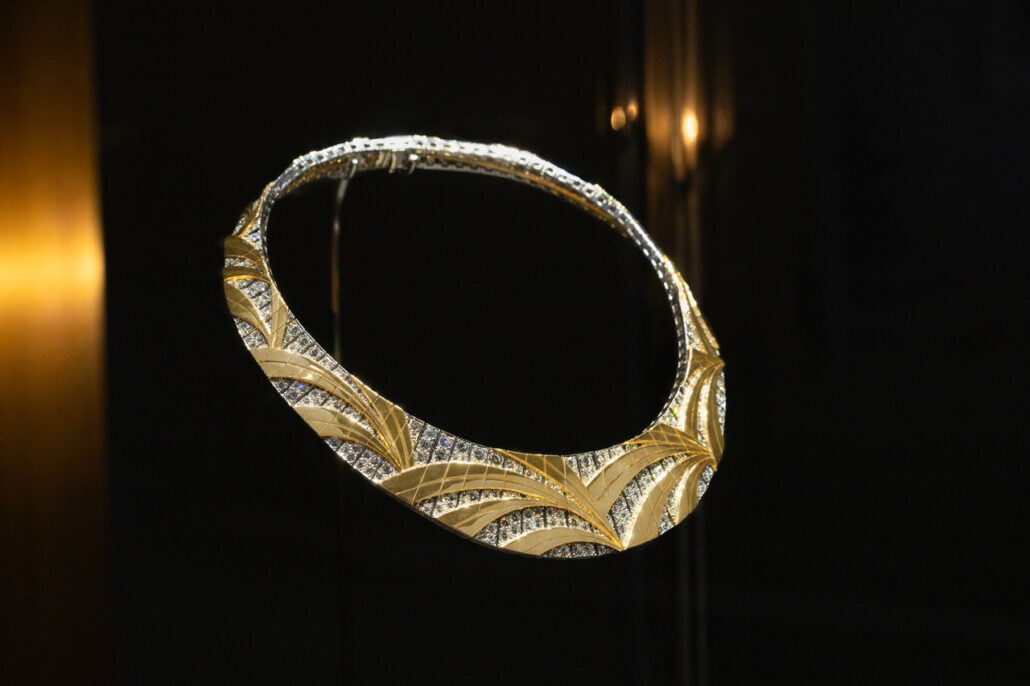
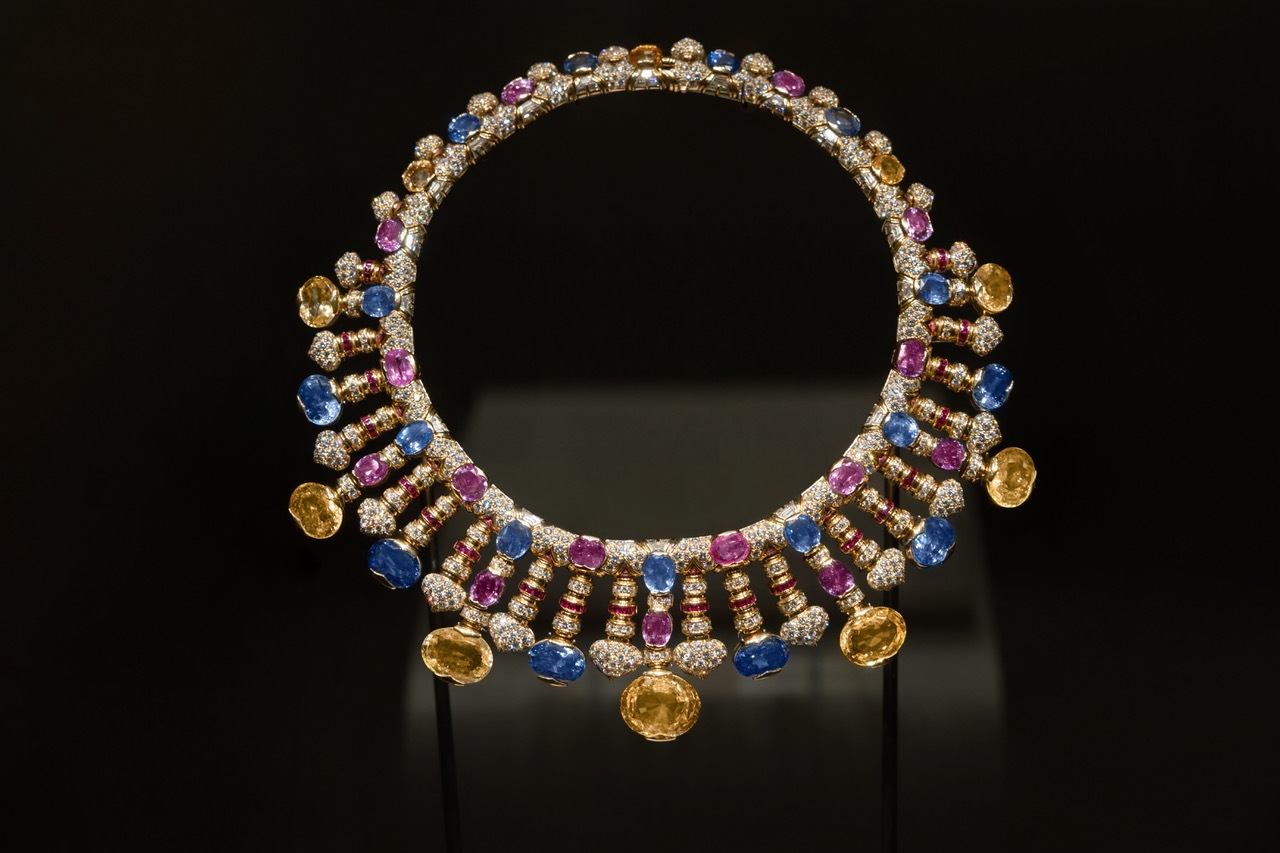
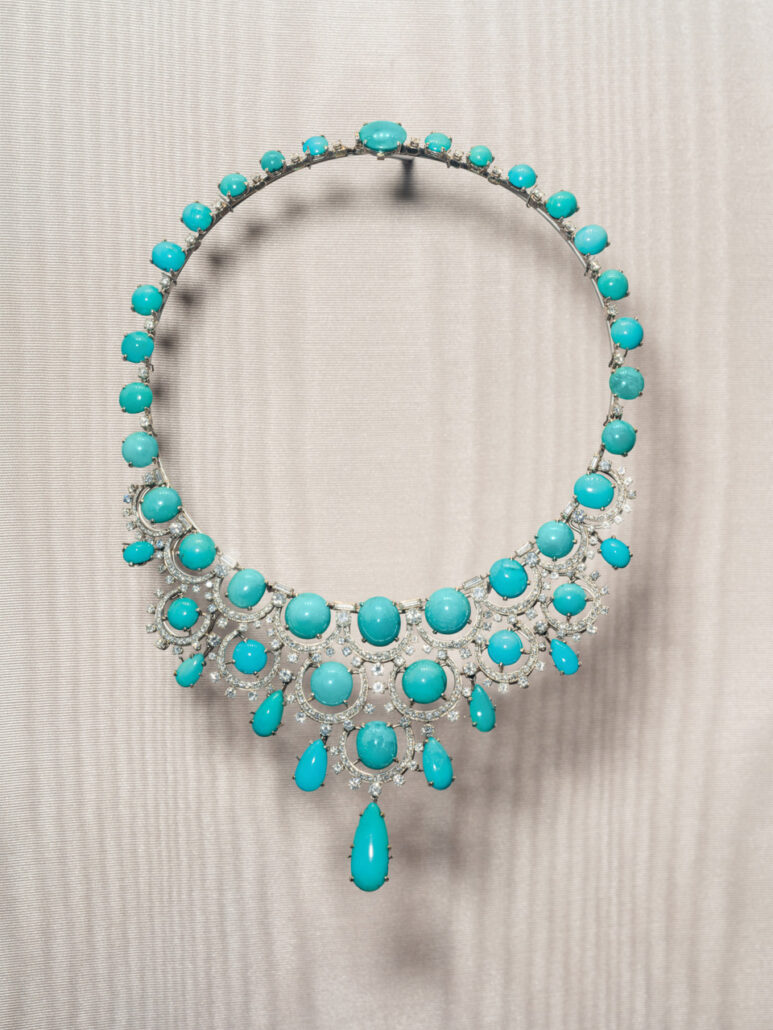
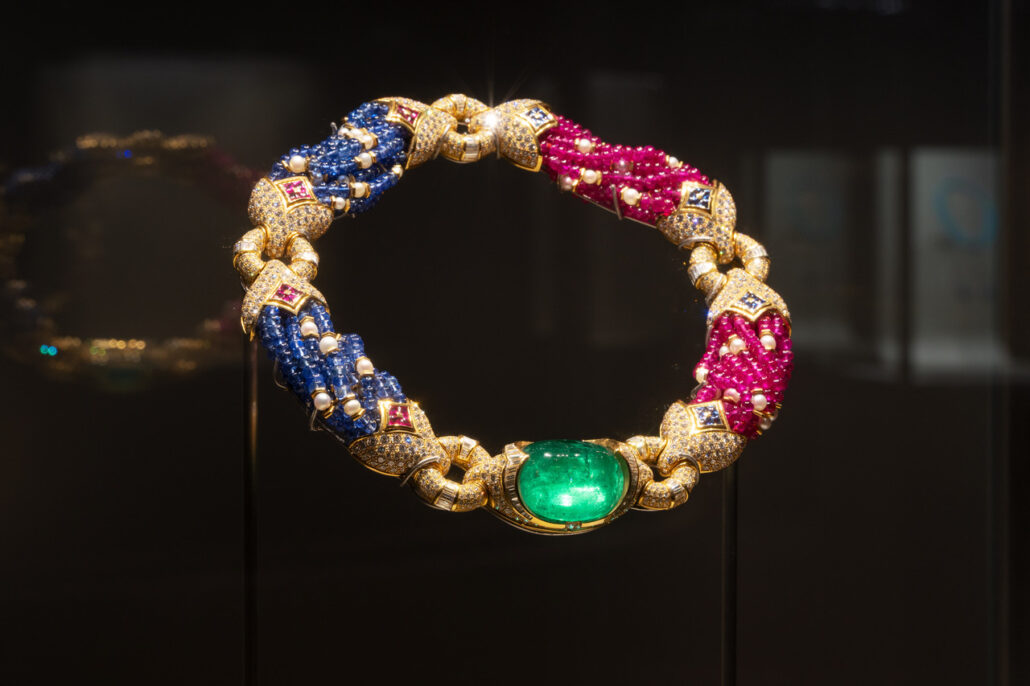
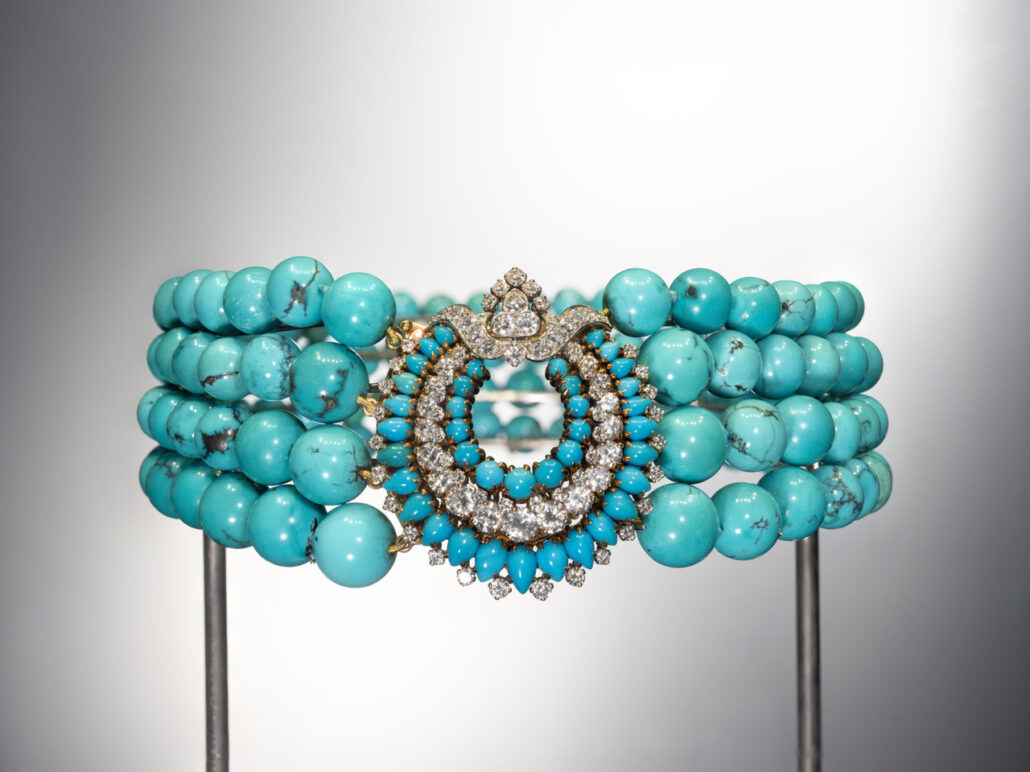
The exhibition unfolds across three chapters. The Science of Colors establishes the perceptual foundations of chromatic theory. Among the works is a 1991 gold necklace adorned with cultured pearls, rubies, sapphires and emeralds, in which primary colors respond to one another without ever cancelling each other out. Another highlight is a gold and platinum necklace set with turquoise and diamonds, created in 1960 around the principle of contrast rather than accumulation.
The second chapter, Color Symbolism, approaches the subject from a cultural perspective. A 1993 gold, ruby and diamond necklace is displayed alongside transformable platinum earrings set with natural pearls and diamonds, dating from 1952. Their pearly nuances suggest purity more than brilliance. A horse-head brooch in gold, onyx, rubies and diamonds, created around 1977, concludes the chapter. Its tension between black and red echoes, in its own way, the Year of the Horse in the Chinese zodiac.
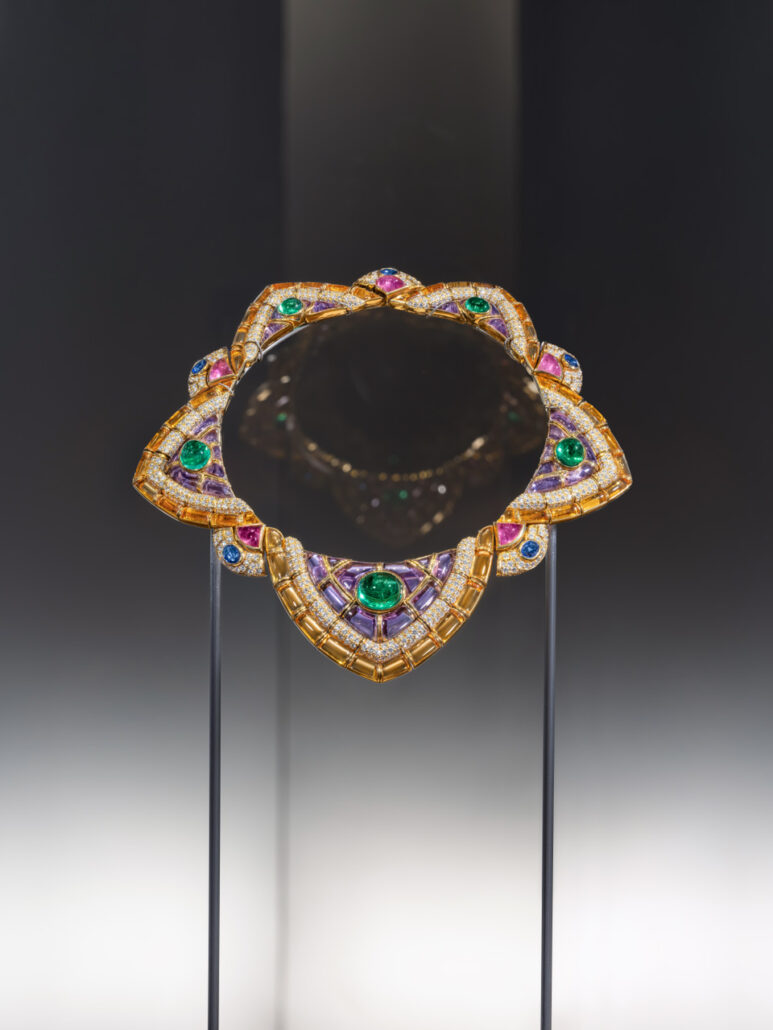
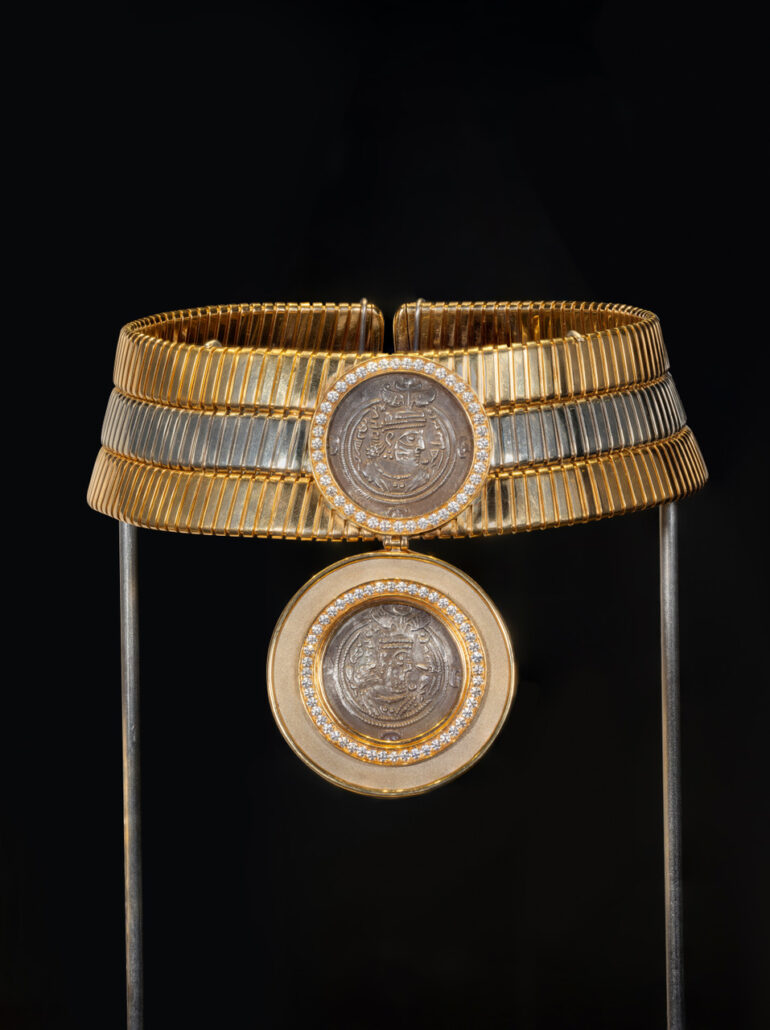
The third chapter, The Power of Light, shifts the focus from color itself to what reveals it. A 1991 gold necklace combining amethysts, citrines, pink tourmalines, sapphires, emeralds and diamonds unfolds like a mosaic of reflections. A Monete Tubogas bracelet in three-color gold, set with a Persian silver coin and diamonds and dating from the 1970s, offers another interpretation of how metal can be made to vibrate through light rather than gemstones.
A Unique Piece Steeped in History
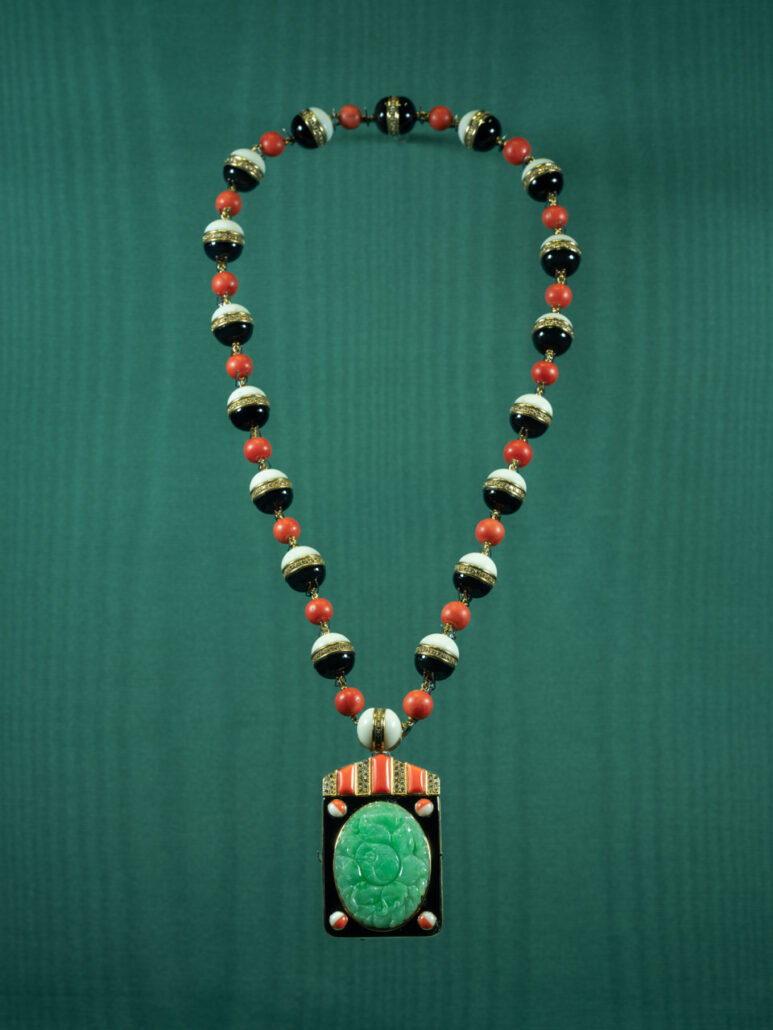
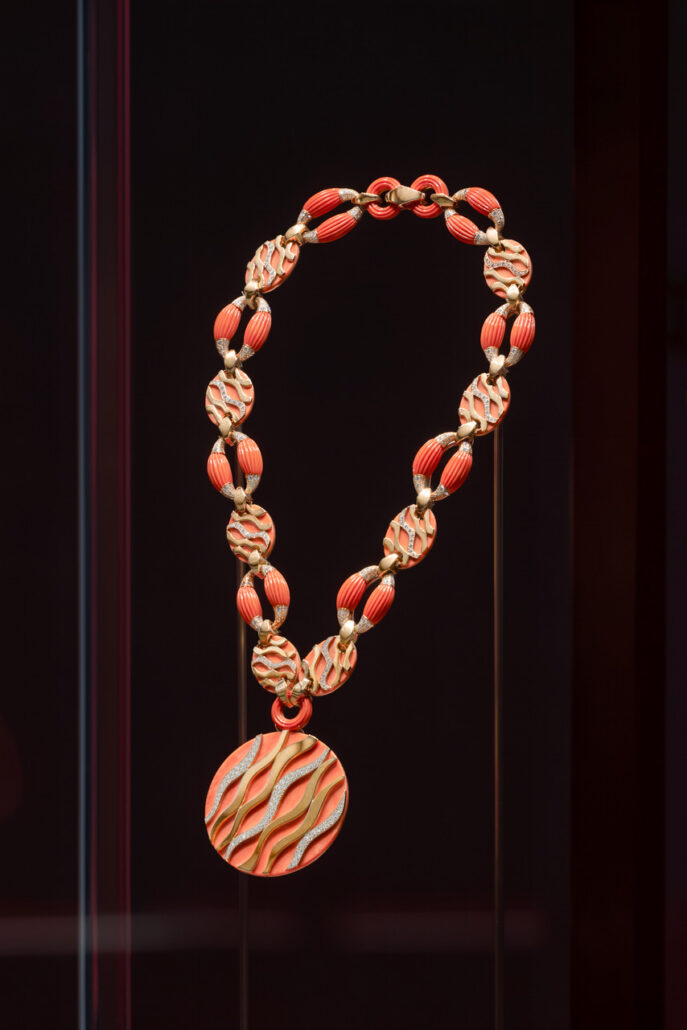
Among the creations presented in Shanghai is a 1973 sautoir from the Bvlgari Heritage collection, shown to the public for the first time. Crafted in gold, coral, onyx and diamonds, it is distinguished by an engraved jade medallion that completes the composition. The choice encapsulates the exhibition’s central theme: a meeting between Bvlgari’s chromatic vocabulary and a material long associated with Chinese artistic tradition. In total, the exhibition brings together more than 300 pieces, including high jewelry creations, works from the Bvlgari Heritage Collection, and loans from private Italian and Chinese collections. Rather than simply juxtaposing objects, the curators seek to place two histories of taste into conversation.
Chinese Contemporary Art as a Counterpoint
The exhibition also stands out for the presence of two installations by Chinese artists. Liang Manqi, a leading figure in geometric abstraction, presents Boundless Synesthesia, a work that extends beyond the traditional confines of the canvas to occupy both walls and floor. Zhang Ding, meanwhile, contributes The Form of Light, an ensemble of golden illuminated panels paired with humanoid glass heads whose surfaces evoke the appearance of precious stone. It offers a meditation on light as both material and metaphor.
The scenography, entrusted to the Japanese agency SANAA in collaboration with the Italian studio Formafantasma, extends this dialogue. Here, space is not simply a setting or a display case, but a third interlocutor, on equal terms with the jewelry and the artworks.
One Stop Among Many, Yet Unlike the Others
Speaking about this new chapter, Bvlgari CEO Laura Burdese emphasized that color is, for the Maison, a language that transcends borders and eras. The Shanghai presentation, she noted, opens this vocabulary to new cultural perspectives. Such a statement might seem familiar were the exhibition itself not so careful to substantiate it, piece by piece, leading to a conclusion that can ultimately be verified with one’s own eyes. For Bvlgari, color is never merely an aesthetic choice. It carries a way of thinking.