


A magnificent cameo enters the Louvre Museum.
First of all, the famous Louvre Museum invites the public to mobilize to enable the acquisition of the Camée Venus and Love. Because it is attributed to one of the greatest sculptors of hard stone of the Italian Renaissance, Giovanni Ambrogio Miseroni.

© Louvre Museum
To begin with, the Milanese family of Miseroni is recognized as the best in the art of glyptography. Indeed, this reputation allows them to present masterpieces to European nobility such as the Medicis and the Habsburgs. It is worth noting that two workshops belonging to the Miseroni family are known. The first is in Milan and the second in Prague, which came into being thanks to the sponsorship of the Habsburgs.

© Louvre Museum, RMN-GP Division, Hervé Lewandowski
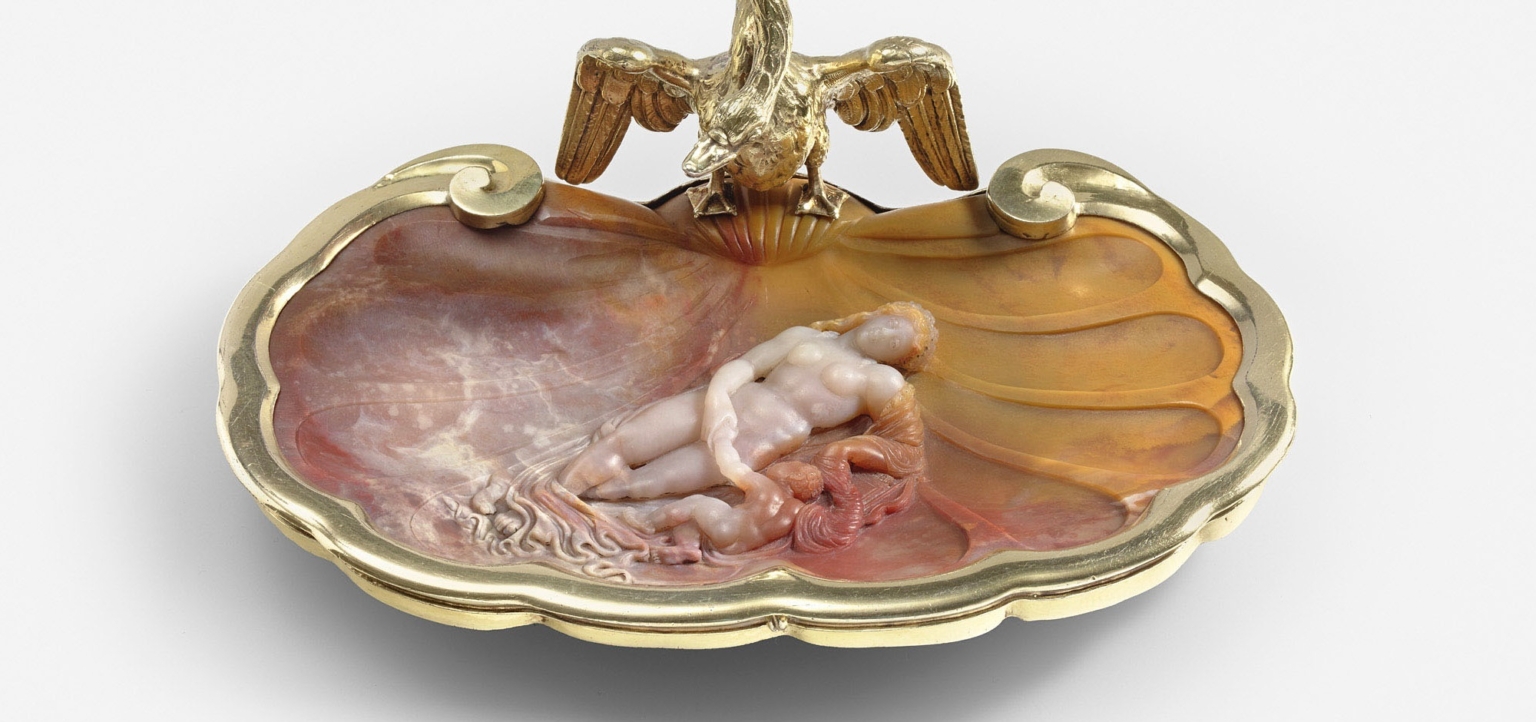
It should be noted that the camée of Venus and Love is the largest cameo known created by the Miseroni family in the early 17th century. Moreover, it is associated with a agate cut in the form of an oval shell described for the first time in the inventory of a famous collector, Cardinal de Mazarin. It then joined the collections of Louis XIV.
Subsequently, during the Revolution, many works belonging to the royal collections were seized, inventoried, and entrusted to the future Louvre Museum.
After that, its presence is no longer mentioned after the Directoire; only the coupe reappears in 1968 during an auction. Finally, it is identified and acquired by the Louvre Museum Thanks to the discreet engraving of the number 376 on the Gemmes de la Couronne. In 2011, the cameo that forms its cover reappears. But the funds collected by the Louvre Museum Unfortunately, they prove insufficient to allow its acquisition.

© Louvre Museum, RMN-GP Division, Hervé Lewandowski
Specifically, the precious camée is carved in the shape of a seashell in agate from the Grisons (Swiss canton).
The fuchsia colors of the stone form irregular spots at the heart of which is a milky, almost mauve body. The diffuse veins of the agate seem to solidify into the opalescent body of the goddess. If the sculptor skillfully uses the yellow layer to represent the blonde hair of Venus, his work reminds us that we already imagine forms in the veins of the agates. This even before the lapidary begins his work. Therefore, the cameo is surrounded by a gold-plated mount adorned with a swan. Moreover, it bears Venus and her son in its center. Love, represented as sleeping opposite each other. Finally, reunited with the true shell that forms its original cup, the cameo completes it as a mirage. As Venus and Love seem to float within it like on an invisible ocean.
Until February 25 the Louvre Museum Therefore, the public is invited to get involved. To thus reassemble one of the most original creations by the sculptor Miseroni by participating in the 12th fundraising campaign All the Meccans!