






Since 1968, four rounded lobes have gradually become a true language of jewelry. Instantly recognizable, the Alhambracollection by Van Cleef & Arpels continues its story today with a material the Maison has worked with since its earliest days: enamel.
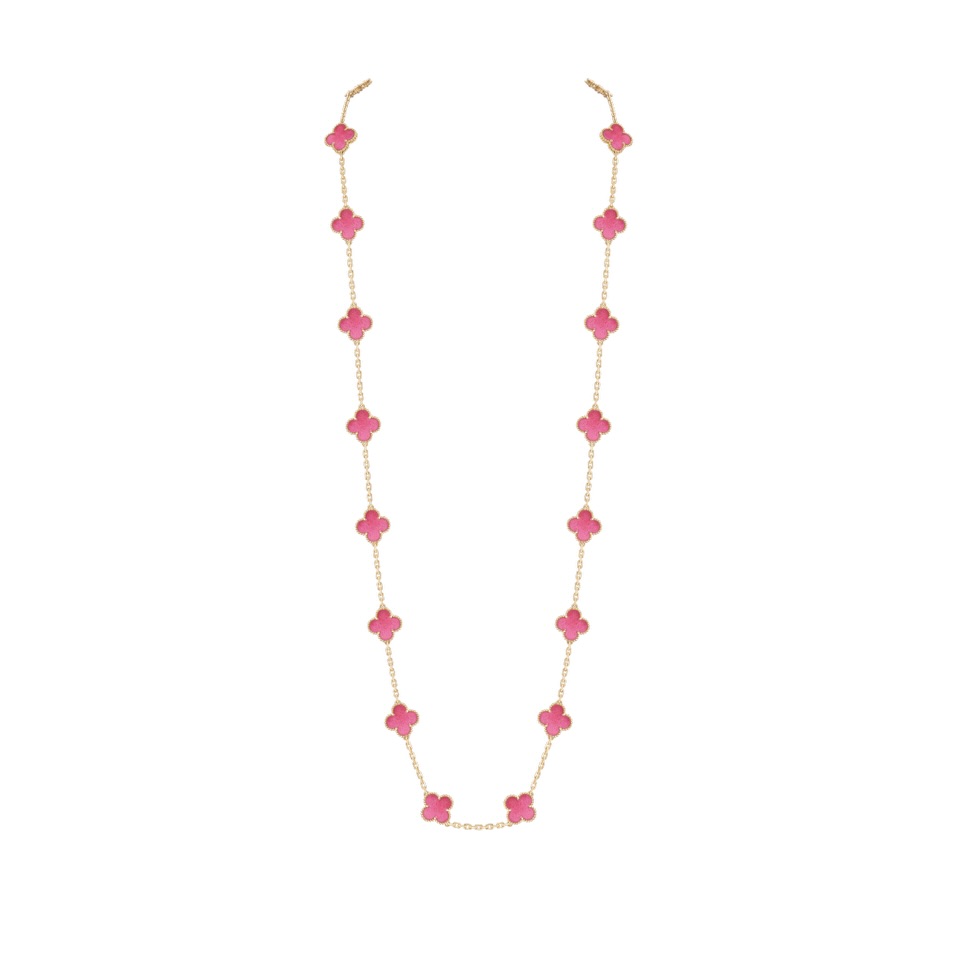
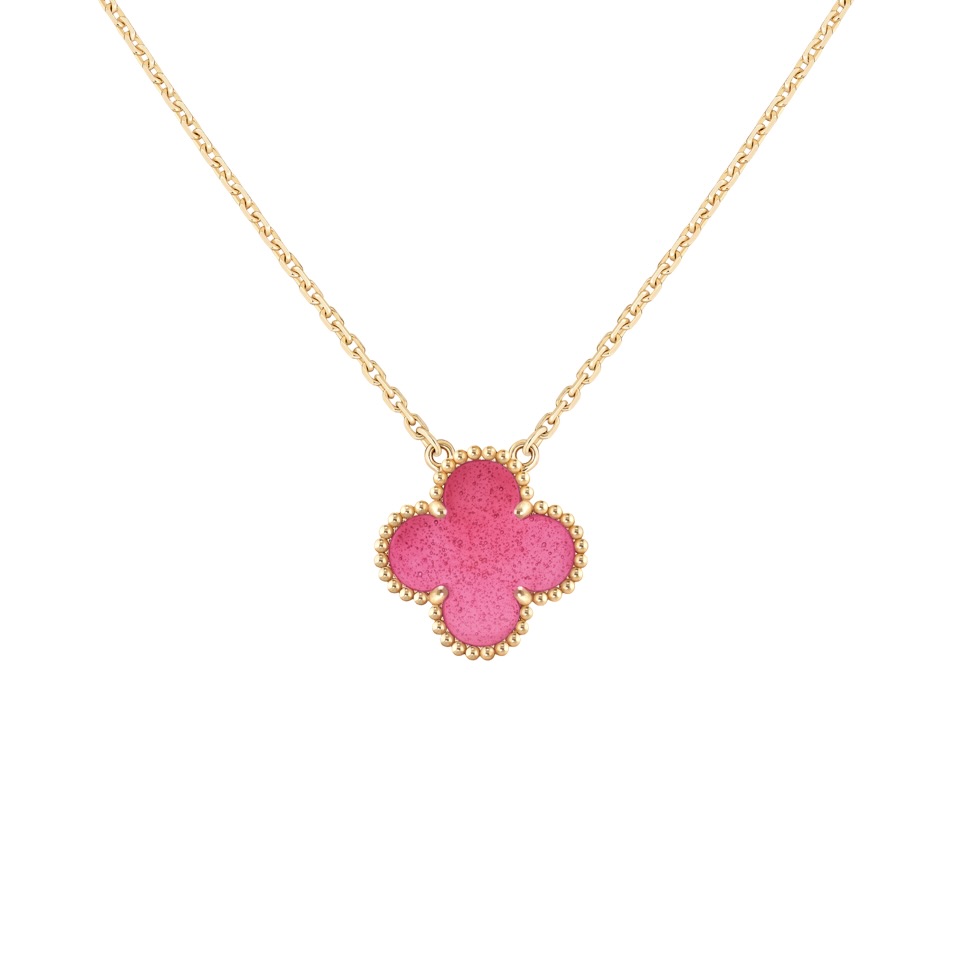
For this new interpretation, the iconic four-leaf clover motif is rendered in a vivid, translucent pink, its surface revealing delicate bubbles within the material. It is a way of turning color into substance and bringing the lucky symbol into a new realm, without altering the qualities that have made it so distinctive.

© Van Cleef & Arpels

© Van Cleef & Arpels
Alhambra, a Silhouette Born in 1968
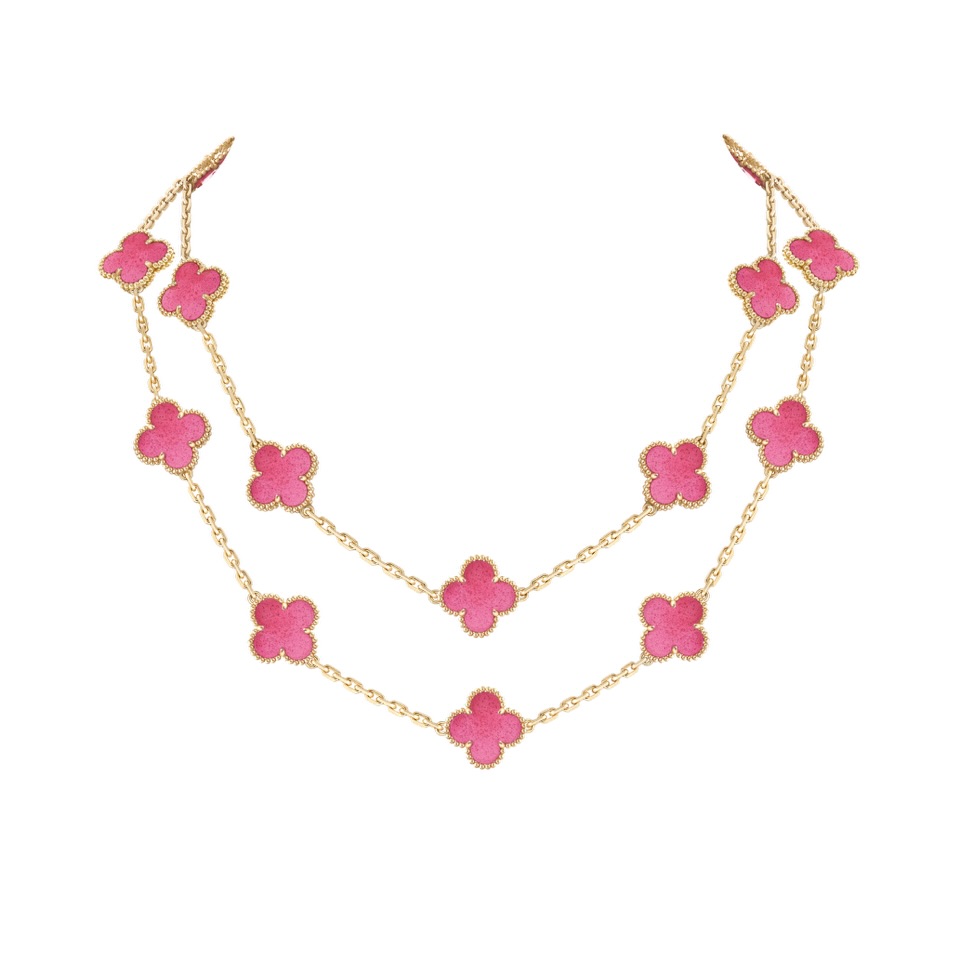
The story of Alhambra begins with a sautoir. In 1968, Van Cleef & Arpels created twenty motifs in textured yellow gold, outlined by a double row of gold beads. Inspired by the four-leaf clover, the design possessed an unusual simplicity within the world of jewelry.
The jewel was supple, easy to wear and conceived to accompany everyday life. This quality would contribute to its destiny. Alhambra was never designed as a fixed emblem: its form could evolve, changing in material, color and proportions while remaining immediately recognizable.
This ability to adapt partly explains the motif’s longevity. Over the decades, yellow, rose and white gold have been paired with mother-of-pearl, onyx, carnelian, diamonds, guilloché gold and Sèvres porcelain. Each combination alters the way the clover is perceived without changing its visual language.
Even before the creation of Alhambra, the four-leaf clover already held a place in the history of the Maison. The archives of Van Cleef & Arpels record its presence as early as 1906, alongside other symbols of good fortune such as ladybugs, charms and certain talismanic jewels.
Jacques Arpels, Estelle Arpels’ nephew, summed up this philosophy in a phrase that has since become famous: “To have luck, you have to believe in luck.”
With Alhambra, that belief takes a form that can be worn.
A Pink Created Through Gold
This new interpretation is not simply about introducing a new color. It is the result of several years of research carried out by the Van Cleef & Arpels enamel workshop.
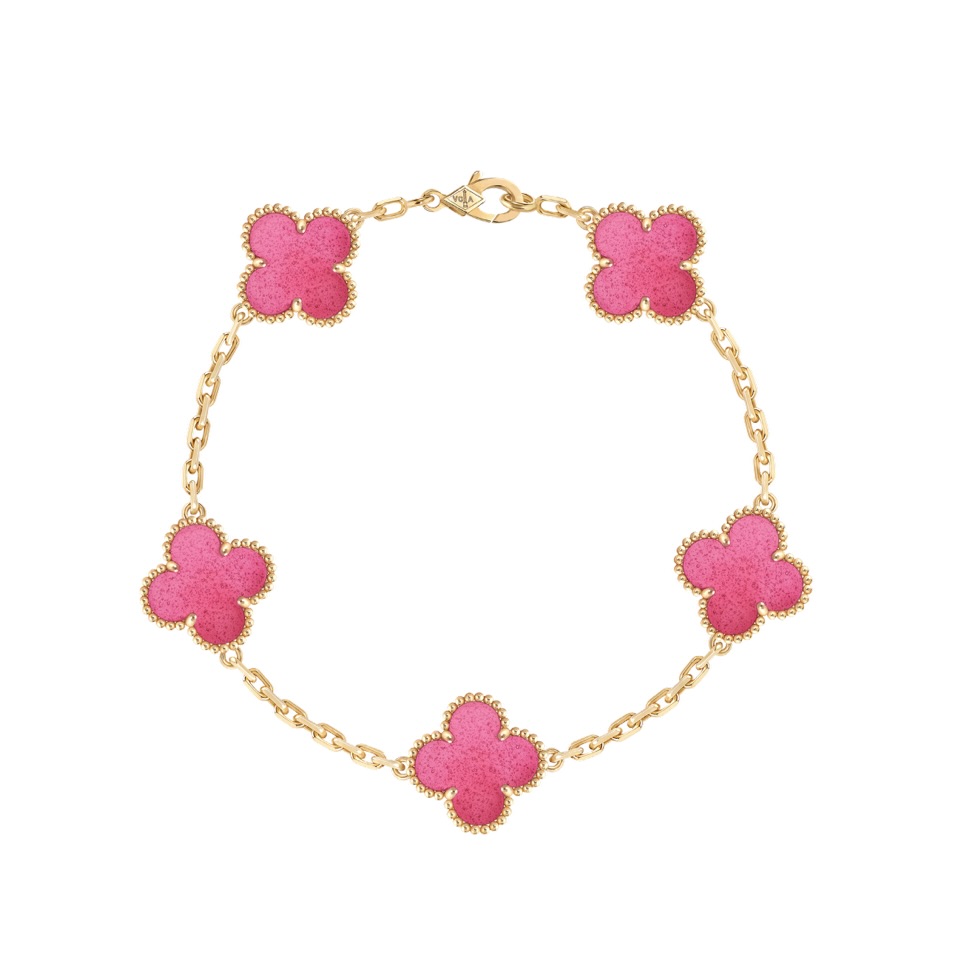
The Maison chose to develop an intense, translucent pink enamel, subtly animated by bubbles, for its Vintage Alhambra and Magic Alhambra motifs. Its particularity lies in the way the color is achieved.
The technique draws inspiration from the historic “gold ruby” process, used as early as the 17th century. Here, the color does not come solely from pigments: it is linked to the presence of gold particles incorporated into the material. Their size, concentration and distribution directly influence the final result.
The challenge, therefore, is less a matter of a simple formula than of achieving an exceptionally precise balance. A variation in the composition can alter the enamel’s tone, transparency or depth.
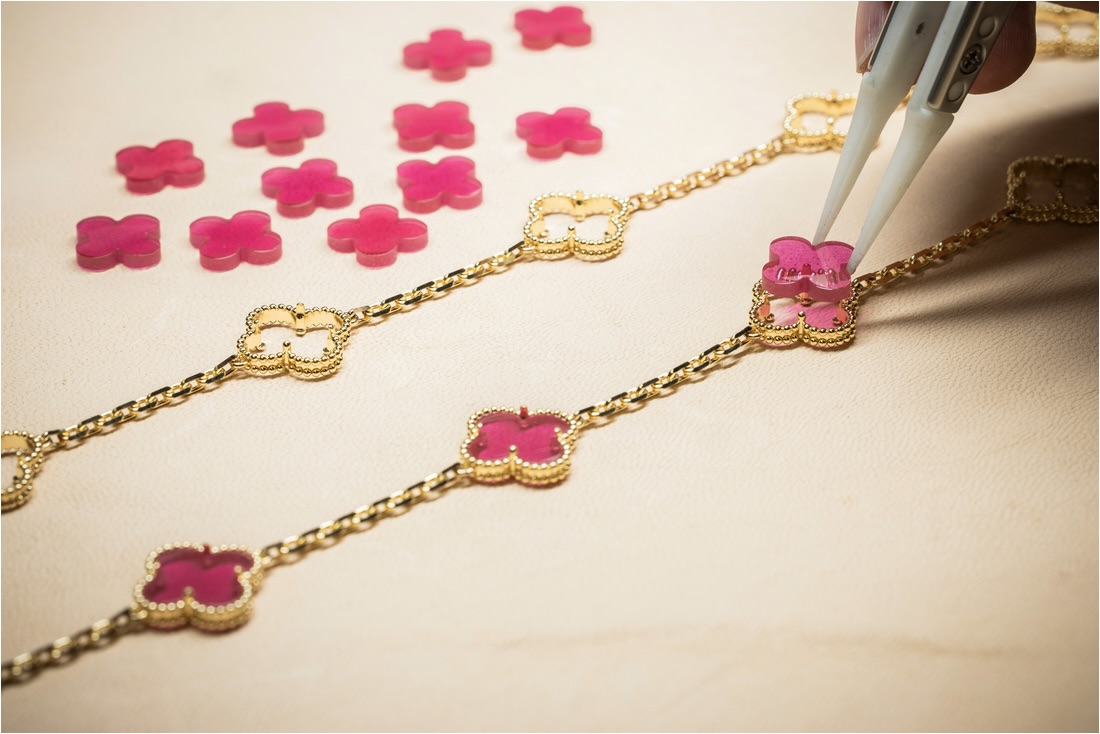
Once worked, the enamel forms a domed surface that follows the contours of the motif. The fine bubbles trapped within the material are more than a visual detail: they contribute to its depth and give each element a subtly different appearance.
Paired with yellow gold, sometimes guilloché, the pink takes on a distinctive presence. The motif appears less drawn than infused with color.
When Métiers d’Art Become Part of Alhambra
This new series is also a story of craftsmanship. Behind the apparent simplicity of the clover lies a succession of gestures, techniques and meticulous controls.
The Van Cleef & Arpels enamel workshop now masters more than fifteen techniques, including miniature painting on enamel, grisaille, plique-à-jour and enamel transfer techniques.
The Maison has also developed an internal training program dedicated to this craft, with a three-year course designed to pass on the skills and knowledge required to practice it.
This commitment to preserving traditional techniques while allowing them to evolve finds a concrete expression here. For Alhambra, the material had to be adapted to the specific shapes of the motifs, particularly their domed volume.
Then come the other jewelry crafts: the making of the setting, polishing, stone-setting and finishing. The fit between the enamel and its gold surround requires considerable precision. The double row of gold beads, characteristic of the Alhambra design, emphasizes the contours while following the reflections across the surface.
On the reverse, the claws are rounded to ensure a softer contact with the skin or clothing. The chain is also meticulously crafted. Its clasp, bearing the Maison’s monogram, discreetly signs the piece.
Enamel, a Story That Goes Beyond Alhambra
Although enamel is now joining Alhambra, it is by no means foreign to the history of Van Cleef & Arpels.
The material has accompanied the Maison since its foundation in 1906. It has appeared on boxes, precious objects, chatelaines, watches and numerous jewels, particularly clips.
Throughout the 20th century, enamel accompanied the Maison’s changing creative sensibilities. In the 1920s and 1930s, its colors contributed to geometric compositions close to the Art Deco aesthetic, as well as figurative scenes and representations inspired by distant cultures.
Later, during the 1950s and 1960s, enamel entered the more everyday world of jewels offered in boutiques. Animals, flowers and familiar figures benefited from its chromatic possibilities.
Plique-à-jour, in particular, made it possible to create transparent petals that played with light like miniature stained-glass windows.
From the 2000s onwards, enamel also became part of the watchmaking universe of Van Cleef & Arpels. The dials of the Maison’s High Jewelry timepieces became spaces where painting, miniature sculpture and jewelry could meet. The Cadrans Extraordinaires collection and certain Lady Arpels watches illustrate this exploration of relief, depth and narrative.

© Van Cleef & Arpels
Alhambra Changes Its Material, Not Its Identity
With this new interpretation, Van Cleef & Arpels continues a principle that has belonged to Alhambra since its creation: evolving a motif without altering its identity.
The clover imagined in 1968 remains instantly recognizable. Yet enamel gives it a different dimension, one that is more tactile and nuanced. The pink is not simply applied to the surface as a uniform color; it is contained within a carefully worked material, animated by transparency and subtle irregularities.
A sautoir, necklace, pendant, bracelet and earrings make up this new ensemble. Through them, Alhambra once again demonstrates how a familiar motif can become a territory for experimentation. After gold, mother-of-pearl, coral, wood, hard stones, guilloché and Sèvres porcelain, enamel writes a new chapter in the history of Alhambra, a story about the possibility of seeing differently a form we thought we already knew.