





The polar dream of Lydia Courteille, White Paradise is a story where nature, spirituality and legend meet.
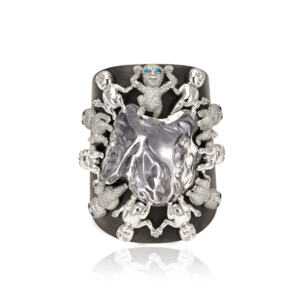
It all starts with a visual shock. In Tucson, Lydia Courteille acquires dendritic white opals. Their surface offers not just a texture, but a mapping: lines, fractures, nuances, as if they were stories to be deciphered. From this material emerges White Paradise, a collection where each piece seems to be ripped from an invisible continent.
The creator first structures her visions. The expanses of the Great North appear, almost evident. The flakes become motifs, the diamonds punctuate the space with precision, while the moonstones diffuse a cold glow, recalling the oscillations of the northern lights. Nothing is fixed: light circulates, slides, transforms.
Then the approach becomes more intense. The influence of indigenous arts introduces a spiritual dimension. A cuff links takes up the symbolism of a passage to the sky, a space of knowledge and transformation. Inside a jewel, a hidden detail reveals a masked shaman, a figure mediating between the worlds. The object then becomes almost ritualistic.
The register changes again with the Arctic fauna. Here, elegance gives way to restrained tension. The animals blend into their surroundings, adopting whiteness as a strategy. Some pieces evoke the latent violence of this universe: the contrasts of colors convey the confrontations, the traces left on the snow. Conversely, a whale adorned with gray diamonds imposes a calm presence, traversing an ocean frozen in opalescence.
The music is subtly present. A tribute to Montreal and its winter lights inspires a ring where the nuances seem to settle like notes. Finally, the imagination shifts towards the Nordic sagas. Mythical figures, fantastic creatures, stories of conquest and shadow fuel the final pieces.
In White Paradise, Lydia Courteille It does not seek to illustrate a real territory; it offers a moving interpretation, where the jewel becomes both a scene, an actor and a memory.