






At Chez Piaget, Gold has never been just a material; it is a vocabulary, a gesture, almost a discipline. With Piaget Glow, The Maison returns to what shaped its uniqueness: this way of treating precious metal not as a fixed surface, but as a territory of relief, light, and movement.
This new capsule is part of the legacy of the House of Gold, The term itself sums up the history of a house that has made jewelry a field of experimentation as essential as its watchmaking expertise. Since the 1950s, Piaget has explored texture as others work with stone or color. Engravings, satin finishes, engravings, brushed effects: each finish becomes a work of art.
With three sculptural rings, Piaget Glow It extends this dialogue between craftsmanship and everyday use. Here, jewelry abandons the idea of ceremonial adornment to invest the ordinary gesture, the hand in motion, and the proximity of the body.
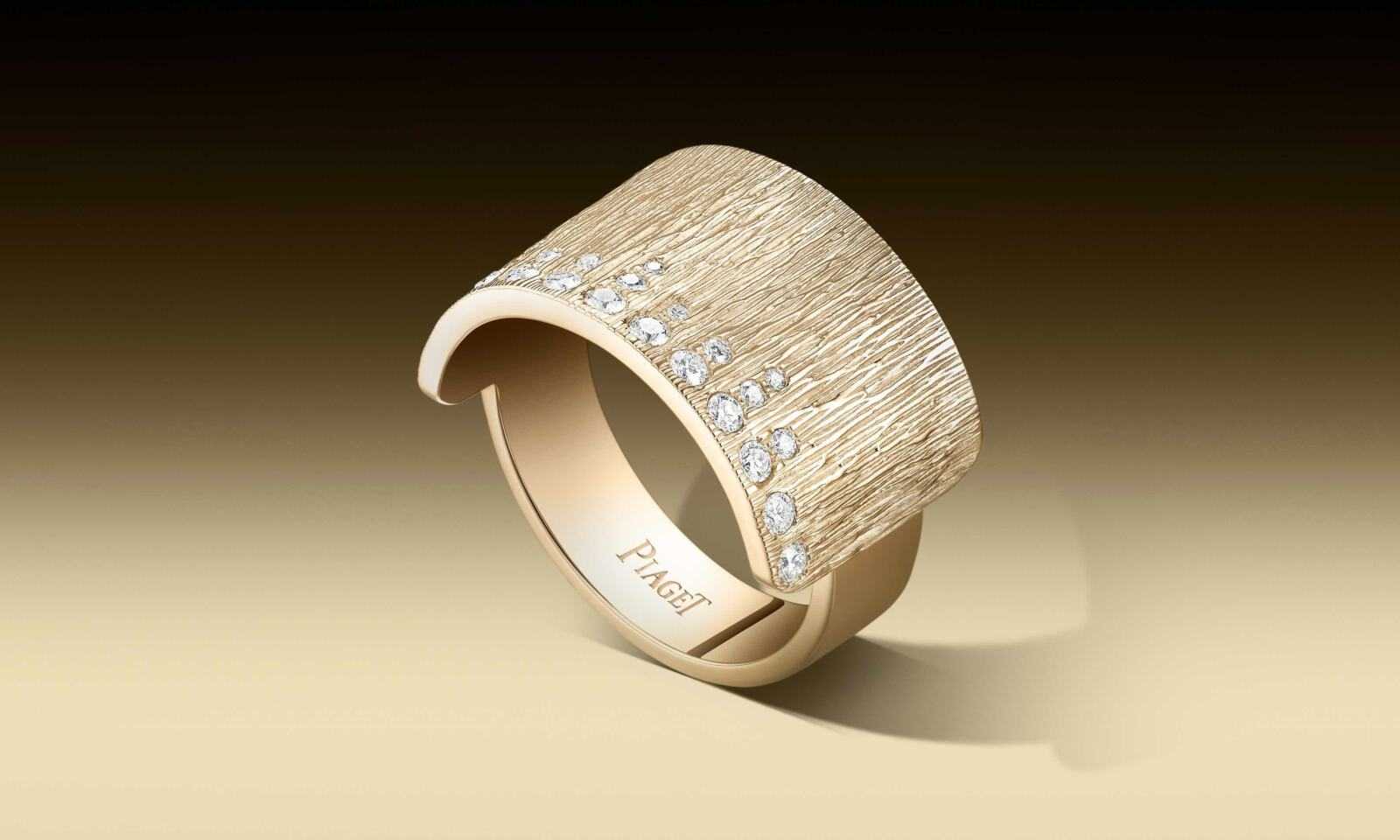
The first creation, in rose gold set with diamonds, echoes the famous Decor Palace, This emblematic engraving developed by the Maison in the 1960s. The striations capture the light with flexibility, giving the metal an almost organic vibration.
The second, in yellow gold, introduces a more instinctive texture play. Its pattern evokes an irregular, almost living rhythm that the diamonds punctuate with restraint.
Finally, the white gold ring adopts a more fluid construction. Its wavy and asymmetrical lines welcome scattered stones, suspended in a composition of light.
Through this trilogy, Piaget Do not seek to reinterpret its heritage in a literal way. The Maison instead pursues an ancient reflection: that of a jewel conceived as a second skin, where the material blends with movement and affirms a form of freedom. Piaget Glow reminds us that, in Piaget, Light often originates from the texture before coming from the diamond.