





Discovered in the Orapa mine in Botswana, the Okavango Blue is one of the most important natural blue diamonds ever discovered. It was entrusted to House Messika, This 20.46 carat diamond becomes the centerpiece of a Haute Joaillerie creation imagined by Valérie Messika.

Messika – Corporate – Savoir Faire 2026 – Okavango Blue – Rough Diamond © Messika
Some diamonds contain far more than just light. They tell the story of the Earth’s depths, geological time, and the territories from which they came. The’Okavango Blue belongs to this rare category.
Discovered in 2018 in the Orapa mine in Botswana, this natural blue diamond had a rough weight of 40.11 carats. After several stages of sizing and processing, the stone now reveals a diamond of 20.46 carats. Rated VVS1, with a deep color distinguished by blue nuances crossed with gray reflections. Considered the largest blue diamond discovered in Botswana and among the most important blue stones ever found in the world.’Okavango Blue' has become a symbol of the country's natural heritage.
The Okavango Blue, a natural treasure of Botswana
Formed billions of years ago, the diamond was mined from the Orapa mine, one of Botswana’s major diamond sites. Its color, rarely observed in a stone of this size. It is a dense, nuanced blue, evoking the Australian landscapes where light, water, and earth seem to merge. For the Government of Botswana, the Okavango Blue It represents much more than a gemological discovery. It embodies a national history and a natural heritage destined to radiate beyond the borders of the country. The stone has thus been entrusted to the House Messika so that Valérie Messika, founder and artistic director of the House, can give it a new expression through a creation of Haute Joaillerie.
A Haute Joaillerie creation signed by Valérie Messika
This collaboration marks a particular milestone in the history of the French House. It brings together Botswana, a major territory in the diamond industry. And Messika, whose creative identity was built around a contemporary vision of the diamond.
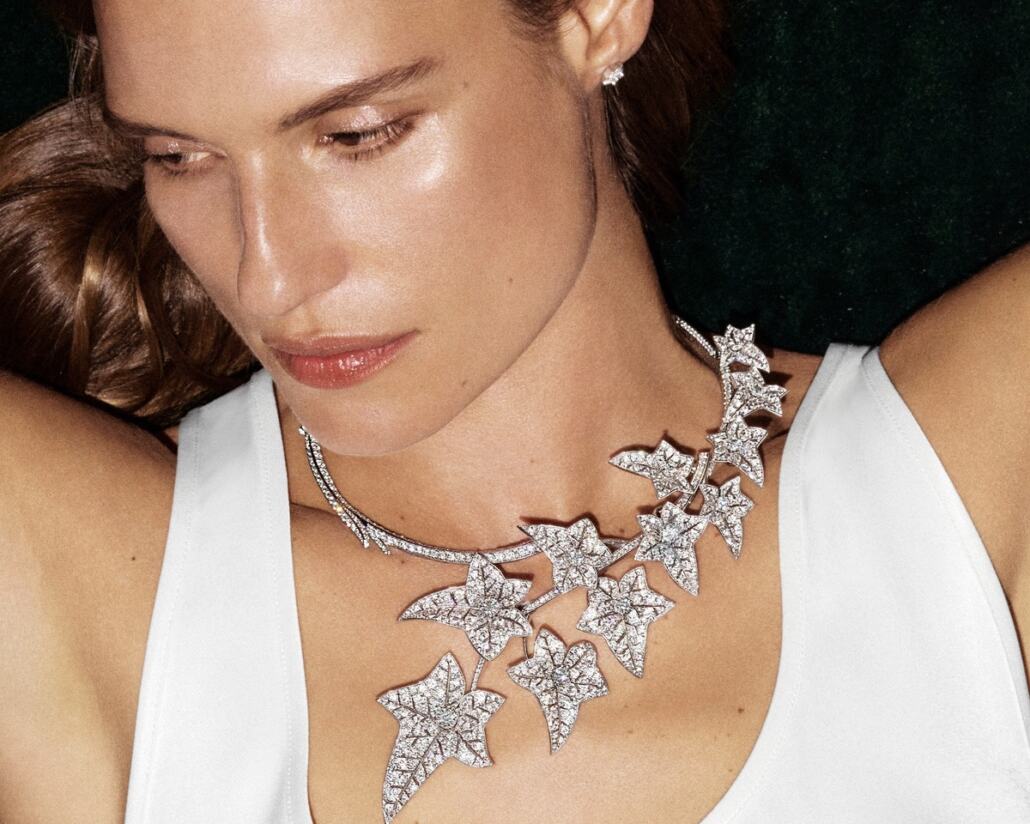
With a diamond of this nature, the challenge was not to add a decorative element. But to create a setting that allowed the stone to express itself. Valérie Messika imagined a necklace where every line leads the eye towards the Okavango Blue. The creation combines two historical codes of Haute Joaillerie: the medallion and the river of diamonds.
More than 500 diamonds in a supple and contemporary river
In the center, the blue diamond takes up space in an oval medallion inspired by the shape of the daisy. An emblematic motif of 18th-century jewelry. The stone is slightly elevated and offset to multiply the perspectives and reveal the variations in its color. Around it, a gradient of white diamonds creates a luminous halo. The volume complements the stone without detracting from its attention. The composition is based on a search for balance between jewelry heritage and contemporary writing.
Nearly thirty versions of the medallion were needed to define the proportions, movement, and flow of the light. The medallion extends through a river composed of more than 500 diamonds. Created in the Parisian workshops of the Maison, it relies on an exclusive enamel system that gives the gold a flexibility similar to that of a textile. The necklace accompanies the curves of the body and follows the movements with fluidity. This construction transforms the traditional river into a more free piece, designed for both wear and light. An oval diamond ensures the connection between the medallion and the river. This detail creates a visual continuity and brings a sense of lightness to the whole.
Messika and Botswana: a meeting between heritage and creation.
Thus, The Okavango Blue It brings two temporalities into dialogue. The one of the Earth, which has shaped the stone for billions of years, and the one of the jewelry creation, born from the drawing and the work of the workshops. Through this piece, Messika does not seek to transform the identity of the diamond. The House builds a language of light and movement around it, in which the stone retains all its presence.
From the Orapa mine to the Parisian workshops, the Okavango Blue It crosses over territories and knowledge. It becomes the meeting point between the history of Botswana, the diamond expertise, and the contemporary vision of Valérie Messika.
With the Okavango Blue, the House Messika signifies a creation where Haute Joaillerie puts itself at the service of a stone shaped by time, a blue diamond whose history begins long before the jewel.