



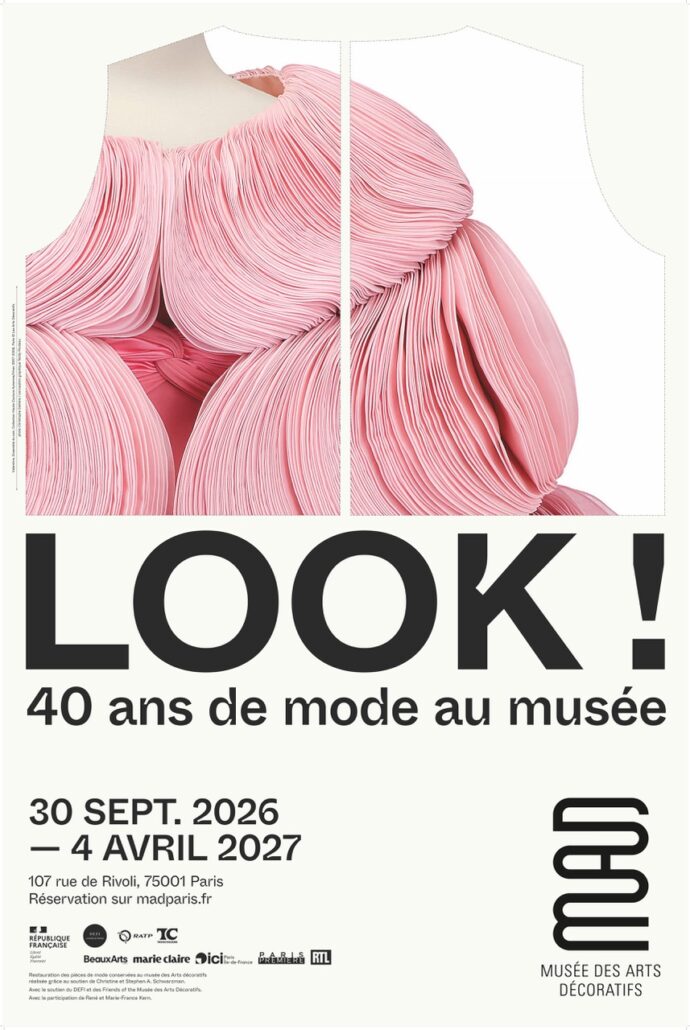
A dress displayed behind glass first existed as a sketch, a pattern, or a toile fitted on a mannequin, before becoming a collection piece. Look ! traces this journey, from the couture atelier to the museum’s storage rooms at 107 rue de Rivoli. The exhibition marks the anniversary of a decision made in 1986: to establish a museum dedicated to the decorative arts of fashion within the Louvre complex.
A Wardrobe Across the Centuries
The exhibition is built around a simple idea: a garment lives twice. First in the atelier and on the runway; then, once it enters the national collections, as a historical object.
The exhibition brings together 57 silhouettes, drawings, embroideries, patterns, archives and photographs.
Its chronological journey stretches from an eighteenth-century pannier dress to a kimono by John Galliano.
Its chronological journey stretches from an eighteenth-century pannier dress to a kimono by John Galliano.
Between these two milestones, a succession of different approaches unfolds: a Jean Dessès organdy strapless dress dating from around 1950–1955; an embroidered Chanel dress by Karl Lagerfeld from the Spring-Summer 1996 Haute Couture collection; Schiaparelli’s painted taffeta flowers by Daniel Roseberry, Autumn-Winter 2021–2022; and the dress worn by Mireille Darc in The Tall Blond Man with One Black Shoe. The nave brings together 40 silhouettes by Maison Margiela, Maison Balenciaga, Christian Lacroix, Valentino and Azzedine Alaïa. Each refers to a landmark exhibition held by the museum, among the nearly 80 exhibitions devoted to fashion since 1986.
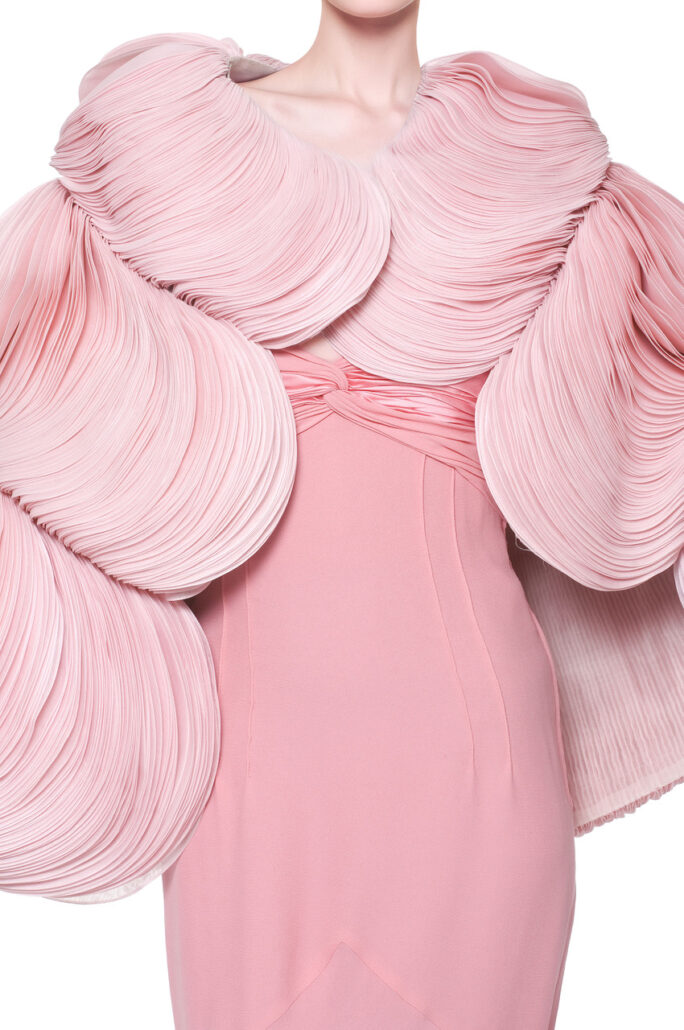
Cape robe en organza de soie, crêpeline de soie, crêpe de soie et satin de soie
Paris, haute couture
Automne-hiver 2007-2008
© Les Arts Décoratifs /
Jean Tholance
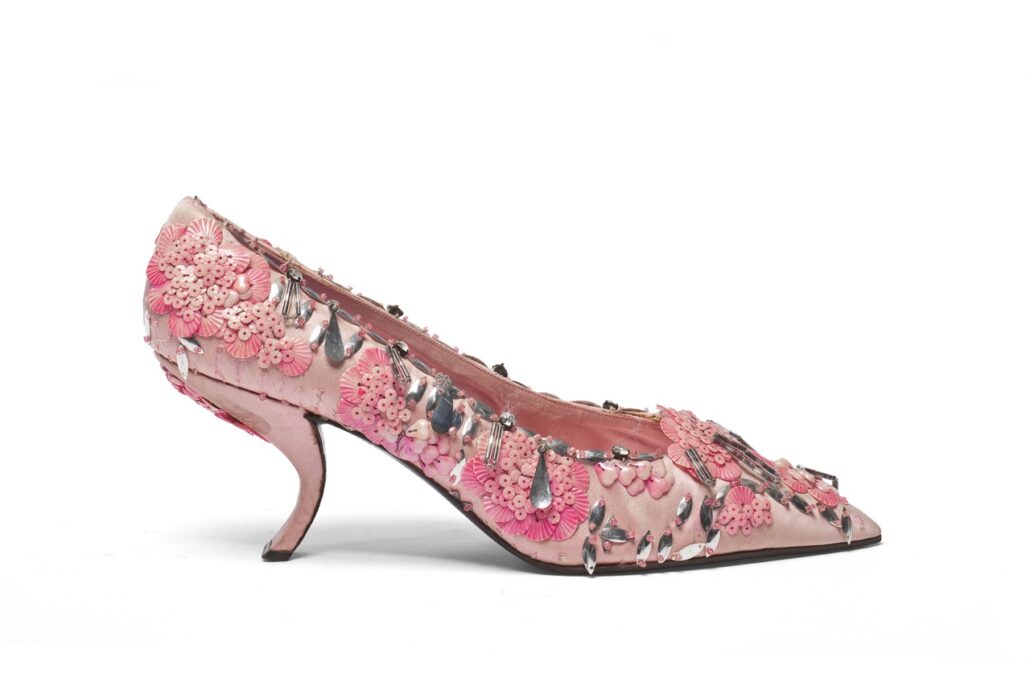
Escarpin en satin brodé
de paillettes et perles
1963
© Les Arts Décoratifs /
Jean Tholance
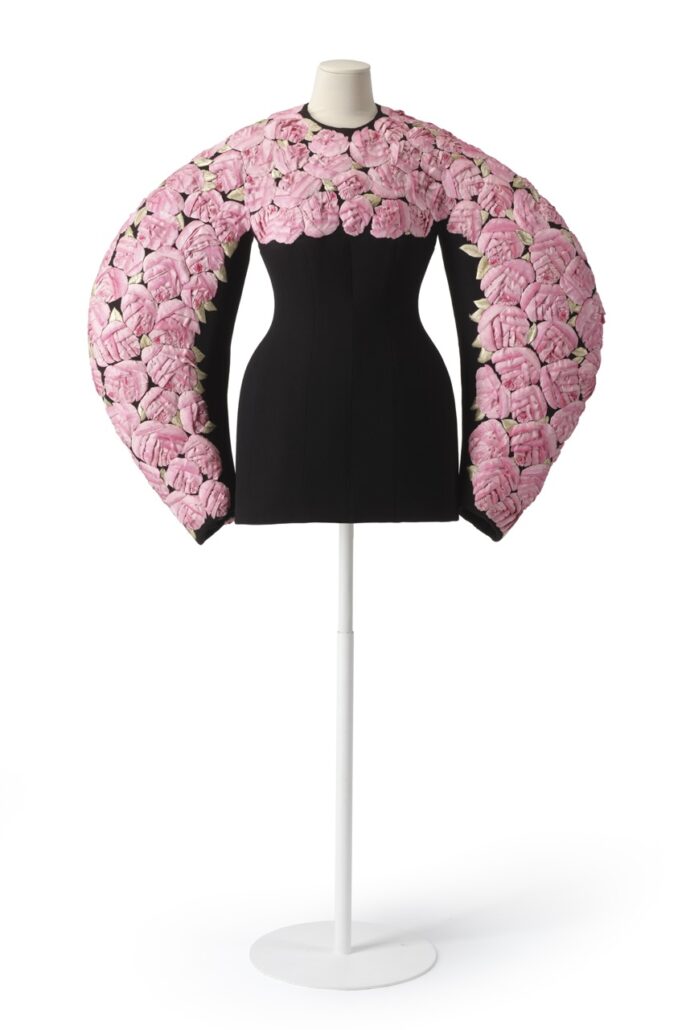
par Daniel Roseberry —
Robe courte en crêpe
de laine et satin duchesse,
fleurs en taffetas peint
et brodé
Collection Matador couture
Paris, haute couture
automne‑hiver 2021-2022
© Les Arts Décoratifs /
Christophe Dellière
From the Atelier to the Image
The first gallery, on the Tuileries side, takes visitors into the making of a garment. Trestle tables, toiles, patterns and moodboards reveal contrasting creative methods. Pierre Balmain sketches, Madeleine Vionnet drapes directly on the mannequin, while Maria Grazia Chiuri brings together visual references.
The decorative arts and craft techniques are given a place of their own. Embroidery by Rébé and Lesage, pleating by Maison Lognon, printed textiles by Brossin de Méré, are presented alongside more contemporary techniques such as 3D printing. Two Roger Vivier pumps, embroidered with beads and sequins in 1963 and 1968, convey the precision of this craftsmanship. For anyone familiar with jewellery, these samples speak a familiar language. Goldwork embroidery, passementerie and beads applied one by one demand the same exacting standards as a setting or a mount. The regularity of the hand, and the ability of a material to withstand the passage of time, are essential to both disciplines. Fashion photographs, some of them taken inside the museum’s galleries, bring this first section to a close.
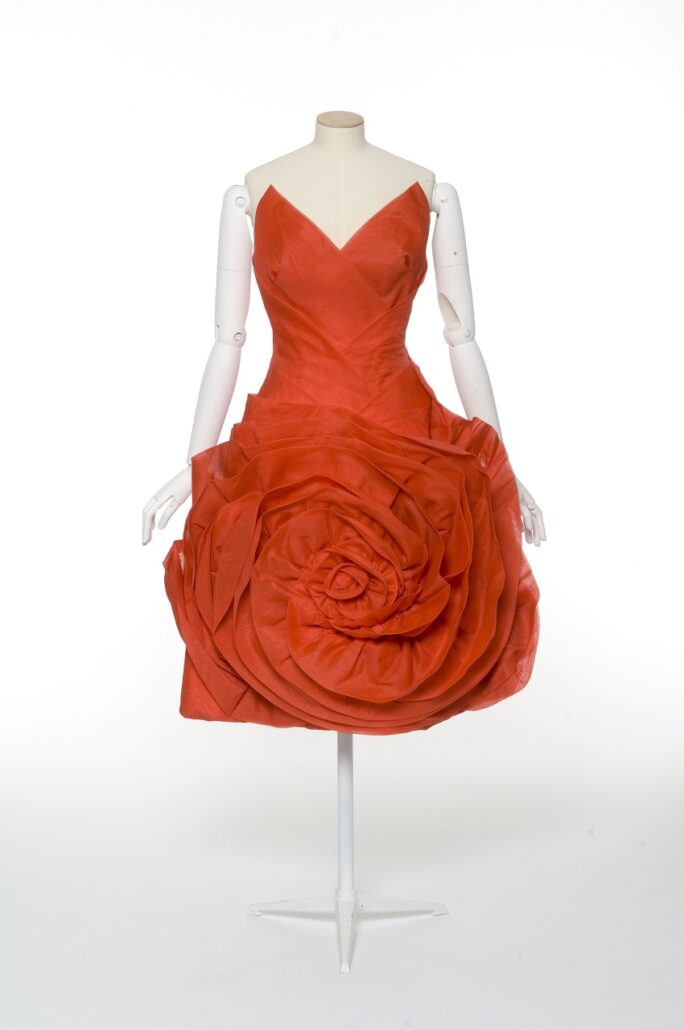
Robe bustier en organdi
de soie
Paris, haute couture
Vers 1950-1955
© Les Arts Décoratifs /
Jean Tholance
On the Rivoli Side: The Life of Dresses After the Runway
The second gallery, arranged in alcoves, opens the doors to the behind-the-scenes world normally hidden from the public. It explains how these works enter the museum’s collections, through donations and patronage, as well as through the Union française des arts du costume, whose collections provided the foundation for the Musée des Arts de la Mode. The work of the museum’s documentation specialists is particularly striking. It emerges through acquisition files, runway invitations and press clippings, as well as through folders of records in which every piece is given its own identity.
Then comes the storage area. Dresses rest flat inside boxes or hang from padded, specially shaped hangers known as “morphological” hangers, designed to follow the contours of the silhouette. Accessories have their own system of storage. Roger Vivier’s collection of pumps and ballet flats illustrates the careful organisation required for a family of delicate objects, protected and reunited pair by pair. Those who work with antique pieces will recognise a principle at the heart of their own profession: without rigorous documentation and appropriate conservation conditions, an object loses part of its historical value. These storage rooms have also become a source of inspiration for designers, with Dries Van Noten among them.
The conservation workshops combine meticulous craftsmanship with scientific analysis, including radiography. Mannequin preparation, an often overlooked stage of any exhibition, consists of restoring the garment’s shape without compromising its integrity. A bare mannequin on display reveals the sculpting and modelling work required to achieve this. The final room brings together posters and catalogues, highlighting the role of graphic design in shaping the identity of these exhibitions.