







Jewellery and Armenian Goldsmiths under the Ottomans, memory and splendour of the Armenian jewel under the Ottoman Empire.
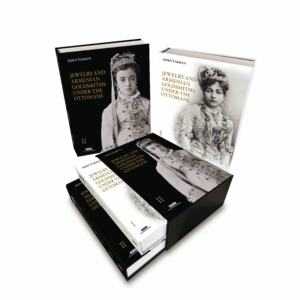
In the workshops of the past, where metal was shaped by hand and by memory, a narrative was drawn that time had fragmented without ever erasing it. Jewelry and Armenian Goldsmiths Under the Ottomans, Arsen Yarman restores this scattered texture and gives it its continuity, just as one reassembles an ancient motif from scattered fragments.
The work does not merely present valuable pieces; it reveals their lineages, gestures, and signatures. Through nearly two millennia of artisan names, recorded since the 18th century, a human map of Armenian craftsmanship unfolds. Scrolls, archives, drawings, and photographs interact to bring to life a world where each jewel becomes a trace, each detail an imprint.
Presented in two volumes assembled in a box designed to last, the collection immediately asserts its purpose: to transmit as much as to preserve. The hundreds of documents unearthed, the precise drawings, the carefully selected images do not constitute a simple illustrative device; they form a living material, a reconstructed archive, where the eye moves as much as the mind lingers.
This work is part of a broader perspective: that of a history of Ottoman jewelry, considered through the artisans who were its discreet artisans. From the 16th to the 20th century, Armenian goldsmiths shaped liturgical objects, watches, ornate weapons, and ornaments and insignia, inscribing their practice at the intersection of commerce, ritual, and power. Their trajectory traversed the major centers of exchange, embraced political changes, and left behind works whose finesse is matched only by their symbolic density.
As the pages are turned, the precious object ceases to be just a decorative object. It becomes the repository of a collective memory, a witness to a cultural continuity forged through necessity and adaptation. The investigation conducted here, based on rare manuscripts, official decrees, and personal markings, reconstructs a long-dispersed history, sometimes buried, now made readable.
This book is aimed at both jewelry professionals and art enthusiasts, historians and collectors alike. It provides a solid foundation for anyone seeking to understand the scope of an art form that, beyond its aesthetic dimension, engages a vision of the world.
And perhaps that is its true significance: to remind us that behind the brilliance of the stones and the precision of the lines lies a story of men, of transmission and persistence, a story that Arsen Yarman opens here as one opens a door that has long remained closed.
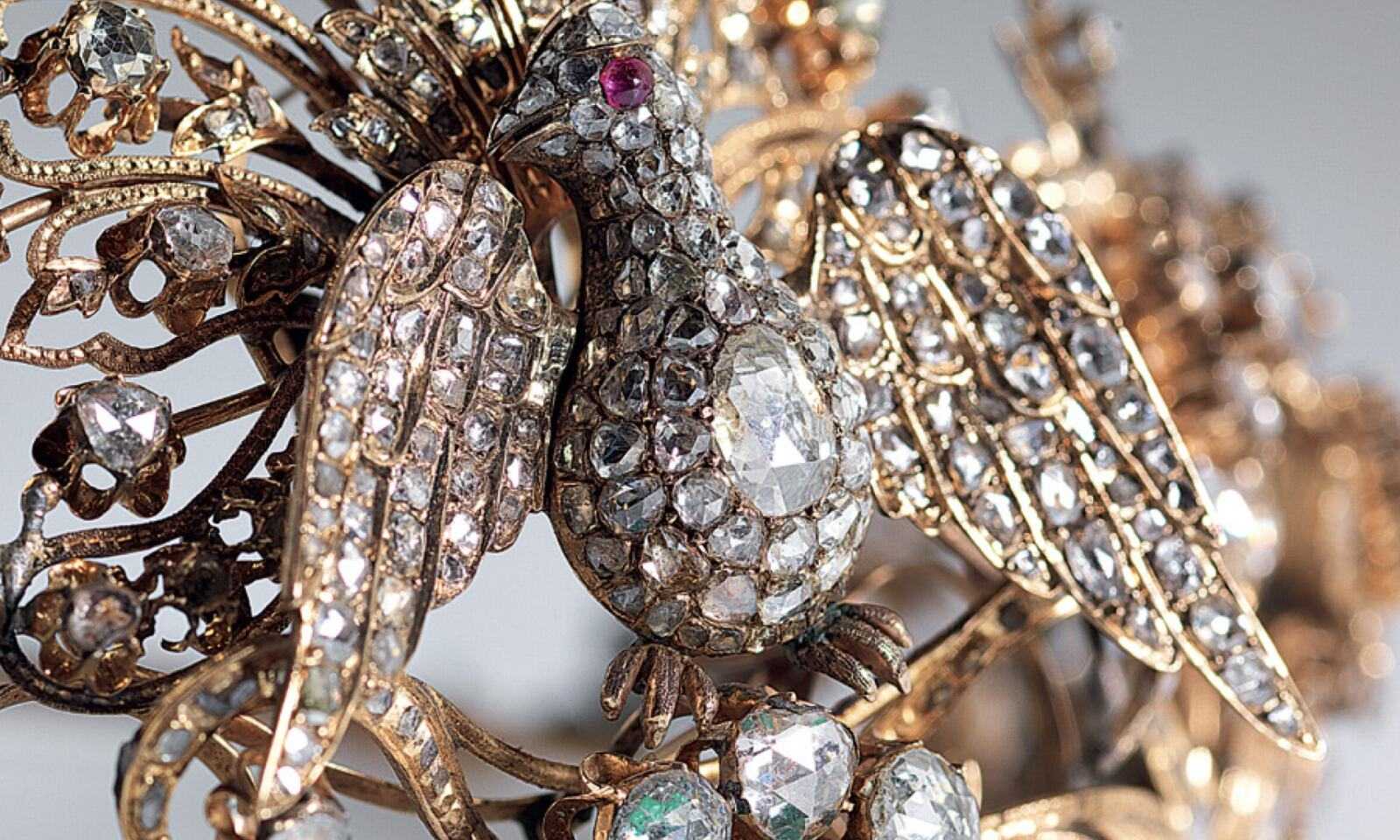
Visual emphasized: Detail Ottoman-style half-crown. 19th century
Sadberk Hanım Museum, 14076-Z. © JEWELLERY AND ARMENIAN GOLDSMITHS