





In 1976, Jean Dinh Van Transforms a simple mechanism into a jeweled signature. Fifty years later, Menottes dinh van remains one of the most recognizable designs in contemporary jewelry.
There are jewels that can be recognized even before knowing their name. Two metallic forms that face each other, fit together, and then separate. An almost mechanical movement that has become a graphic sign over the decades. In 1976, Jean Dinh Van He does not seek to create an icon, however. He observes an ordinary object and distorts its function to invent a new language of jewelry.
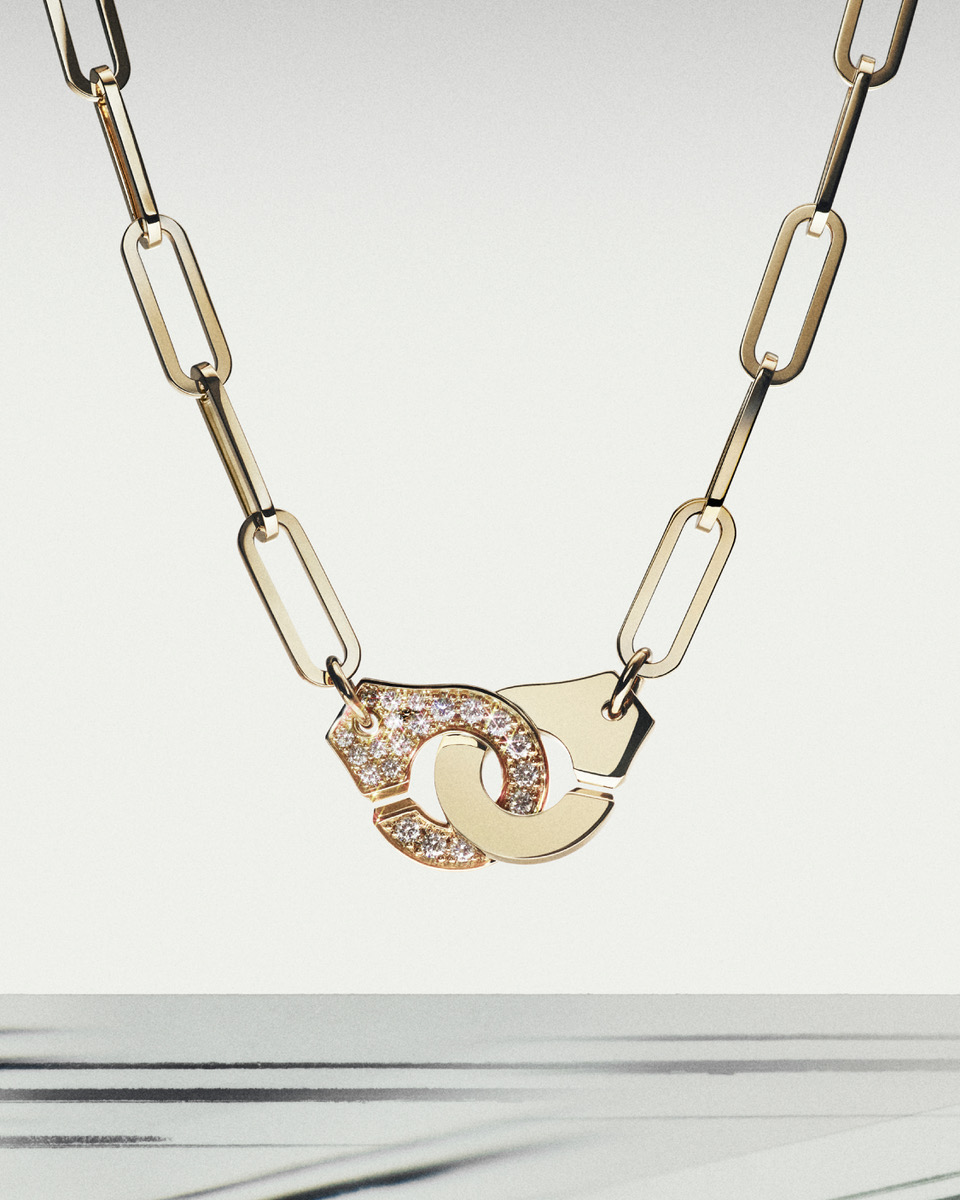
Thus is born Handcuffs Dinh Van.
The word evokes attachment, constraint, and closure. The drawing, on the other hand, tells a different story. Nothing truly locks in place.
The two elements unite without ever losing their ability to separate. The jewel then becomes a representation of a chosen connection: a presence without possession, a bond that leaves room for movement.
From a key to a jewel
The origin of the handcuffs Dinh Van It involves a simple gesture. Jean Dinh Van is interested in the hinged head of a key, that small metal element that allows several keys to be assembled onto a single key ring and easily detached.
A utilitarian object, designed to be manipulated.
The jeweler retains the principle of assembly and translates it to a different scale. The mechanism becomes a design, then the design becomes a jewel. The closure is no longer an invisible part of the piece: it becomes its identity. The system relies on a 90-degree rotation, which allows the clasp to open and close. A functional solution whose simplicity precisely contributes to its visual strength.
«The story of the padlock is because I had a key to the lock. And that's how the padlock was born, a piece of metal that I had in my hand to open and close. It's a story of a key; it became the padlock,» explained Jean Dinh Van. This phrase sums up a conception of jewelry that is deeply linked to its use. In the jeweler’s workshop, the object is never separated from the gesture that animates it.
1976: WHEN THE JEWEL CHANGES STATUS
To understand the scope of Menottes Dinh Van, We have to go back to its time.
The 1970s saw the clothing and social conventions evolve rapidly. Silhouettes became more fluid, jewelry was worn in different ways, and the distinction between precious items and everyday objects began to fade away.
Jean Dinh Van accompanies this transformation with a singular vision of jewelry. He favors straightforward shapes, objects that can be easily worn, touched, and manipulated. The jewel no longer serves only for special occasions: it enters everyday life.
Cuffs Dinh Van belongs fully to this movement. Where traditional jewelry often seeks to conceal the machinery, Dinh Van He chooses to show it. The clasp becomes a motif. The function becomes aesthetic. The gesture becomes an integral part of the design. This approach contributes to the emergence of contemporary jewelry.e More free, where the value of a creation no longer rests solely on ornamentation but also on the intelligence of its design.


A SIGN THAT CROSSES GENERATIONS
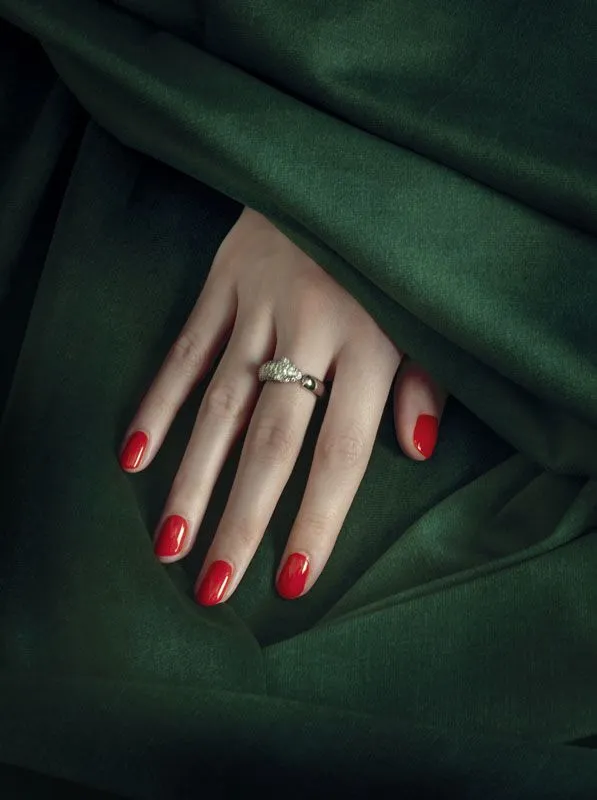
Bracelet with cord, ring, necklace, earrings or pavé stones: over the years, Menottes Dinh Van has taken on many interpretations.
Gold, platinum, diamonds or even hard stones can change its character without altering its essence. The motif can become discreet, almost intimate, or take on a more sculptural presence. But its vocabulary remains instantly identifiable: two elements, one movement, one space that remains open.
This permanence also explains its particular status in the history of the house. Menottes Dinh Van It is not just a collection that is regularly enriched. It has become a sign of recognition, passed from one generation to the next and associated with a certain idea of jewelry: personal, functional and free from conventions.
SCULPTED MESH DINING TABLES: THE MECHANISM BECOMES A FORM
To celebrate the fiftieth anniversary of the motif, the Maison continues this research with Cuffs Dinh Van carved.
The clasp, based on this 90-degree rotation, is no longer just a technical element. It becomes a subject for exploration in space. Clean edges, polished surfaces, and precise geometry give the design a more architectural dimension. The ring, in particular, plays on the square section of the wire and on the principle of the rounded square, a graphic signature of Dinh Van. The line maintains its tension while maintaining curves that soften the construction.
On the bracelet and the torque, the Flex technology extends the jeweler’s research into the flexibility of metal. Opening and closing become a natural movement, achieved without a hinge thanks to the material’s elasticity. The jewel thus returns to what was already one of the intuitions of 1976: designing a piece around its intended use rather than adding it afterwards.


ICÔNE CHANGES MATERIALS
This anniversary also opens the way for new expressions.
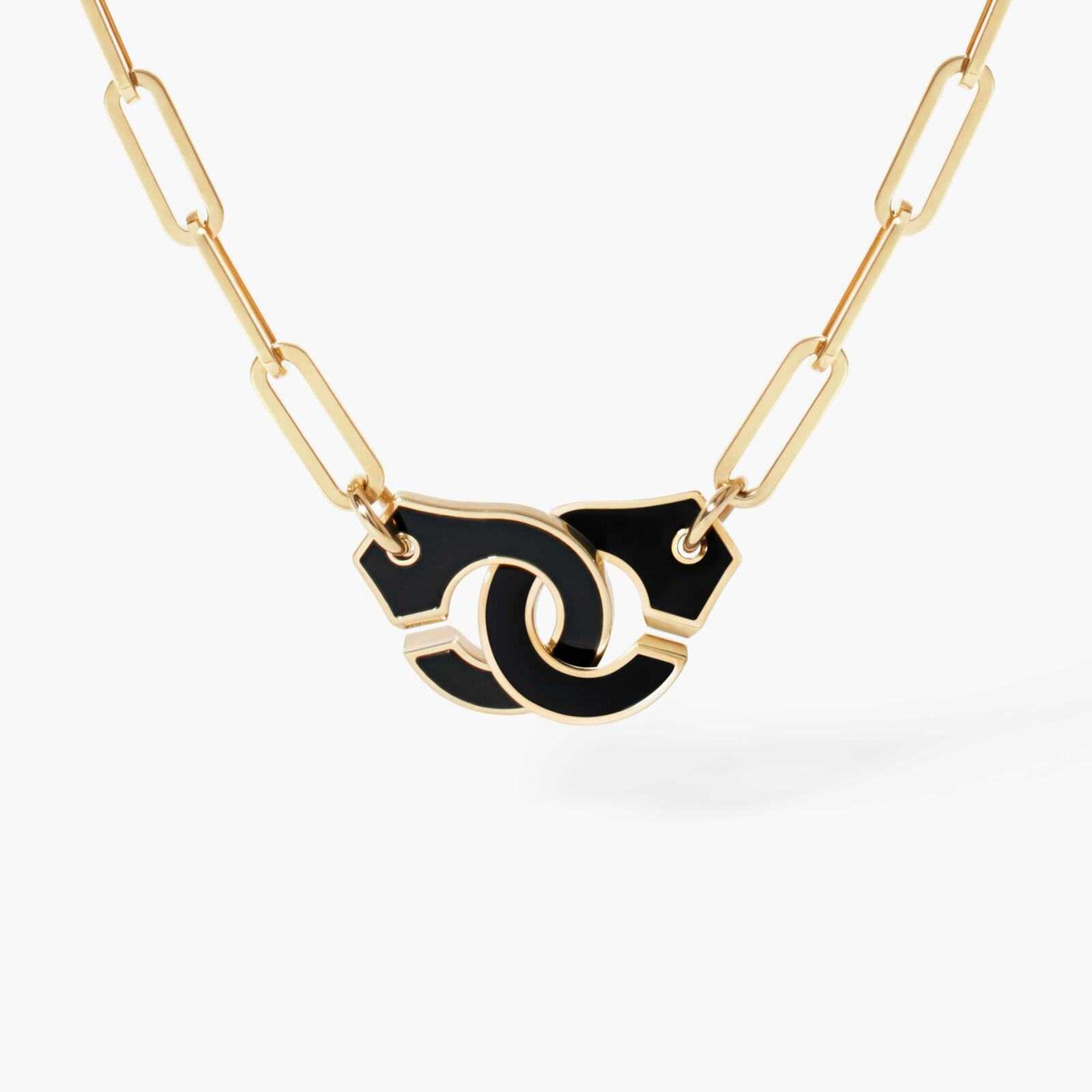
Nacre and onyx introduce another reading of Menottes Dinh Van. The necklaces, available in small and large sizes, as well as the chain-linked earrings, play on the presence of the hard stone and the purity of the metal. Reversible, the necklaces offer two different looks: one entirely in gold or one that reveals the mineral material. A way to evolve the jewel according to the moment, the outfit, or simply the desire of the person wearing it.
The Maison also continues its work on the woven bracelet. A new attachment system allows the bracelets and the Menottes motifs to be interchanged. Handcrafted in Japan using traditional craftsmanship, these bracelets introduce a modular dimension to the collection’s universe.
Personalization then becomes another way of telling the story of the connection.
FIFTY YEARS, AND STILL OPEN
It is rare for a piece of jewelry to retain its readability for so long without becoming a prisoner of its era. Menottes dinh van y succeeds precisely because its design is not based on a trend.
His idea is more basic: two elements that meet without possessing each other. In fifty years, the motif has changed in scale, material, and status. It has been enriched with diamonds, hard stones, new constructions, and technical solutions. Yet, its principle remains intact.
Perhaps this is what makes this creation so contemporary today. Menottes dinh van ne does not celebrate attachment as a constraint, but as a choice. It does not seek to imprison the bond; it leaves it an option. A half-century after its inception, Menottes Dinh Van He continues to pose, with astonishing simplicity, a very current question: how can one be connected without giving up one's freedom?
Jean Dinh Van He had found the answer in a key. He turned it into a jewel.