




Esprit Joaillerie and the Miller House The 1940s were a time of great change. Strongly marked by the Second World War, artists and creators tried to continue creating, despite everything, on both sides of the Atlantic.
It is this creative, resilient spirit that we will highlight in this article, about the music «Nuage» by Django Reinhardt and the Hot Club de France.
Art Deco saw the style of the 1940s succeed, feeding off the Surrealist spirit. In Europe overrun by terror, destruction multiplied; artistic, commercial, and industrial activities were dormant. The evolution of objects was guided by social evolution.
The 1937 exhibition in Munich denounces «degenerate art» (entartete Kunst): Cubism, Dadaism, and Impressionism are worthless; there must be only official art, «heroic art,» as decided by the Nazi regime.
Thousands of works of art will be seized and destroyed.
Facing the growing threat of war, evacuation operations begin for the public collections; the Louvre Museum chooses to protect its treasures in isolated locations, in the countryside.
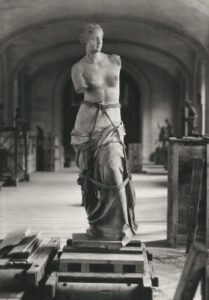
© Louvre Museum, Aulanier fonds
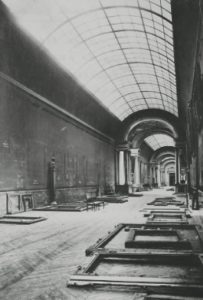
© Louvre Museum, Aulanier fonds
The famous Joconde left the Louvre on August 28, 1939. On September 3, the day after the declaration of war, the decision was made: the most valuable works must be taken away during the day.
In his painting «Geopolitical Child Observing the New Man», Salvador Dali shows that humanity must leave its old world to be reborn in difficulty.
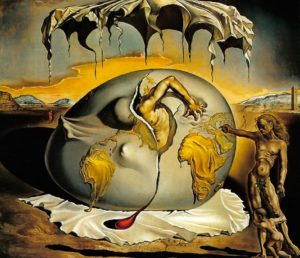
«Child watching the birth of the new man»
For Picasso, painting is a form of resistance (we remember his famous painting Guernica); creation is life. Threatened with death, locked in his studio, he paints this still life at the end of the war.
«Head of a dead person, a jug and leeks».

Still life with a head of a dead person, a jug and onions, 1945
© Collection Particulière — Picasso Succession 2011

At the window of his studio, rue des Grands-Augustins, Paris 8th. 1944.
© Pierre Jahan / Roger-Viollet / Paris en Images
Some accessories can also contribute to the expression of resistance.
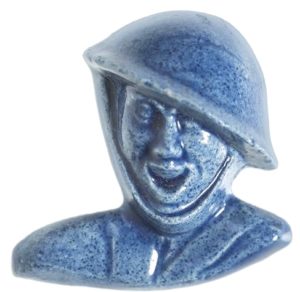
Painted ceramics, metal. France 1940-1949
©Photo Les Arts Décoratifs, Paris / Jean Tholance
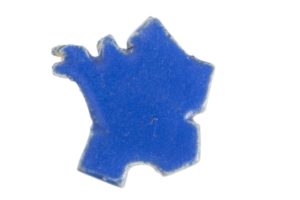
Enamel ceramics, metal. France 1940-1949
©Photo Les Arts Décoratifs, Paris / Jean Tholance
The problem of raw materials arises, and the shortage leads to imagination. Alternative materials then find their place. Fashion also becomes a way to resist, to remain dignified in the face of the occupier. Elegant despite the war, women then become more inventive and ingenious.,
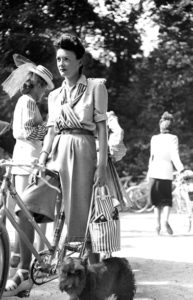
© LAPI / Roger-Viollet / Paris en Images
The Grès house ignores the strict rules of fabric draping.
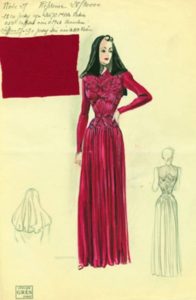
Evening Dress
Winter 1942
© Collection Galliera/ Photo DR

1943
© Eugène Rubin/FNAC/Centre National des Arts Plastiques Ministry of Culture and Communication, Paris.
The hat replaces the hairdresser and has become a favorite subject for creativity. Headbands are experiencing a surge in popularity.
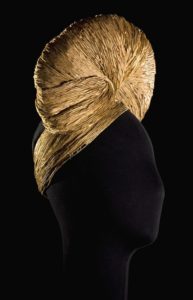
Straw hat made of lace sewn on organza and black fabric. 1942-1943. © Galliera Musée de la Mode de la Ville de Paris.
Despite material difficulties, restrictions, and limited resources, the world of entertainment and the arts also holds out. Cinema, cabarets, and theaters experience high attendance.

© Roger Berson / Roger-Viollet / Paris en Images
Although it is difficult to move around because the arrests, constant checks, and curfews remind us that war is still very much present, the public still wants to live, to have some fun.
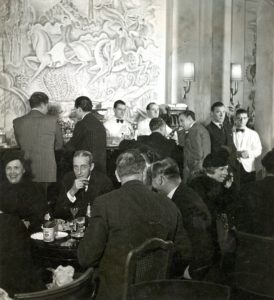
© Ritz
While some representations may be interrupted by power outages or bomb alerts in large cities, resistance is also found in escaping through culture. Literature is also swept up in an economy of restriction; paper and ink are rationed, but still active and remain a favorite refuge of the French. Another medium that followed the French during the 1940s was radio. Very effective, this new means of communication and information reached a large number of people at the same time.
The jewel must have also had to adapt to the circumstances.

Clip Or, Sapphire
Around 1940
© Doyle
During the war, the wholesale trade in gold was prohibited by the Banque de France. The activity of jewelry workshops was therefore slowed down. When a customer wanted to create an object in gold, they had to provide the metal needed for its creation, and often old jewelry was transformed.

Earrings
Sapphires, Diamonds, Gold
1940
Precious stones no longer arrived in Europe in large numbers. These difficulties were overcome, and French jewelry designers managed to change the appearance and purpose of their work. Gold jewelry, a symbol of wealth, dominates the creations.

Earrings
Around 1945
© FD Gallery
Jewels from « resistance »They appear, like the caged bird clips. Under occupation, the Maison Cartier with Jeanne Toussaint and the cartoonist Peter Lemarchand created several pieces depicting a little sparrow, imprisoned in a cage, a symbol of this occupied France.


Bird in Cage
1942/43
At the end of the war, Cartier opened this symbolic cage.
France is liberated!

Broche L’oiseau libéré 1944

Clip «Moineau de Paris»
Around 1945
Gold is worked in such a way as to reproduce the texture of certain fabrics or even the ornamentation of lace, such as chevrons or mesh patterns. The lace knots (polished and perled gold is enhanced with diamonds to imitate the effects of lace) featured in the collections
Van Cleef & Arpels is experiencing some success.
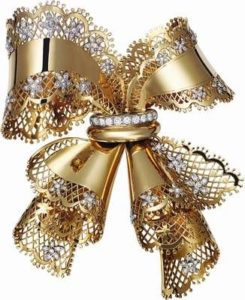
Brooch with a Bow Knot Around 1945
Figurative motifs such as the graceful ballerina are sought after.
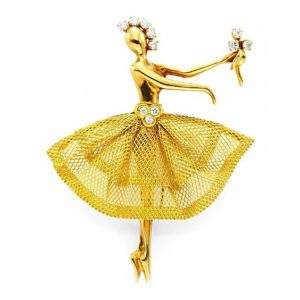
Clip «Ballerine» Diamonds, Gold.
Around 1940
© Fd Gallery
The 40s style is massive and voluminous; aesthetically, it is three-dimensional. Precious stones are less present, and the use of fine stones such as topaz, citrine, or amethyst is chosen.

Citrine ring, Sapphires, Gold
Around 1940
© Boucheron

Citrine ring, Emeralds, Gold.
Around 1940

Citrine ring, gold
1940
Many synthetic sapphires and rubies are also found. The jewelry is often hollow, and if gold replaces platinum, it retains its precious appearance by offering several colors such as pink, green, yellow or white.

Bracelet/Yellow Gold, Rose Gold, Platinum, Diamonds
Around 1940
© Van Cleef & Arpels
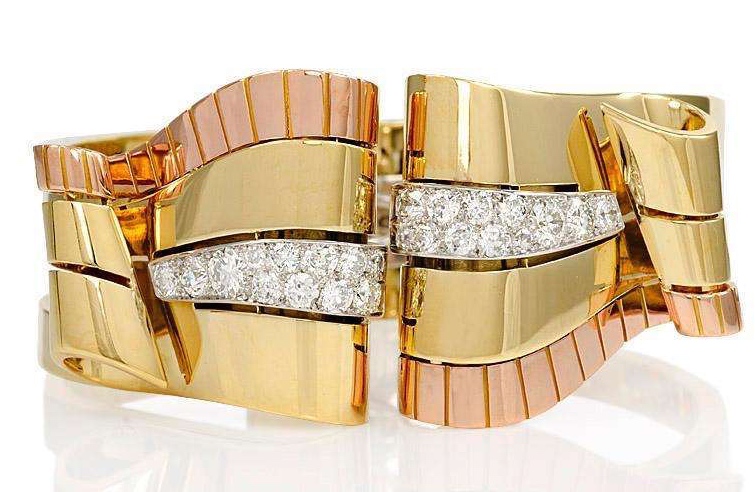
If we had to choose a characteristic jewel of that era, it would be the bracelet. Designed in gold, articulated, the bracelets are made up of large, square, hexagonal patterns …
The most characteristic models are inspired by the caterpillars of tanks, thus giving them their names.
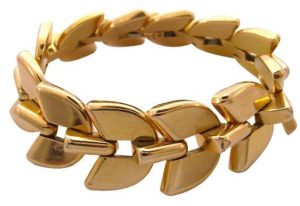
1940
Miller House
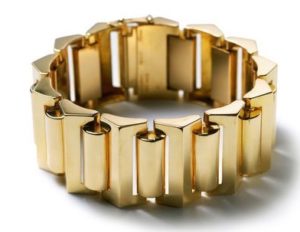
«Tank» gold bracelet
Around 1940
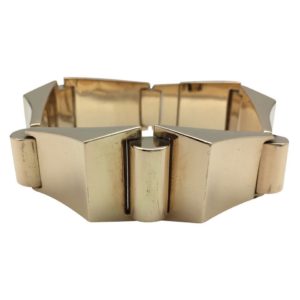
Around 1940
Miller House
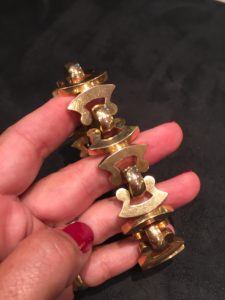
Miller House
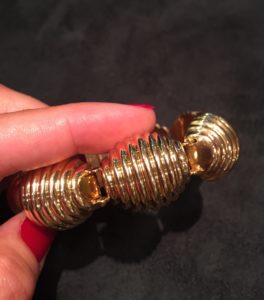
Miller House
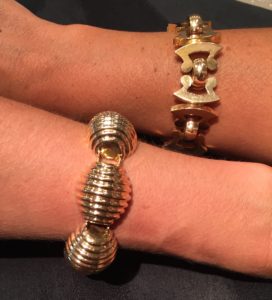
Miller House
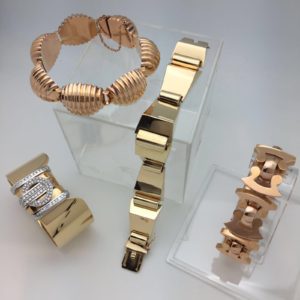
Miller House
The Official of Couture of May 1940 described French jewelry: «An eminently luxury trade, French jewelry could not, in these difficult times, claim to survive without changing the appearance and purpose of its production. Certainly, the pieces of great value still exist in these precious showcases. But the French, the French woman who now has the desire to walk through the doors of these great houses, the pride of our national trade, are rather looking for fancy jewelry of a price that is more easily accessible. That is why the Parisian jewelers have mainly focused on a practical and decorative design for their creations.»

Brooch » Escargot Liberation » Gold, enamel.
1945
© Lucas Rarities
It is not easy to find an emblematic place from the 1940s; we chose the famous bar of the Ritz, the one frequented by Ernst Hemingway and his famous legend that the future Nobel Prize winner arrived in a jeep on Place Vendôme, declaring: «I am coming to liberate the Ritz.».
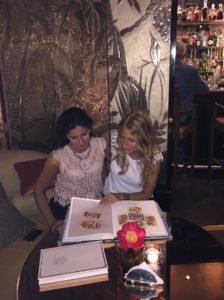
Ritz Bar Hemingway